Rock Dove
Columba livia
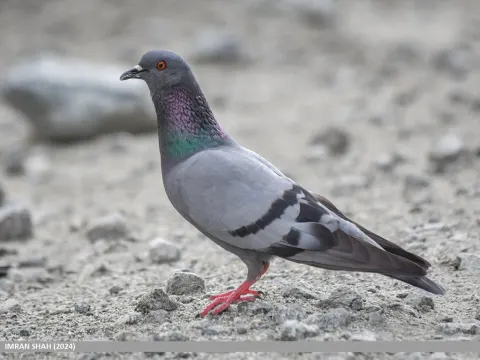
Look for a pale grey pigeon with two black bars across each wing: this is the wild Rock Dove, Columba livia. Its white lower back is a useful identifying feature, while the dark neck can shine greenish to reddish purple. In flight, the white underwings become conspicuous, and the bird often glides with its wings held in a pronounced V. Its familiar call is a soft, slightly wavering coo.
The Rock Dove's natural range extends across western and southern Europe, North Africa and into South Asia; feral descendants now live much more widely. Wild birds favour open or semi-open places, avoiding dense vegetation and feeding on the ground. They roost and breed on cliffs and rock ledges, with nesting sites including caves, canyons and sea cliffs. Even in the Sahara they can live where rocks, water and some plant matter are available. Outside the breeding season, pigeons often gather in flocks, and a disturbed bird's noisy take-off can prompt others to fly. They eat mainly plant food, especially fruit and grains, but may also take worms or insect larvae.
Breeding can occur at any time of year, though it peaks in spring and summer when food is plentiful. A pair builds a flimsy platform of straw and sticks on a sheltered ledge, where both parents incubate two white eggs for 17 to 19 days. Both also feed the chicks, which receive pigeon milk alone for their first few days. Predators and human persecution are the main causes of death in the wild, and peregrine falcons are among the birds that hunt them. Wild Rock Doves also face a threat from interbreeding with domestic and feral pigeons.
Written from the English Wikipedia article Rock dove (CC BY-SA 4.0).
- Records
- 5,176,110
- Countries
- 226
- Atlas places
- 22
- Namib-Naukluft· Namibia
- Zambezi National Park· Zimbabwe
- Dorob National Park· Namibia
- uKhahlamba-Drakensberg Park· South Africa
- Volcanoes National Park· Rwanda
- Walvis Bay· Namibia
- Aberdare National Park· Kenya
- Annapurna Conservation Area· Nepal
- Arusha National Park· Tanzania
- Chobe National Park· Botswana
- Hell's Gate National Park· Kenya
- Iguaçu National Park· Brazil
- Iguazú National Park· Argentina
- Jozani Chwaka Bay National Park· Tanzania
- Langtang National Park· Nepal
- Madikwe Game Reserve· South Africa
- Nairobi National Park· Kenya
- Okavango Delta· Botswana
- Queen Elizabeth National Park· Uganda
- Table Mountain National Park· South Africa
- Tsau ǁKhaeb (Sperrgebiet) National Park· Namibia
- Yala National Park· Sri Lanka
These are open occurrence records, so they show where people looked for and recorded the Rock Dove as much as where it lives. Cells are up to 25 km across, and every location is generalised to its cell.
Generalised encounter areas, not exact locations. Each shape is a grid cell coloured by how likely the species is there.
- Very likelyUnited States25 km zone · high confidence · 2377068 records · updated 86 days ago
- Very likelyCanada25 km zone · high confidence · 655863 records · updated 86 days ago
- Very likelyIndia25 km zone · high confidence · 365978 records · updated 86 days ago
- Very likelyAustralia25 km zone · high confidence · 144810 records · updated 86 days ago
- Very likelyUnited Kingdom25 km zone · high confidence · 132991 records · updated 86 days ago
- Very likelyPortugal25 km zone · high confidence · 89041 records · updated 86 days ago
- Very likelySpain25 km zone · high confidence · 75340 records · updated 86 days ago
- Very likelySweden25 km zone · high confidence · 65965 records · updated 86 days ago
- Very likelyArgentina25 km zone · high confidence · 61494 records · updated 86 days ago
- Very likelyTaiwan25 km zone · high confidence · 58288 records · updated 86 days ago
Conservation status not assessed here yet, so every location is generalised to its grid cell.