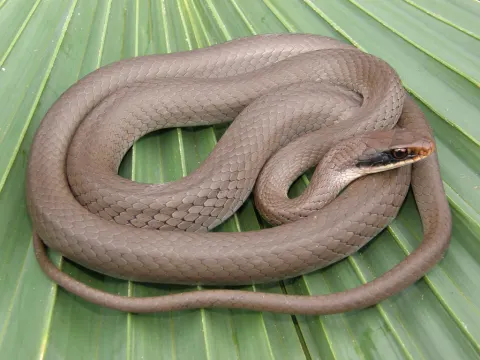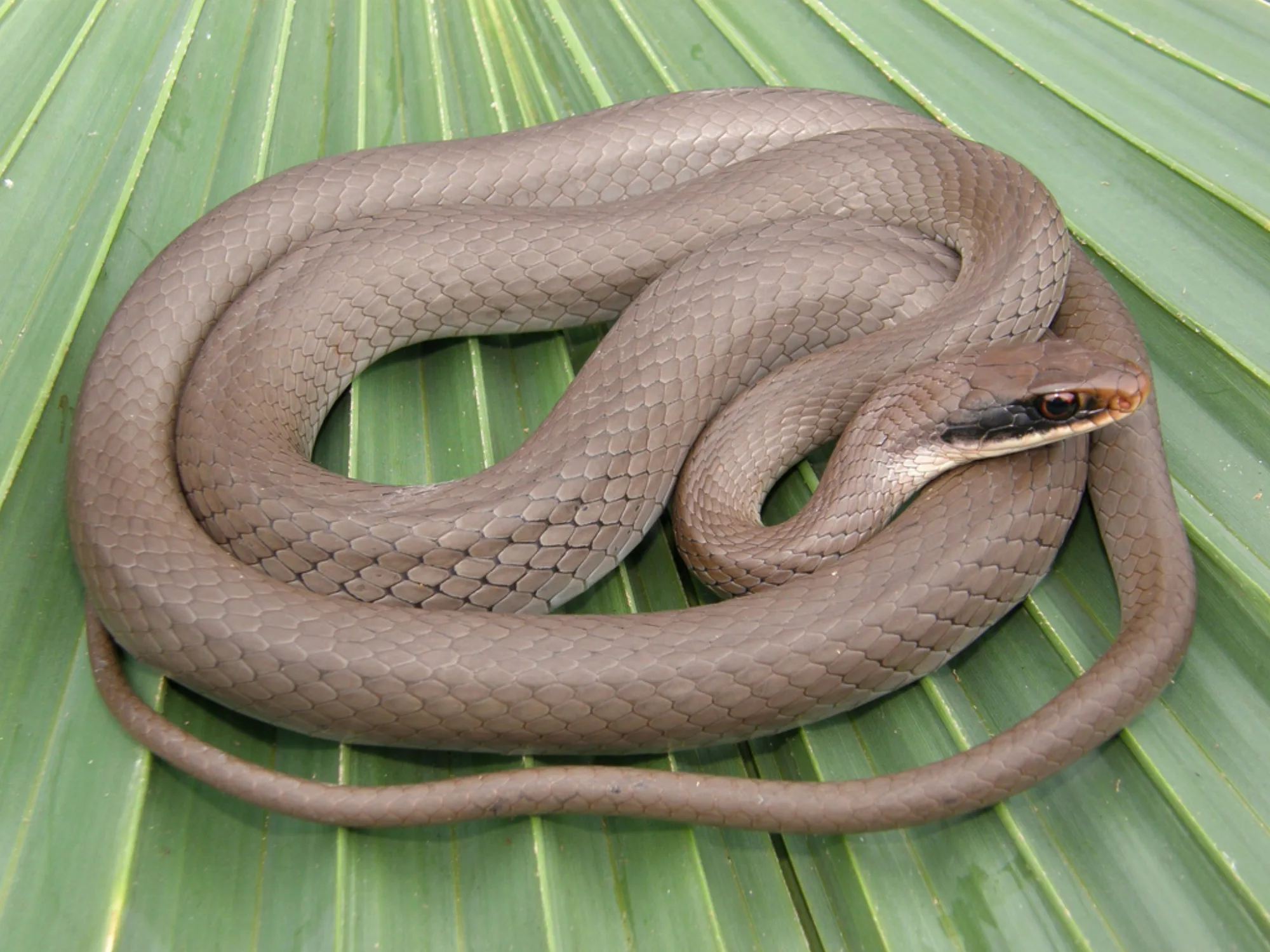
Eastern Racer
Coluber constrictor
Quick and alert, the Eastern Racer is a nonvenomous snake native to North and Central America. Adults typically measure 50 to 152 cm in total length, although their appearance varies among subspecies. Many are a single colour, ranging from black and brown to tan, blue or green, with a paler underside. Young racers look different: dark blotches mark a light background, and the pattern gradually fades as they grow.
The species ranges across much of the United States, from either side of the Rocky Mountains, and reaches Canada, Mexico, Guatemala and Belize. Look for it in open grassland, light forest or semiarid country, usually close to somewhere it can hide. Racers also turn up near water, in brush and swamps, along roadsides and in suburban areas. They spend much of their time on the ground but can climb into shrubs and trees.
Active by day, racers hunt by sight and sometimes lift their heads above the ground to survey their surroundings. Their diet includes small rodents and other mammals, frogs, toads, small turtles, lizards and snakes. Some climb trees to take eggs and young birds, while juveniles also eat insects and other small invertebrates. When faced with a potential predator, a racer usually flees, but it can bite repeatedly if cornered. In spring, females mate and, around a month later, lay three to 30 eggs in a sheltered place, perhaps beneath a rock or inside a hollow log or disused rodent burrow. The young hatch in early autumn, and some racers share egg-laying sites with other snakes, including members of other species.
Written from the English Wikipedia article Eastern racer (CC BY-SA 4.0).
- Records
- 1,577
- Countries
- 2
- Atlas places
- 3
These are open occurrence records, so they show where people looked for and recorded the Eastern Racer as much as where it lives. Cells are up to 25 km across, and every location is generalised to its cell.
Generalised encounter areas, not exact locations. Each shape is a grid cell coloured by how likely the species is there.
- Very likelyUnited States25 km zone · medium confidence · 1538 records · updated 80 days ago
- Very likelyCanada25 km zone · medium confidence · 39 records · updated 80 days ago
Conservation status not assessed here yet, so every location is generalised to its grid cell.