Pacific Saury
Cololabis saira
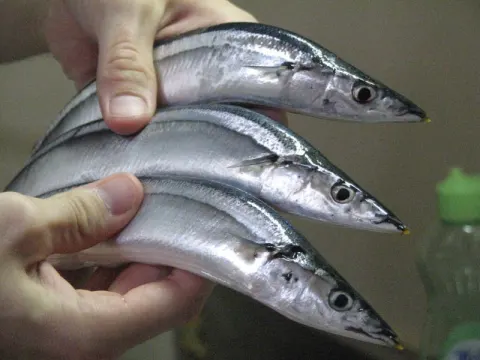
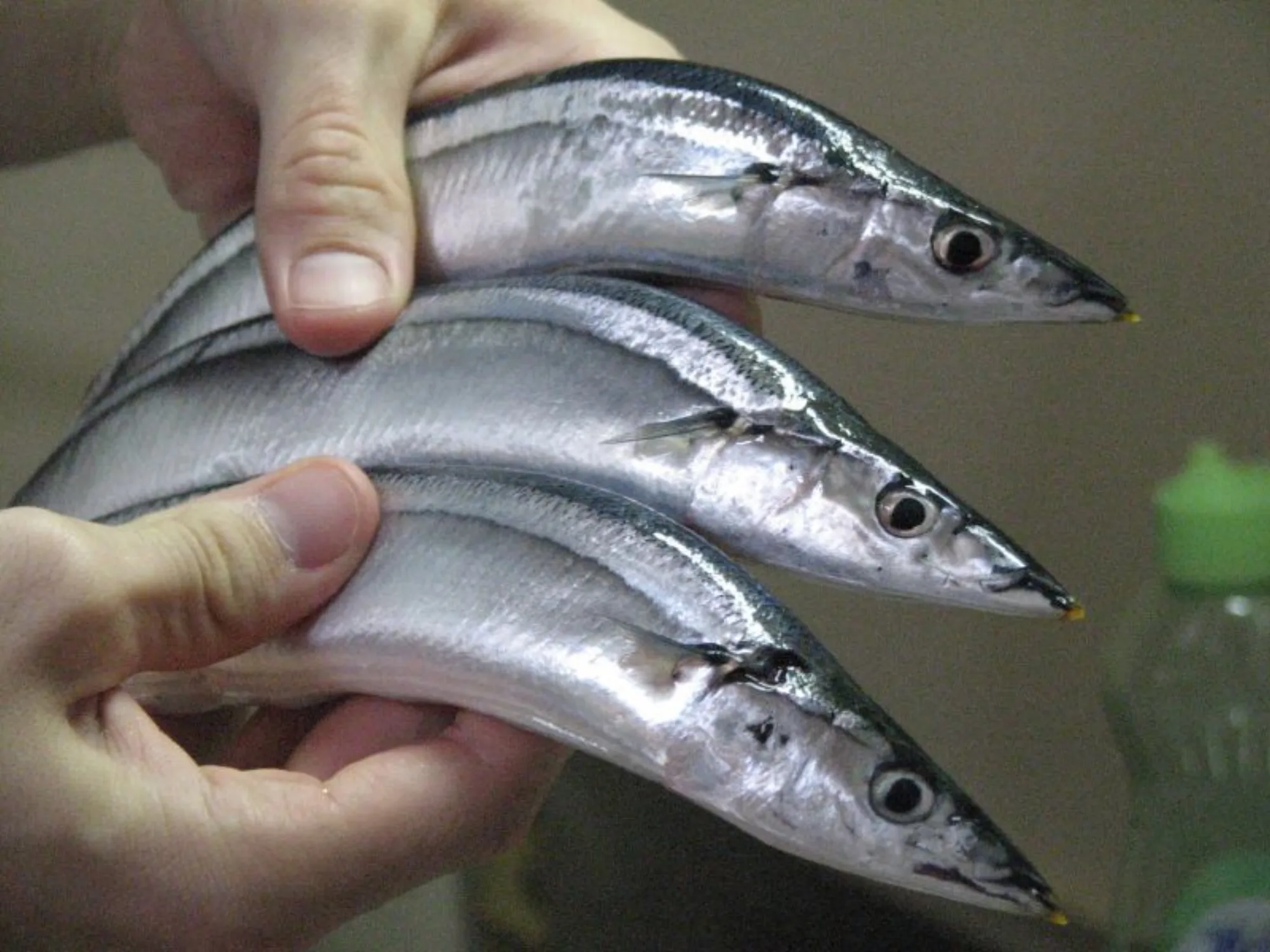
Slim and silvery, the Pacific Saury has an elongated body, a small mouth and a forked tail. Its back ranges from dark green to blue, while small, bright blue blotches are scattered along its sides. A row of small finlets adds to its distinctive outline. When caught, it is typically 25 to 30 centimetres long, though it can reach 40 centimetres and weigh about 180 grams in autumn. Its life expectancy is approximately four years.
This schooling fish migrates widely, ranging from waters off China, Korea and Japan across the North Pacific to the Gulf of Alaska and south to sub-tropical Mexico. It favours water around 15 to 18 degrees Celsius. Adults generally gather offshore near the ocean surface, while juveniles associate with drifting seaweed. Although usually found close to the surface, saury can occur as deep as 230 metres. When escaping predators, it floats on the surface. Its food includes zooplankton such as copepods, krill and amphipods, as well as the eggs and larvae of fish such as anchovies. The fish lays eggs that attach to floating objects, including seaweed.
Marine mammals, squid and tuna are among its natural predators. People also catch Pacific Saury for food and use it as bait for pike and sea fishing. It is a seasonal autumn food in Japan, where it is often served salted and grilled whole. China, Japan, South Korea and Taiwan are among the places that fish for saury, and Taiwan has expanded its catch. In 2002, China also began fishing for it, with catches of over 100,000 tons a year.
Written from the English Wikipedia article Pacific saury (CC BY-SA 4.0).
- Records
- 6,758
- Countries
- 4
- Atlas places
- 2
These are open occurrence records, so they show where people looked for and recorded the Pacific Saury as much as where it lives. Cells are up to 25 km across, and every location is generalised to its cell.
Generalised encounter areas, not exact locations. Each shape is a grid cell coloured by how likely the species is there.
- Very likelyCanada25 km zone · high confidence · 3705 records · updated 80 days ago
- Very likelyUnited States25 km zone · high confidence · 2868 records · updated 80 days ago
- PossibleMexico25 km zone · medium confidence · 177 records · updated 80 days ago
- PossibleChina25 km zone · medium confidence · 8 records · updated 80 days ago
Conservation status not assessed here yet, so every location is generalised to its grid cell.