Western Jackdaw
Coloeus monedula
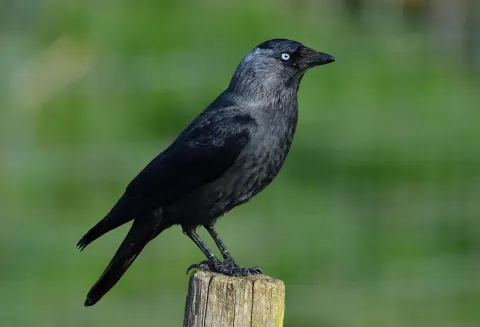
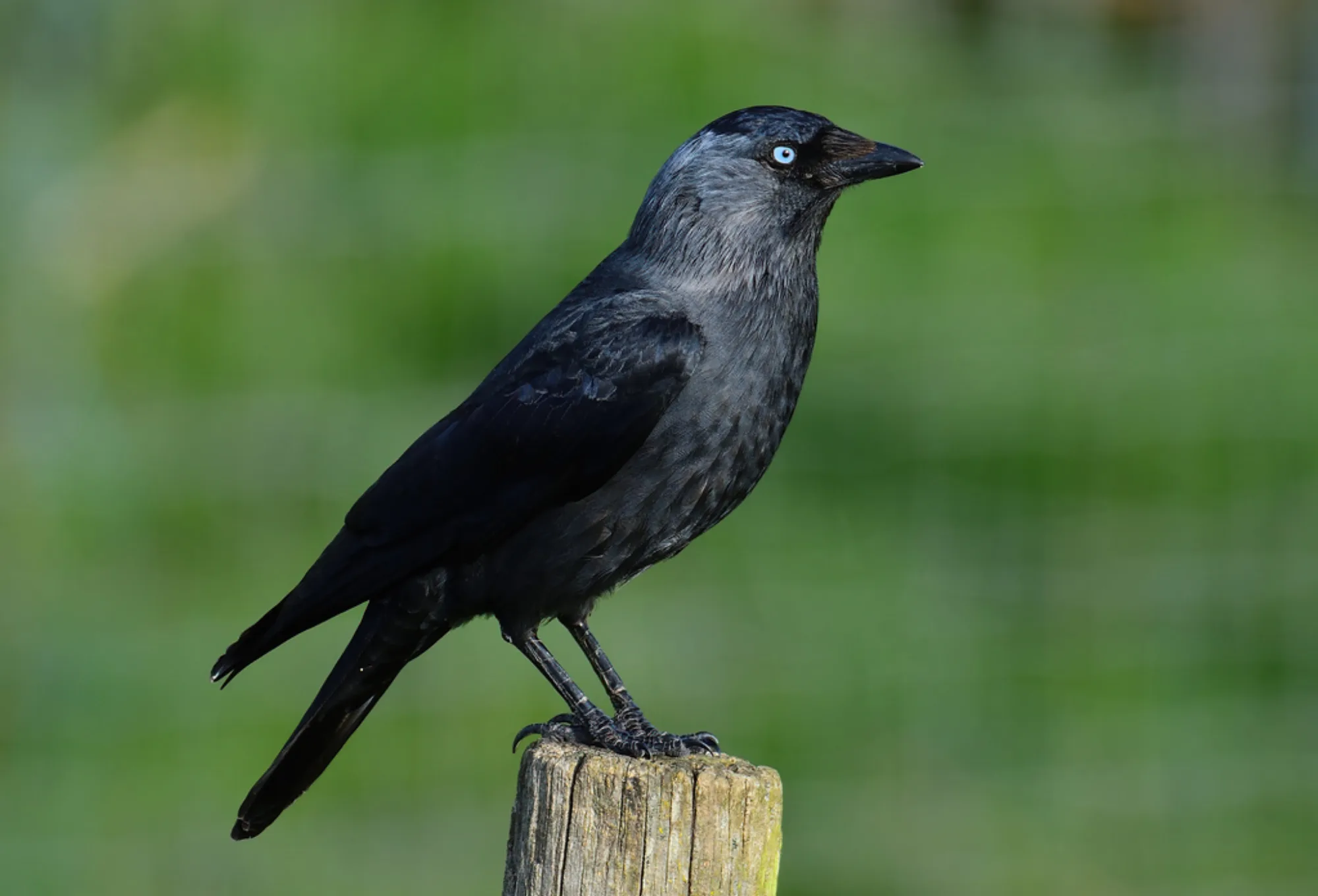
A grey nape and pale eyes help distinguish the Western Jackdaw, a small member of the crow family with mostly glossy black plumage and a short, stout bill. It measures 34 to 39 centimetres long, and adults have greyish or silvery white eyes. Listen for its metallic, squeaky calls in flight, or the chatter of birds gathered on a perch.
Western Jackdaws live across much of Europe, Northwest Africa and parts of Asia, reaching east to Lake Baikal and the eastern Himalayas. Most stay in their range year-round, while northern and eastern populations move to wintering areas. Look for them in farmland, pastures, coastal cliffs and towns, especially where trees and buildings meet open ground. They are generally wary in the countryside but much tamer in urban areas. Sociable birds, they gather in flocks and assemble at dusk to roost together, sometimes alongside rooks or hooded crows. They forage mainly on the ground, taking insects, snails, seeds, grain and fruit, as well as food waste. Their diet changes with what is available, and insects become the main food during breeding.
Pairs usually breed in colonies, making stick nests in sheltered cavities in trees, cliffs, buildings or chimneys. A clutch usually contains four or five eggs, and the young leave the nest after 28 to 35 days. Falcons hunt jackdaws, while ravens, owls, weasels and rats are among the animals that rob their nests. People have also hunted the birds as pests, including for their use of belfries and their feeding on grain crops.
Written from the English Wikipedia article Western jackdaw (CC BY-SA 4.0).
- Records
- 1,315,535
- Countries
- 69
No atlas park has a record of the Western Jackdaw in or around it yet.
These are open occurrence records, so they show where people looked for and recorded the Western Jackdaw as much as where it lives. Cells are up to 25 km across, and every location is generalised to its cell.
Generalised encounter areas, not exact locations. Each shape is a grid cell coloured by how likely the species is there.
- Very likelyUnited Kingdom25 km zone · high confidence · 645909 records · updated 86 days ago
- Very likelyBelgium25 km zone · high confidence · 147693 records · updated 86 days ago
- Very likelyNorway25 km zone · high confidence · 103846 records · updated 86 days ago
- Very likelyFinland25 km zone · high confidence · 57810 records · updated 86 days ago
- Very likelySpain25 km zone · high confidence · 46806 records · updated 86 days ago
- Very likelyNetherlands25 km zone · high confidence · 43133 records · updated 86 days ago
- Very likelyFrance25 km zone · high confidence · 35680 records · updated 86 days ago
- Very likelyIsrael25 km zone · high confidence · 22061 records · updated 86 days ago
- Very likelySweden25 km zone · high confidence · 21108 records · updated 86 days ago
- Very likelyDenmark25 km zone · high confidence · 20781 records · updated 86 days ago
Conservation status not assessed here yet, so every location is generalised to its grid cell.