Northern Bobwhite
Colinus virginianus
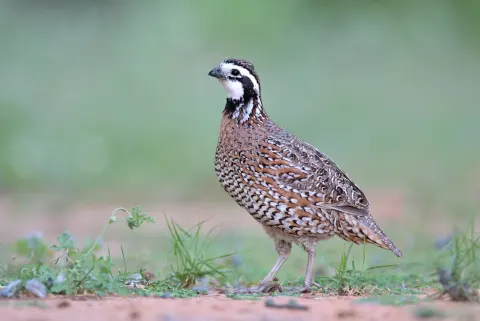
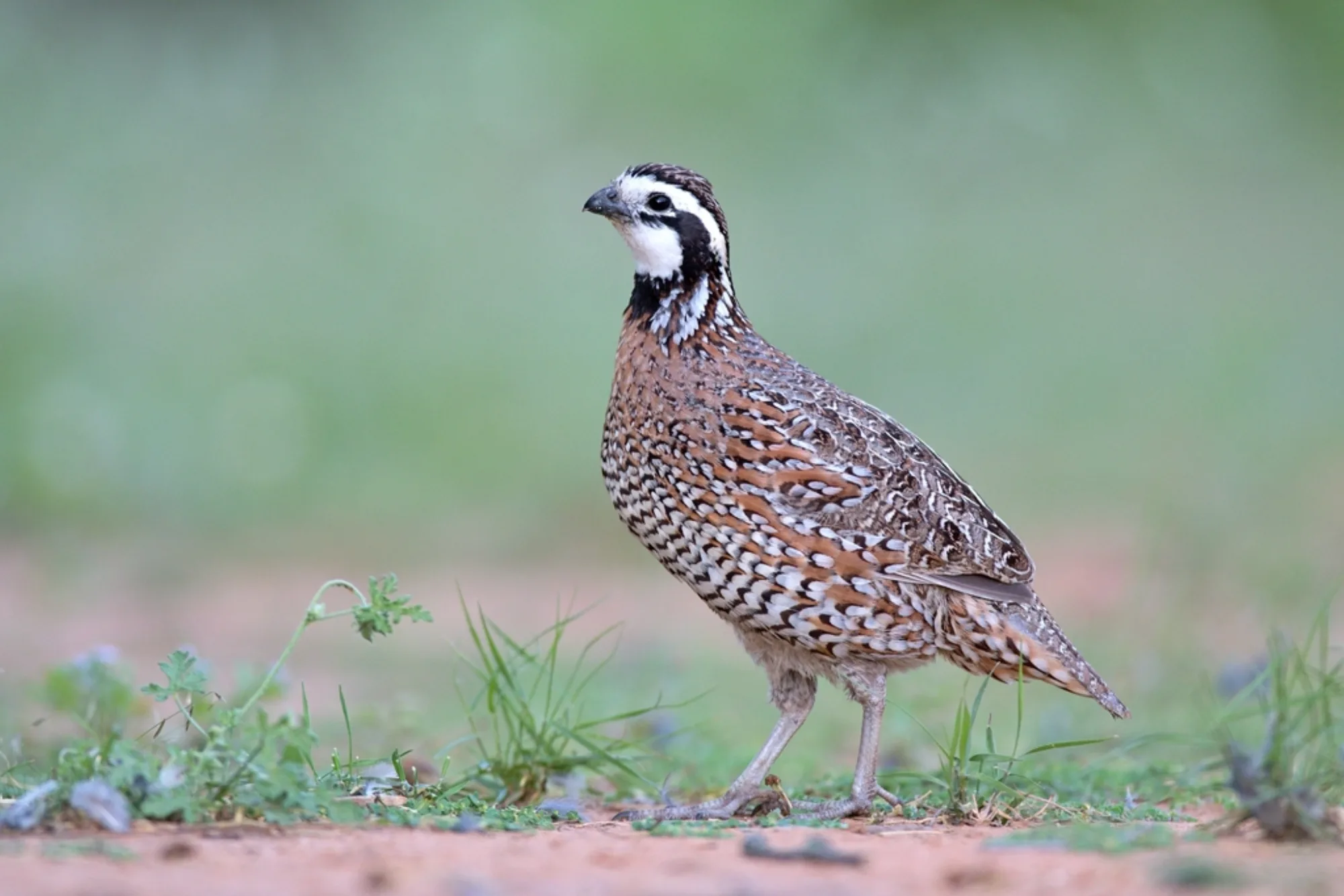
A clear, rising whistle of “bob-WHITE” or “bob-bob-WHITE” can give away the Northern Bobwhite, a shy, ground-dwelling quail. It has a chunky, rounded shape and measures 24 to 28 cm long. Males have a white throat and a white brow stripe edged in black. Their reddish-brown plumage is mottled grey on the wings, with white scalloped stripes along the flanks and black scallops on the pale underparts.
The bird occurs naturally in Cuba and across parts of Mexico, the United States and Canada, and has been introduced to parts of Asia, Europe and the Caribbean. It can be found year-round in grassland, agricultural fields, open woodland, roadsides and woodland edges. When threatened, it may crouch motionless, relying on camouflage, before flying low if disturbed at close quarters. Birds are generally alone or in pairs early in the year, while family groups are common in late summer. In winter, a roosting covey may contain two dozen or more birds. On the ground in open areas with patches of taller vegetation, bobwhites forage for seeds, wild berries and cultivated grains, as well as small creatures including snails, grasshoppers and beetles.
Either parent can incubate the eggs for 23 days, and the young leave the nest soon after hatching. Predators are the main cause of nest failure, although a hen may try nesting again up to four times until she succeeds. Across its range, the bird faces habitat loss and degradation as land use and fire patterns change. In eastern North America, habitat degradation has contributed to a population decline of roughly 85% from 1966 to 2014. Many of its subspecies are also hunted extensively as game birds.
Written from the English Wikipedia article Northern bobwhite (CC BY-SA 4.0).
- Records
- 192,260
- Countries
- 3
- Atlas places
- 2
These are open occurrence records, so they show where people looked for and recorded the Northern Bobwhite as much as where it lives. Cells are up to 25 km across, and every location is generalised to its cell.
Generalised encounter areas, not exact locations. Each shape is a grid cell coloured by how likely the species is there.
- Very likelyUnited States25 km zone · high confidence · 183472 records · updated 80 days ago
- Very likelyMexico25 km zone · high confidence · 8329 records · updated 80 days ago
- Very likelyCuba25 km zone · high confidence · 459 records · updated 80 days ago
Conservation status not assessed here yet, so every location is generalised to its grid cell.