Northern Flicker
Colaptes auratus
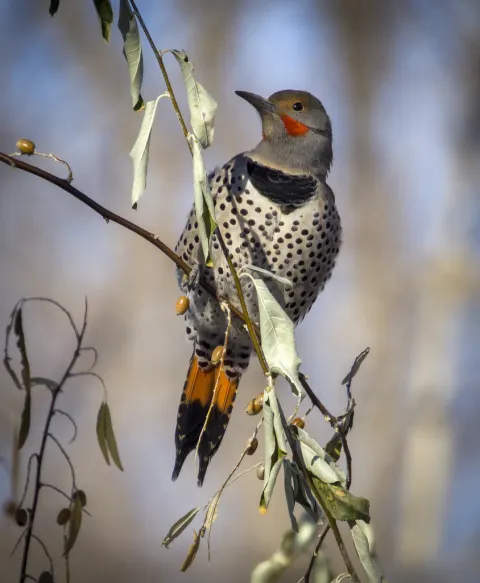
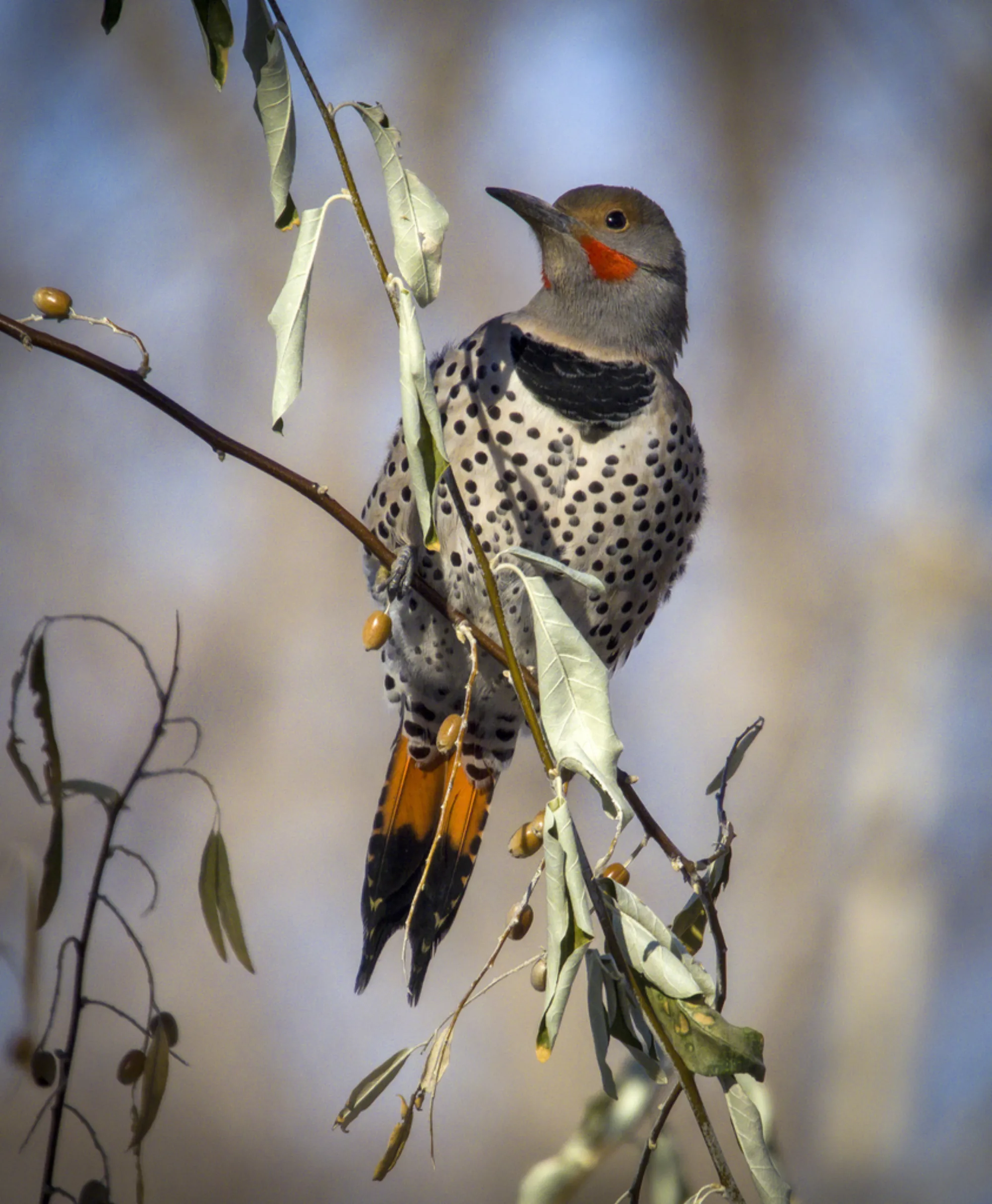
Look for the Northern Flicker on the ground as well as among the trees: this medium-sized woodpecker frequently feeds on the ground. Adults are brown with black bars across the back and wings, a black breast patch, and a spotted beige belly. A white rump stands out in flight, which follows a rolling pattern of quick flaps and pauses. Males have a dark stripe beside the beak in the east and a red one in the west; females lack it. Listen, too, for a sustained laughing call or loud drumming on trees and sometimes metal.
Its native range covers much of North America and extends into Central America, as well as Cuba and the Cayman Islands. It uses open places near trees, from woodland edges to yards and parks, and reaches the tree line in the mountains of the western United States. Insects are its main food, and it breaks into underground ant colonies to reach the larvae. It also eats fruit, seeds and nuts, with berries and seeds especially useful in winter. Some flickers migrate, while certain southern populations stay put; migrating birds may gather in flocks.
Both sexes help excavate a nest, usually in a tree, although the birds may also use suitable posts or birdhouses. A typical clutch contains six to eight white eggs, which both parents incubate for about 11 to 12 days. The young leave the nest about 25 to 28 days after hatching. Nestlings are vulnerable to predators including hawks, raccoons, squirrels and snakes, while larger hunting birds prey on adults. Common starlings can also drive flickers away from nesting sites.
Written from the English Wikipedia article Northern flicker (CC BY-SA 4.0).
- Records
- 5,045,375
- Countries
- 9
- Atlas places
- 3
These are open occurrence records, so they show where people looked for and recorded the Northern Flicker as much as where it lives. Cells are up to 25 km across, and every location is generalised to its cell.
Generalised encounter areas, not exact locations. Each shape is a grid cell coloured by how likely the species is there.
- Very likelyUnited States25 km zone · high confidence · 4182694 records · updated 86 days ago
- Very likelyCanada25 km zone · high confidence · 850333 records · updated 86 days ago
- Very likelyCayman Islands25 km zone · high confidence · 4732 records · updated today
- Very likelyMexico25 km zone · high confidence · 4536 records · updated today
- LikelyCuba25 km zone · high confidence · 2304 records · updated today
- LikelySt. Pierre & Miquelon25 km zone · high confidence · 605 records · updated today
- PossibleGuatemala25 km zone · high confidence · 98 records · updated today
- PossibleBermuda25 km zone · medium confidence · 65 records · updated today
- UncommonPortugal25 km zone · medium confidence · 8 records · updated today
Conservation status not assessed here yet, so every location is generalised to its grid cell.