Yellow-billed Cuckoo
Coccyzus americanus
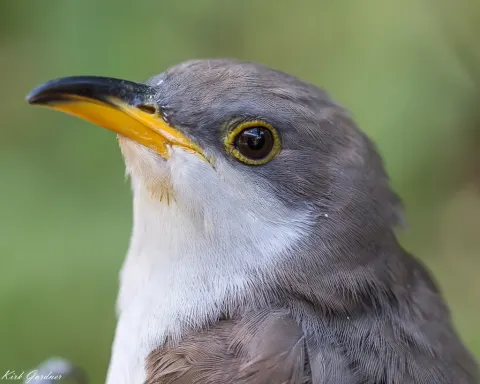
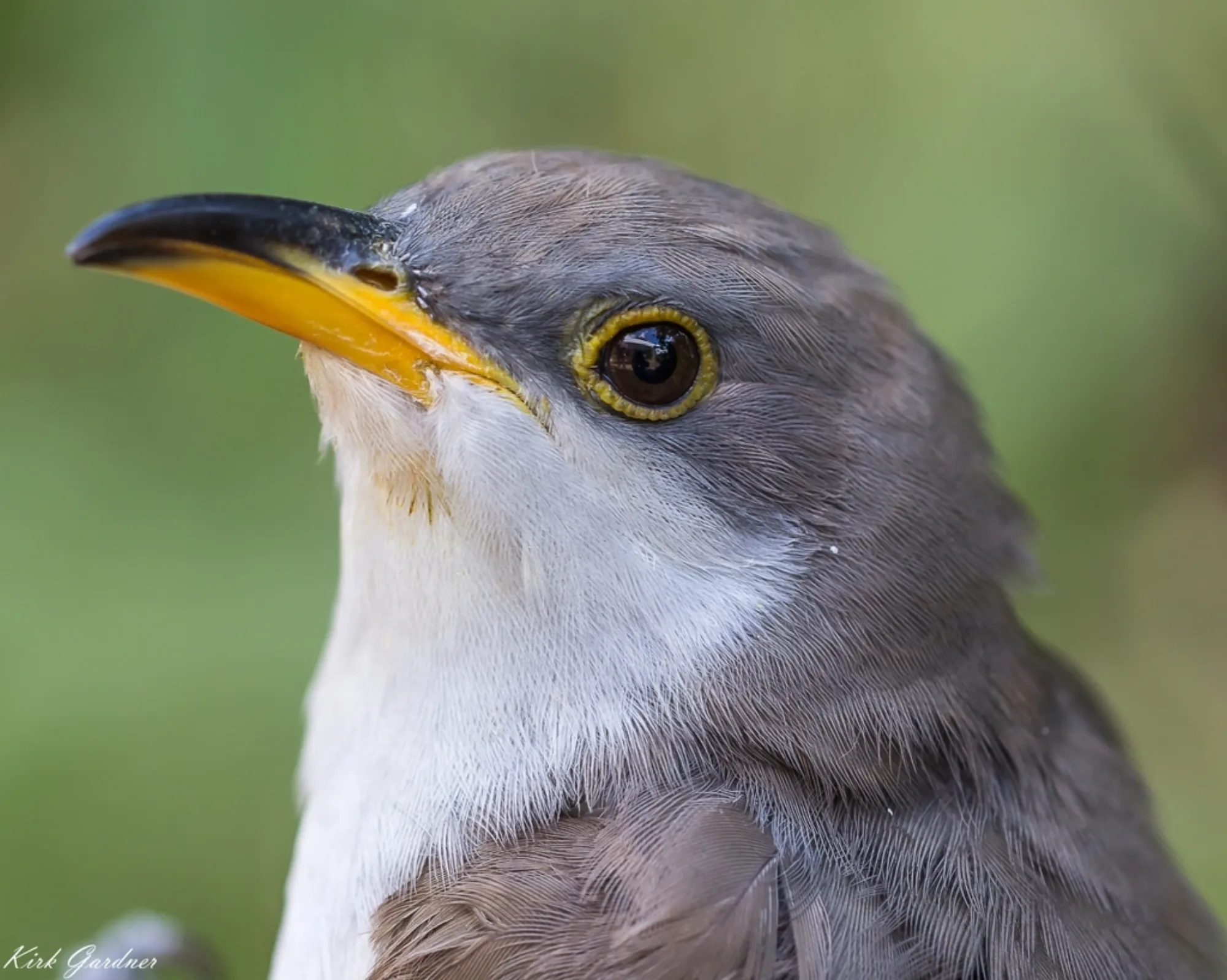
Look for the Yellow-billed Cuckoo in leafy cover, where its brown upperparts and white underside can blend with the trees and shrubs it uses for foraging. Its long tail is brown on top and black and white underneath; adults also have a curved black bill with yellow concentrated on the lower part, and a yellow ring around the eye. In flight, their wings show cinnamon colouring. Young birds look much like adults, though grey replaces black beneath the tail, while adult males and females cannot be distinguished by their plumage.
The bird breeds in deciduous woods across an area that includes southern Canada, Mexico and the Caribbean. It winters in South America, with birds from eastern North America travelling through the Caribbean and those from the west moving down the western side of Mexico and Central America. In dense shrubs and trees, it searches for food, chiefly insects such as tent caterpillars and cicadas, and sometimes catches insects in flight. Lizards, other birds' eggs and berries also form part of its diet, and cuckoos may gather where insects are abundant. A nest is a slight platform of short twigs on a horizontal branch in a tree or shrub, usually 1 to 4 metres above ground. The 3 to 4 eggs hatch after 14 days or less of incubation, and the young can climb and fly at about 7 to 9 days old. Some females also lay eggs in other birds' nests, most often those of the closely related black-billed cuckoo.
Western North American populations have fallen steeply, with the species lost from British Columbia, Washington and Oregon before the middle of the twentieth century. Eastern populations have also declined, though less sharply.
Written from the English Wikipedia article Yellow-billed cuckoo (CC BY-SA 4.0).
- Records
- 437,308
- Countries
- 3
- Atlas places
- 1
These are open occurrence records, so they show where people looked for and recorded the Yellow-billed Cuckoo as much as where it lives. Cells are up to 25 km across, and every location is generalised to its cell.
Generalised encounter areas, not exact locations. Each shape is a grid cell coloured by how likely the species is there.
- Very likelyUnited States25 km zone · high confidence · 424169 records · updated 80 days ago
- Very likelyMexico25 km zone · high confidence · 8826 records · updated 80 days ago
- Very likelyCanada25 km zone · high confidence · 4313 records · updated 80 days ago
Conservation status not assessed here yet, so every location is generalised to its grid cell.