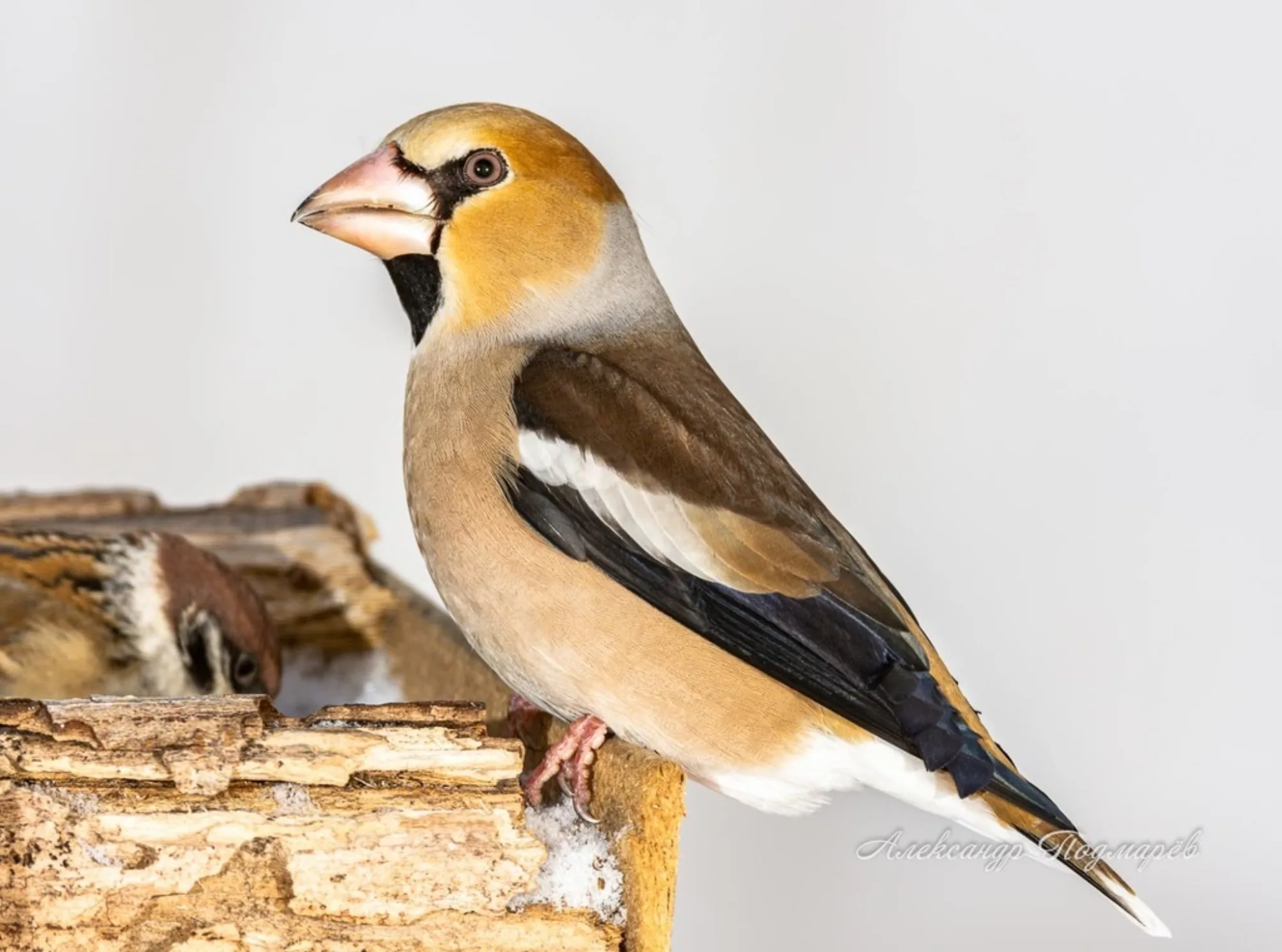
Hawfinch
Coccothraustes coccothraustes
A bulky finch with a large, round head and a formidable bill, the Hawfinch can be difficult to spot among the branches. Its orange-brown head has a black stripe through the eye and a black bib, with a dark brown back and orange underparts. The bill is black in summer and paler in winter. In flight, look for white wing bars, a white tail tip and a tail that appears strikingly short. Its call is a hard chick, but its song is quiet and mumbled.
Hawfinches breed across Europe and temperate Asia, and also occur in North Africa. They favour deciduous or mixed woodland with large trees, including hornbeam, and visit parks and gardens. In autumn and winter they seek woods that provide food, especially those with cherry and plum trees. Shy and often high in the branches, they come to the ground to find seeds or drink, staying close to trees. They are usually seen in pairs or small groups, although flocks gather to roost in winter at Bedgebury Pinetum in England. Many birds in Asia move south for winter, while those in Europe are mainly resident.
A powerful bill opens hard seeds and fruit kernels, including those of cherries and plums. Hawfinches also eat berries, sprouts and occasional caterpillars and beetles, and sometimes catch insects in flight. Breeding pairs usually nest alone, building an untidy nest of twigs high in a tree. Both parents feed the chicks, which leave the nest after 12 to 14 days. In the United Kingdom, numbers fell sharply between 1968 and 2011, but the reasons for the decline are not understood.
Written from the English Wikipedia article Hawfinch (CC BY-SA 4.0).
- Records
- 244,242
- Countries
- 74
- Atlas places
- 1
These are open occurrence records, so they show where people looked for and recorded the Hawfinch as much as where it lives. Cells are up to 25 km across, and every location is generalised to its cell.
Generalised encounter areas, not exact locations. Each shape is a grid cell coloured by how likely the species is there.
- Very likelyNorway25 km zone · high confidence · 66051 records · updated 86 days ago
- Very likelyFrance25 km zone · high confidence · 57055 records · updated 86 days ago
- Very likelyBelgium25 km zone · high confidence · 14174 records · updated 86 days ago
- Very likelySpain25 km zone · high confidence · 13934 records · updated 86 days ago
- Very likelyCzechia25 km zone · high confidence · 12410 records · updated 86 days ago
- Very likelySweden25 km zone · high confidence · 12094 records · updated 86 days ago
- Very likelyGermany25 km zone · high confidence · 8367 records · updated 86 days ago
- Very likelyFinland25 km zone · high confidence · 5474 records · updated 86 days ago
- Very likelyPoland25 km zone · high confidence · 4717 records · updated 86 days ago
- Very likelyAustria25 km zone · high confidence · 3361 records · updated 86 days ago
Conservation status not assessed here yet, so every location is generalised to its grid cell.