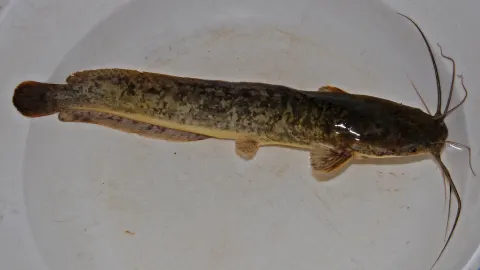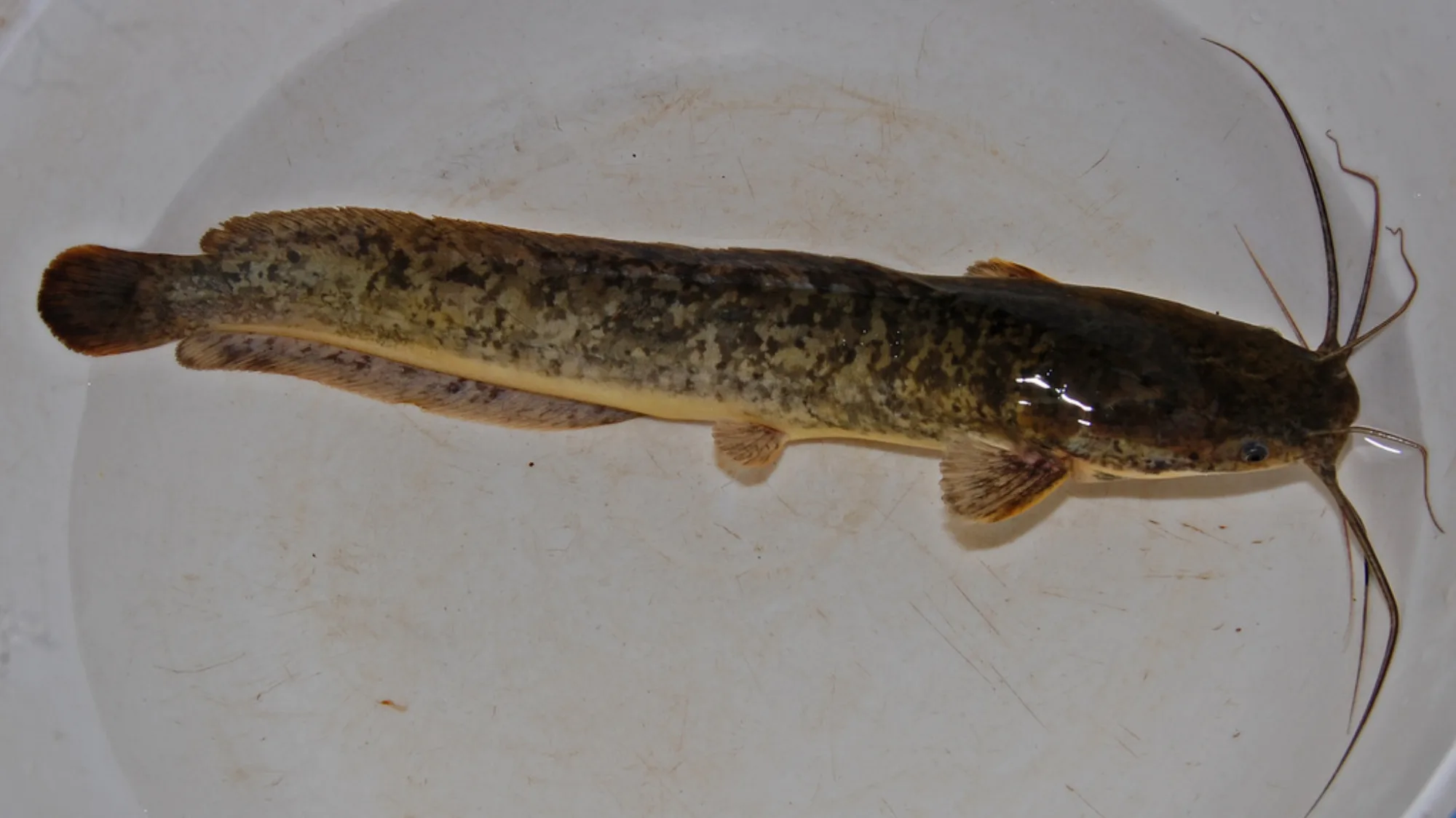
Sharptooth Catfish
Clarias gariepinus
With its long, eel-like body and flattened head, the Sharptooth Catfish is a large freshwater fish that breathes air. Its back is usually dark grey or black, fading to a white belly, and four pairs of barbels surround its broad mouth. Adults average 1 to 1.5 m long, while the largest recorded length given is 1.7 m, with a weight of up to 60 kg. Only its pectoral fins carry spines.
The fish occurs throughout Africa and the Middle East, in freshwater lakes, rivers and swamps. It also lives in human-made places, including oxidation ponds and urban sewage systems. Introduced around the world for aquaculture in the early 1980s, it now occurs far beyond its natural range, including in Brazil, Vietnam and India. It is active at night and eats both living and dead animal matter, from insects and snails to fish, birds and small mammals, as well as fruit and seeds. Its wide mouth lets it swallow relatively large prey whole, and it has been known to take common moorhens. As pools dry, it can crawl across dry ground to escape, or survive for long periods in shallow mud between rainy seasons. African catfish sometimes make loud croaking sounds reminiscent of a crow.
Spawning usually happens at night in shallow, flooded areas of rivers, lakes and streams. Males can be highly aggressive towards one another before courtship, and pairs breed in shallow water. Beyond choosing a suitable site, the parents provide no care for their offspring; the larvae can swim within 48 to 72 hours after fertilisation. The species can host several kinds of internal and external parasites.
Written from the English Wikipedia article Clarias gariepinus (CC BY-SA 4.0).
- Records
- 3,734
- Countries
- 18
- Atlas places
- 16
- Kruger National Park· South Africa
- iSimangaliso Wetland Park· South Africa
- Addo Elephant National Park· South Africa
- Okavango Delta· Botswana
- uKhahlamba-Drakensberg Park· South Africa
- Ai-Ais/Richtersveld Transfrontier Park· Namibia
- Lake Mburo National Park· Uganda
- Queen Elizabeth National Park· Uganda
- Augrabies Falls National Park· South Africa
- Golden Gate Highlands National Park· South Africa
- Gonarezhou National Park· Zimbabwe
- Hluhluwe-iMfolozi Park· South Africa
- Kasanka National Park· Zambia
- Madikwe Game Reserve· South Africa
- Murchison Falls National Park· Uganda
- Tsau ǁKhaeb (Sperrgebiet) National Park· Namibia
These are open occurrence records, so they show where people looked for and recorded the Sharptooth Catfish as much as where it lives. Cells are up to 25 km across, and every location is generalised to its cell.
Generalised encounter areas, not exact locations. Each shape is a grid cell coloured by how likely the species is there.
- Very likelySouth Africa25 km zone · medium confidence · 2057 records · updated 80 days ago
- Very likelyMozambique25 km zone · high confidence · 1230 records · updated 80 days ago
- Very likelyUganda25 km zone · medium confidence · 171 records · updated 80 days ago
- Very likelyNigeria25 km zone · medium confidence · 102 records · updated 80 days ago
- Very likelyKenya25 km zone · medium confidence · 52 records · updated 80 days ago
- LikelyBotswana25 km zone · medium confidence · 25 records · updated 80 days ago
- LikelyBenin25 km zone · medium confidence · 17 records · updated 80 days ago
- LikelyPhilippines25 km zone · medium confidence · 17 records · updated 80 days ago
- LikelyNamibia25 km zone · medium confidence · 13 records · updated 80 days ago
- LikelyEswatini25 km zone · medium confidence · 10 records · updated 80 days ago
Conservation status not assessed here yet, so every location is generalised to its grid cell.