Walking Catfish
Clarias batrachus
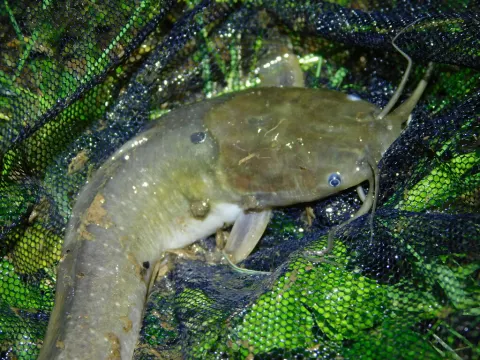
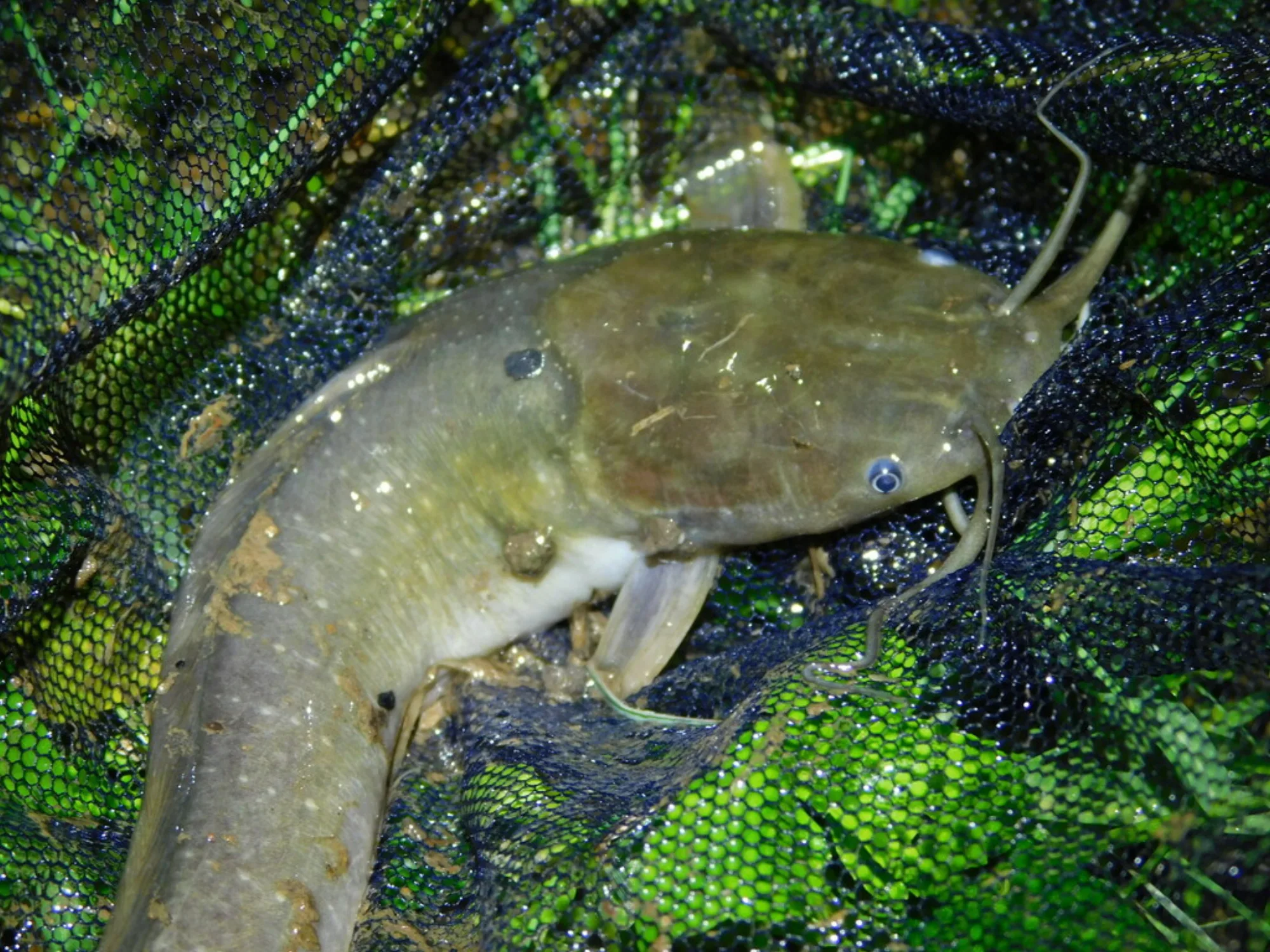
With its long body and whisker-like barbels, the Walking Catfish is a freshwater fish that can breathe air. It is mainly grey or greyish brown, often with small white spots along its sides, and can reach almost 0.5 m in length and 1.2 kg in weight. Its scaleless skin is coated in mucus, which protects it when it leaves the water. Fins help it stay upright as it wriggles across land in a snake-like motion, moving in search of food or another place to live. It can survive for 18 hours out of water.
The confirmed native range of true Clarias batrachus is the Indonesian island of Java. Closely related fish have often been confused with it, so some reported information about its behaviour, ecology and introduced populations may refer to those other species. Walking catfish use slow-moving or stagnant water, including ponds, swamps, streams, rivers, flooded rice paddies and temporary pools. They also occur in muddy canals and ditches, and can move to another body of water when a temporary pool dries up.
The fish spends most of its time on or just above the bottom, occasionally rising to gulp air. Its varied diet includes smaller fish, molluscs, other invertebrates, aquatic weeds and detritus. Introduced widely within Asia and beyond its native range, it can consume food needed by native fish and prey on their young. In Florida, where it is established, it has entered fish-farm ponds and eaten farmed fish, prompting farmers to put up fences.
Written from the English Wikipedia article Walking catfish (CC BY-SA 4.0).
- Records
- 502
- Countries
- 6
- Atlas places
- 1
These are open occurrence records, so they show where people looked for and recorded the Walking Catfish as much as where it lives. Cells are up to 25 km across, and every location is generalised to its cell.
Generalised encounter areas, not exact locations. Each shape is a grid cell coloured by how likely the species is there.
- Very likelyUnited States25 km zone · medium confidence · 407 records · updated 80 days ago
- Very likelyTaiwan25 km zone · medium confidence · 57 records · updated 80 days ago
- LikelyPhilippines25 km zone · medium confidence · 30 records · updated 80 days ago
- PossibleIndia25 km zone · medium confidence · 4 records · updated 80 days ago
- PossibleBangladesh25 km zone · medium confidence · 3 records · updated 80 days ago
- RareSingapore25 km zone · medium confidence · 1 record · updated 80 days ago
Conservation status not assessed here yet, so every location is generalised to its grid cell.