Long-tailed Duck
Clangula hyemalis
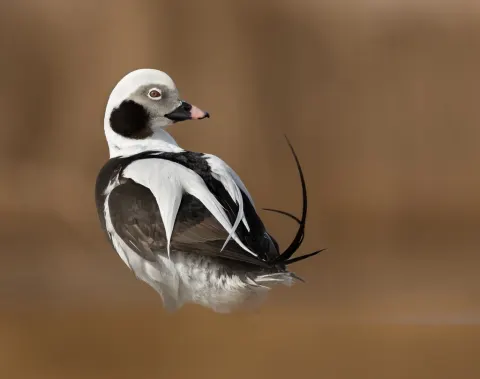
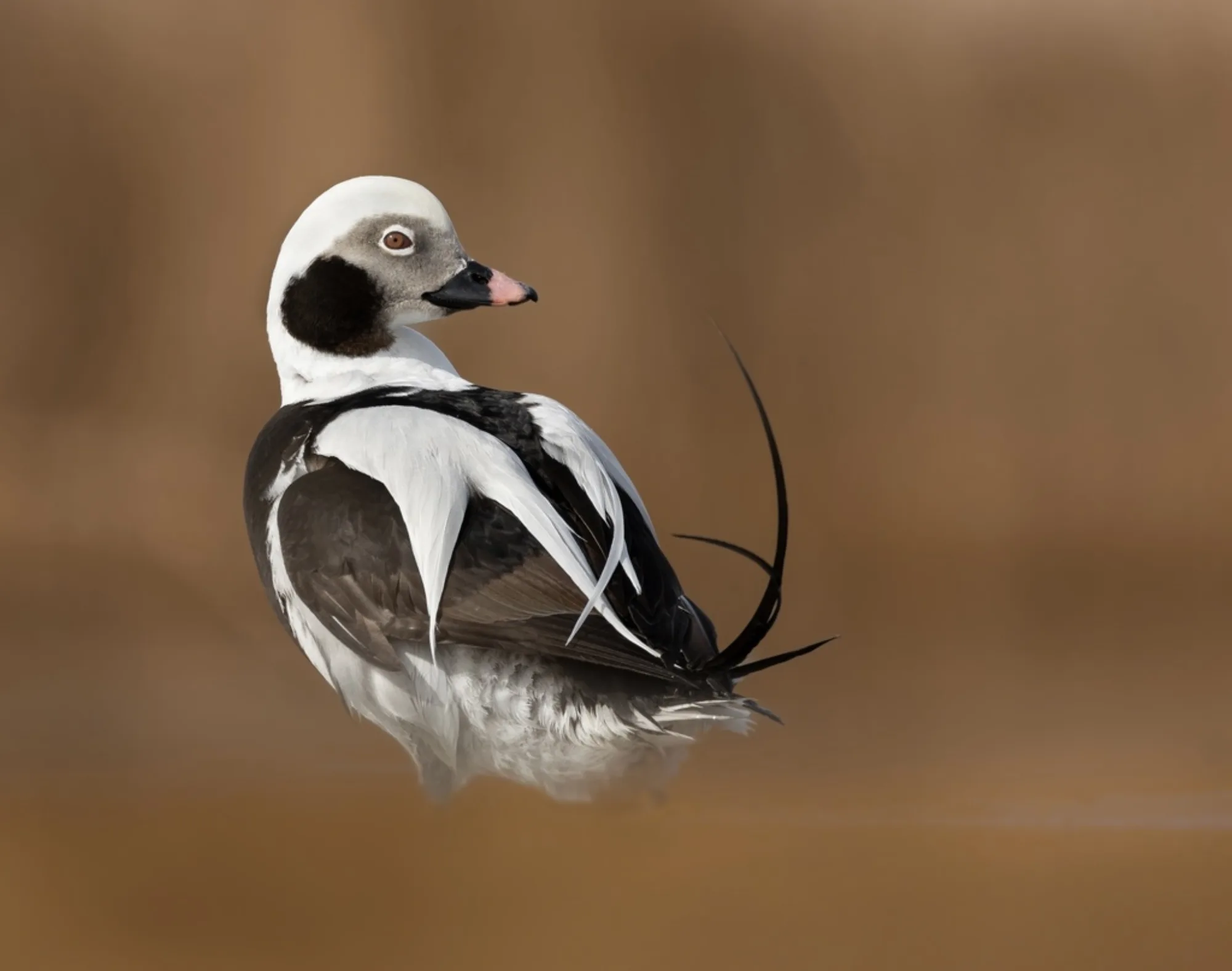
Across Arctic tundra and northern seas, the Long-tailed Duck moves between breeding grounds and winter waters. This medium-sized sea duck has white underparts, but its other plumage changes through a complex moult. The male has a pointed tail measuring 10 to 15 cm and a dark grey bill with a pink band. In winter, his mostly white head has a dark cheek patch, while in summer his head, neck and back are dark and his cheek patch is white. Females have brown backs and shorter pointed tails; in winter, a dark crown contrasts with their white heads and necks, while in summer their heads are dark. Males are vocal, with a musical yodelling call.
Breeding grounds stretch across northern Eurasia and North America, as well as places including Iceland, the Faroe Islands and southern Greenland. Birds nest around tundra pools and marshes, along coasts and beside large mountain lakes, placing a vegetation nest lined with down on the ground near water. A clutch contains six to nine pale grey to olive eggs. In winter, the ducks gather on and near large bodies of water, including the North Atlantic, North Pacific and Great Lakes. They are sociable birds, forming large flocks during migration and winter; about 4.5 million gather in the Baltic Sea, their most important wintering area. They dive for molluscs, crustaceans and some small fish, usually feeding near the surface. Hunting continues across much of their range, while entanglement in gillnets has contributed to a significant decline in birds wintering in the Baltic Sea.
Written from the English Wikipedia article Long-tailed duck (CC BY-SA 4.0).
- Records
- 767,419
- Countries
- 57
- Atlas places
- 3
These are open occurrence records, so they show where people looked for and recorded the Long-tailed Duck as much as where it lives. Cells are up to 25 km across, and every location is generalised to its cell.
Generalised encounter areas, not exact locations. Each shape is a grid cell coloured by how likely the species is there.
- Very likelyUnited States25 km zone · high confidence · 417238 records · updated 86 days ago
- Very likelyCanada25 km zone · high confidence · 209048 records · updated 86 days ago
- Very likelyNorway25 km zone · high confidence · 78098 records · updated 86 days ago
- Very likelyIceland25 km zone · high confidence · 13883 records · updated 86 days ago
- Very likelyFinland25 km zone · high confidence · 10029 records · updated 86 days ago
- Very likelyGermany25 km zone · high confidence · 8791 records · updated 86 days ago
- Very likelyPoland25 km zone · high confidence · 8217 records · updated 86 days ago
- Very likelyUnited Kingdom25 km zone · high confidence · 5091 records · updated 86 days ago
- Very likelySvalbard & Jan Mayen25 km zone · high confidence · 4018 records · updated 86 days ago
- Very likelyBelgium25 km zone · high confidence · 1614 records · updated today
Conservation status not assessed here yet, so every location is generalised to its grid cell.