Greater Spotted Eagle
Clanga clanga
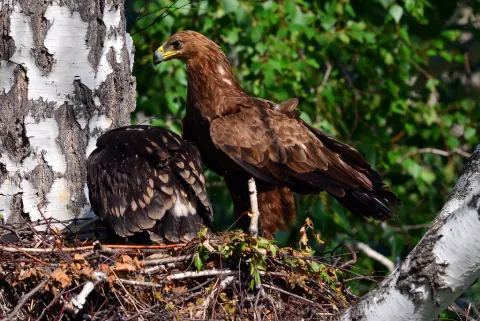
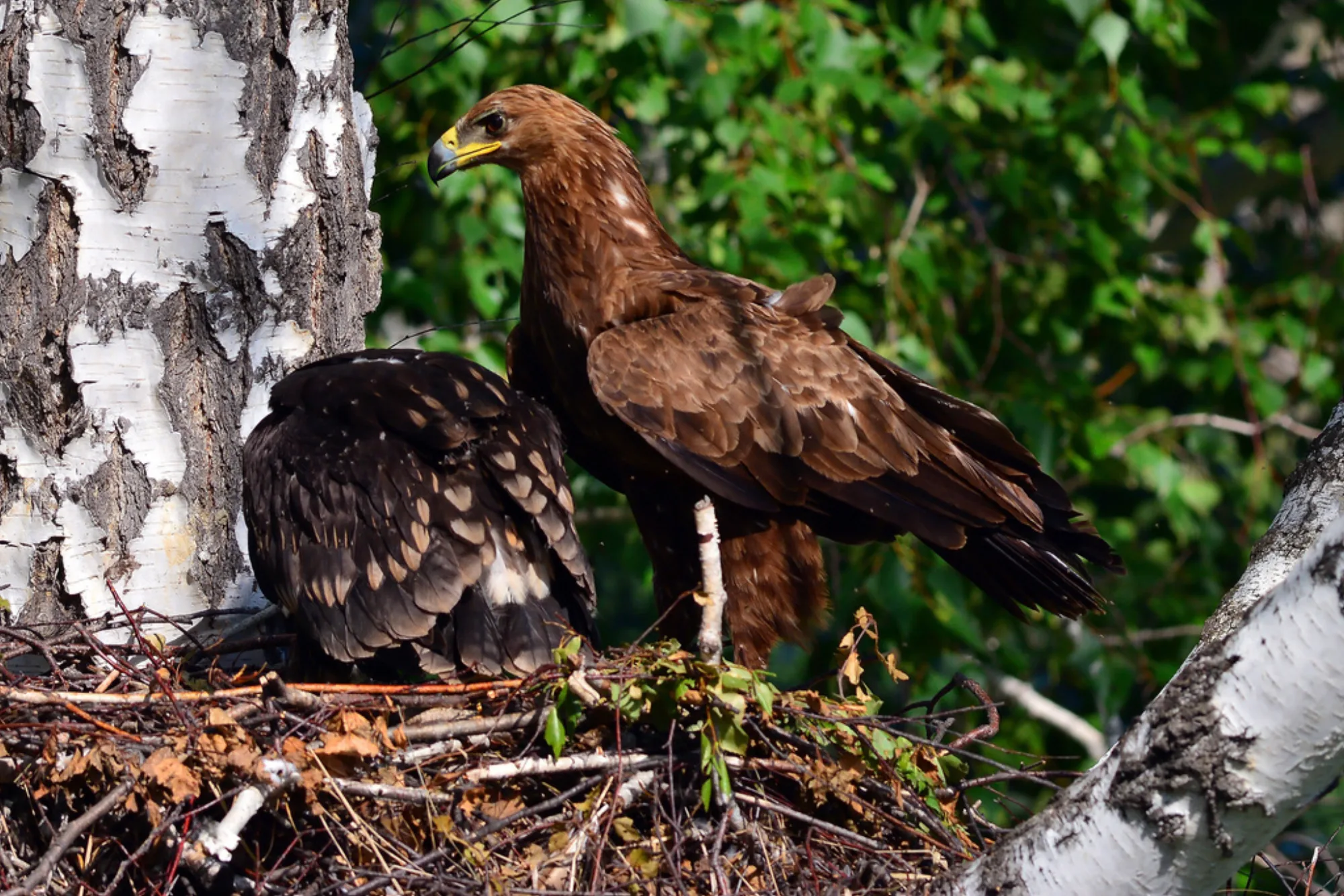
Broad wings and a short, rounded tail give the Greater Spotted Eagle a silhouette that can look almost vulture-like. This large migratory bird of prey is usually dark brown to blackish, with a contrasting yellow beak. Young birds have whitish to yellowish spots, including conspicuous rows across the wings. Identification can be difficult, especially at a distance, where it may be hard to distinguish from the lesser spotted eagle. Look for it perched openly on a treetop at a forest edge, or on an isolated bush, utility pole or steep riverbank.
During the breeding season, its range stretches across Eastern Europe, central Russia and central Asia to parts of China, with other isolated areas. It favours wet woodland and forest edges near marshes, bogs and wet meadows, and breeds mainly on floodplains. In winter it moves to regions including South and Southeast Asia, the Middle East, the Mediterranean Basin and parts of East Africa. Wetlands remain favoured places, though the eagle also occurs in drier habitats, including savanna.
The eagle hunts mainly in flight, searching open ground or dropping steeply onto prey, but it also hunts from perches and on foot. Small mammals form much of its diet, alongside birds, frogs and other prey; it also scavenges carrion. It builds a stick nest in a large tree and lays one to three eggs. The female tends the eggs and chicks, while her mate hunts and supplies food; the pair rarely raises more than one fledgling a year. Habitat destruction and collisions threaten the species, as does breeding with lesser spotted eagles, which produces hybrids.
Written from the English Wikipedia article Greater spotted eagle (CC BY-SA 4.0).
- Records
- 65,059
- Countries
- 29
- Atlas places
- 4
These are open occurrence records, so they show where people looked for and recorded the Greater Spotted Eagle as much as where it lives. Cells are up to 25 km across, and every location is generalised to its cell.
Generalised encounter areas, not exact locations. Each shape is a grid cell coloured by how likely the species is there.
- Very likelyIndia25 km zone · high confidence · 29551 records · updated 80 days ago
- Very likelyIsrael25 km zone · high confidence · 8603 records · updated 80 days ago
- Very likelyUnited Arab Emirates25 km zone · medium confidence · 6374 records · updated 80 days ago
- Very likelyGeorgia25 km zone · high confidence · 3392 records · updated 80 days ago
- Very likelyOman25 km zone · high confidence · 2116 records · updated 80 days ago
- Very likelyKuwait25 km zone · high confidence · 2009 records · updated 80 days ago
- Very likelyThailand25 km zone · high confidence · 1629 records · updated 80 days ago
- Very likelyGreece25 km zone · high confidence · 1533 records · updated 80 days ago
- Very likelyLebanon25 km zone · high confidence · 1385 records · updated 80 days ago
- Very likelyFrance25 km zone · high confidence · 1325 records · updated 80 days ago
Conservation status not assessed here yet, so every location is generalised to its grid cell.