Hen Harrier
Circus cyaneus
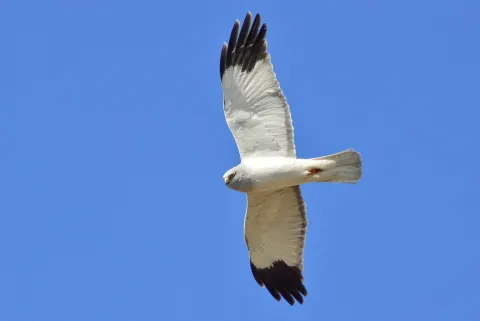
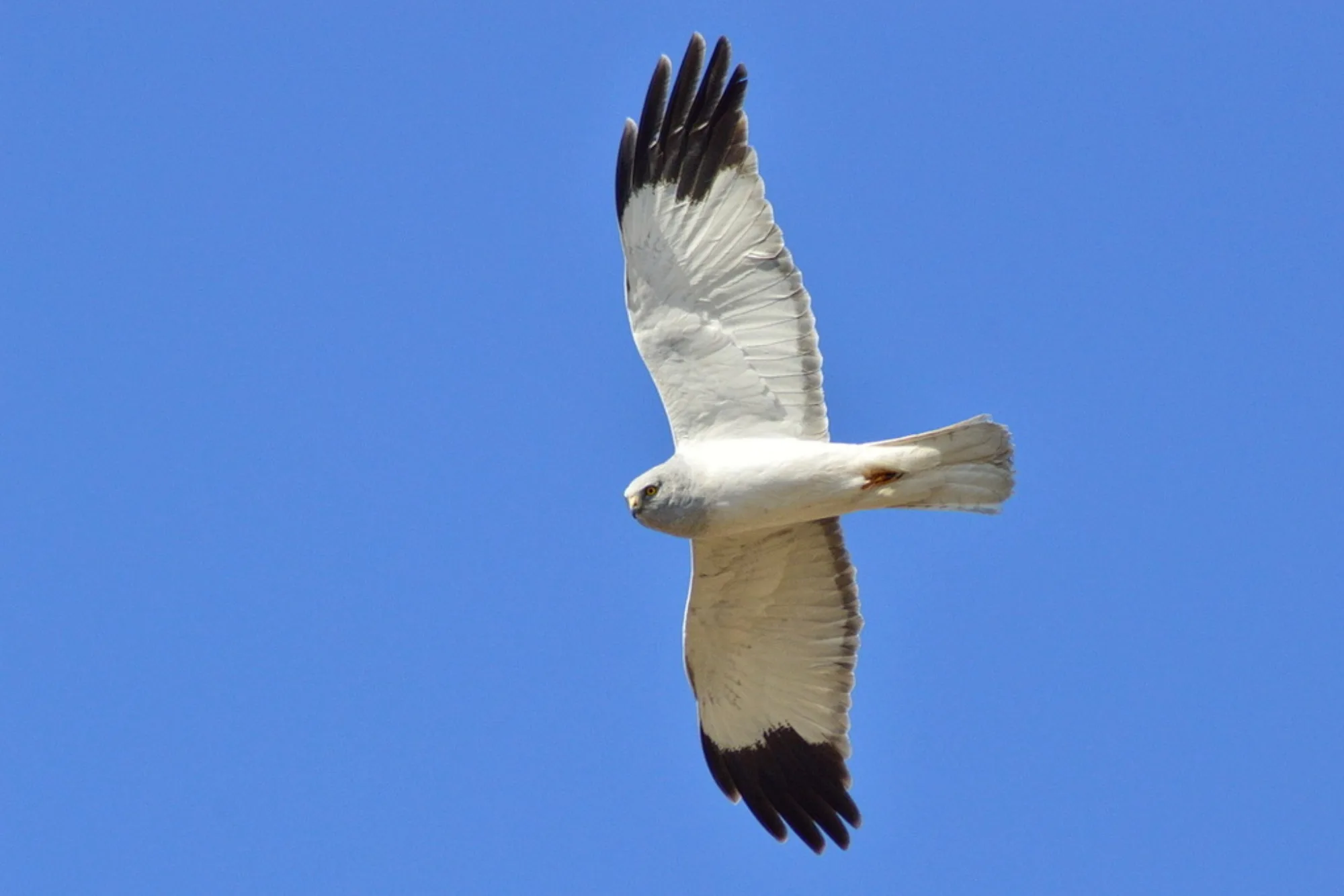
Low over a moor, a Hen Harrier may glide with its long wings raised in a shallow V, following the contours of the ground. This medium-sized bird of prey has long wings and a long tail, with males mostly grey and white and females mainly brown. Males have black wingtips, while females show buff underparts with brown bars. Both sexes have a white rump patch, which stands out more on females and young birds.
Hen Harriers breed across Eurasia in open places including moorland, bogs, farmland, marshes and grasslands. Many move south outside the breeding season, although some stay year-round in places with mild climates, including France and Great Britain. In winter they use open country and often roost together, sometimes alongside merlins and marsh harriers. They search for prey by sight and sound, circling over fields and moors and surprising animals from low flight. Small mammals make up much of their diet, but they also take birds and occasionally frogs, reptiles and insects. The nest is built on the ground or a mound, from sticks lined with grass and leaves. The female does most of the incubation, while the male brings food for her and the chicks. Young birds leave the nest at around 36 days old.
In Britain and Ireland, the main threats are the loss of habitat and unlawful shooting on moors managed for grouse. Birds may also be trapped, and their eggs and nests destroyed. Forestry can reduce the open habitat available to harriers, although young plantations can provide nesting and foraging areas before the canopy closes. Eggs and nestlings are also vulnerable to predators including foxes, badgers, crows and owls.
Written from the English Wikipedia article Hen harrier (CC BY-SA 4.0).
- Records
- 235,224
- Countries
- 88
- Atlas places
- 7
These are open occurrence records, so they show where people looked for and recorded the Hen Harrier as much as where it lives. Cells are up to 25 km across, and every location is generalised to its cell.
Generalised encounter areas, not exact locations. Each shape is a grid cell coloured by how likely the species is there.
- Very likelyFrance25 km zone · high confidence · 45923 records · updated 86 days ago
- Very likelyUnited States25 km zone · high confidence · 35612 records · updated 86 days ago
- Very likelyBelgium25 km zone · high confidence · 35355 records · updated 86 days ago
- Very likelyNorway25 km zone · high confidence · 19938 records · updated 86 days ago
- Very likelyNetherlands25 km zone · high confidence · 15363 records · updated 86 days ago
- Very likelySpain25 km zone · high confidence · 11897 records · updated 86 days ago
- Very likelyCanada25 km zone · high confidence · 11314 records · updated 86 days ago
- Very likelyRussia25 km zone · high confidence · 6758 records · updated 86 days ago
- Very likelyPortugal25 km zone · high confidence · 4962 records · updated 86 days ago
- Very likelyFinland25 km zone · high confidence · 4915 records · updated 86 days ago
Conservation status not assessed here yet, so every location is generalised to its grid cell.