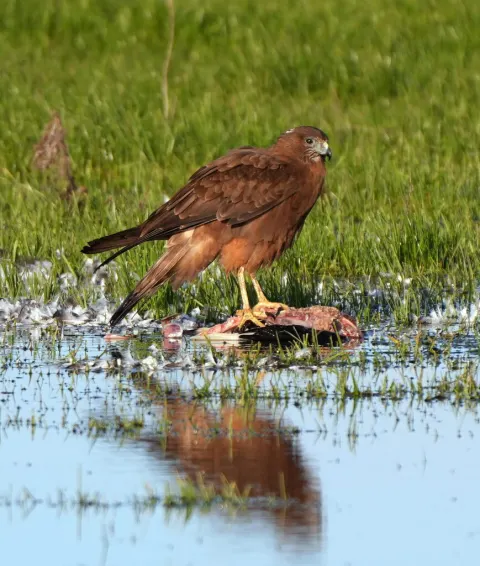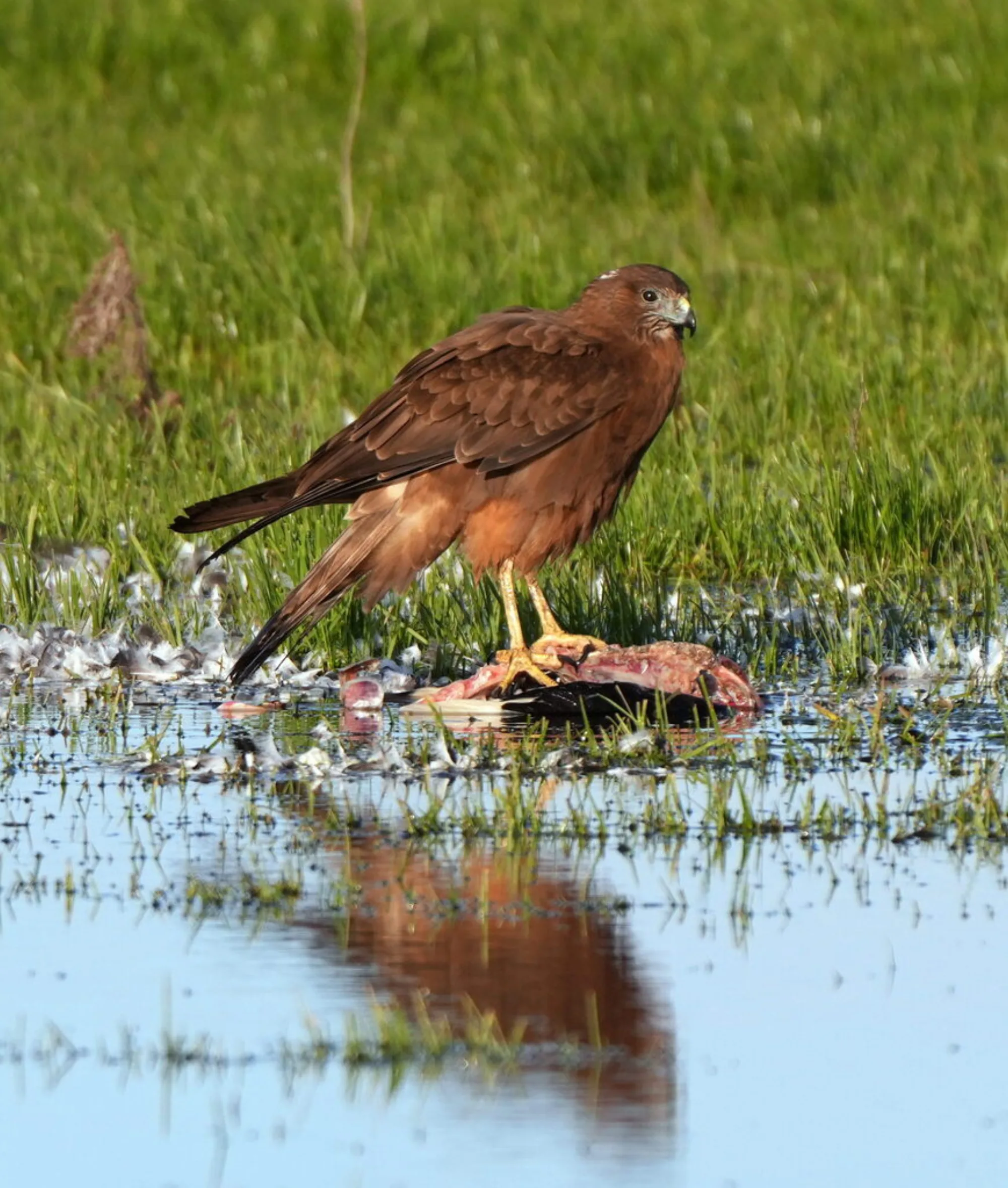
Swamp Harrier
Circus approximans
Low over a wetland or open field, the Swamp Harrier hunts with slow wingbeats and its wings held in an upswept shape. This large, slim bird of prey is mostly dark brown, with a conspicuous white rump, and its plumage becomes lighter as it ages. It measures 48 to 62 cm in length, with a wingspan of 118 to 145 cm; females are significantly larger than males. In New Zealand, where it is also called kāhu, the harrier is common in open country and especially common on farmland.
Its range extends across much of Australia, except the arid region, as well as New Zealand, Fiji, Vanuatu and New Caledonia, with occasional birds reaching some subantarctic islands. Wetlands and well-watered open country are its usual habitats. Its main prey includes birds found on the ground and in water, along with rabbits, small mammals, reptiles, frogs and fish. In winter it also eats substantial amounts of carrion, including animals killed on roads, where harriers themselves are frequently hit by vehicles. Australian magpies, masked lapwings and European starlings are also enemies, with lapwings dive-bombing harriers and starlings mobbing them.
Swamp Harriers nest on the ground, often on a mound among reeds or other dense vegetation in wetlands, though in some districts they also use oat or barley fields. A clutch can contain two to seven eggs, usually three or four; the female incubates them for 31 to 34 days. Both parents feed the chicks, which are fully feathered by 28 days and leave the nest about 45 days after hatching. Harriers have also faced persecution after being blamed for killing chickens, pheasants and ducklings.
Written from the English Wikipedia article Swamp harrier (CC BY-SA 4.0).
- Records
- 179,240
- Countries
- 10
- Atlas places
- 7
These are open occurrence records, so they show where people looked for and recorded the Swamp Harrier as much as where it lives. Cells are up to 25 km across, and every location is generalised to its cell.
Generalised encounter areas, not exact locations. Each shape is a grid cell coloured by how likely the species is there.
- Very likelyNew Zealand25 km zone · high confidence · 91095 records · updated 86 days ago
- Very likelyAustralia25 km zone · high confidence · 86059 records · updated 86 days ago
- Very likelyFrench Polynesia25 km zone · high confidence · 707 records · updated 86 days ago
- LikelyFiji25 km zone · high confidence · 546 records · updated today
- LikelyVanuatu25 km zone · high confidence · 432 records · updated today
- LikelyNew Caledonia25 km zone · high confidence · 338 records · updated today
- PossibleIndonesia25 km zone · medium confidence · 23 records · updated today
- PossibleNorfolk Island25 km zone · medium confidence · 20 records · updated today
- PossiblePapua New Guinea25 km zone · medium confidence · 17 records · updated today
- UncommonTonga25 km zone · medium confidence · 3 records · updated today
Conservation status not assessed here yet, so every location is generalised to its grid cell.