Western Marsh Harrier
Circus aeruginosus
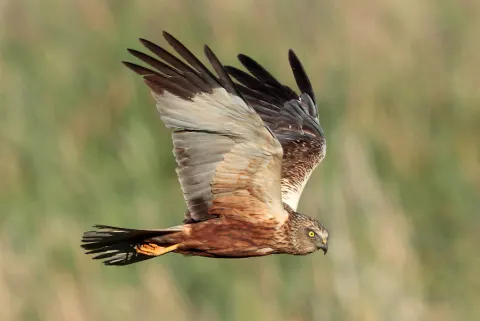
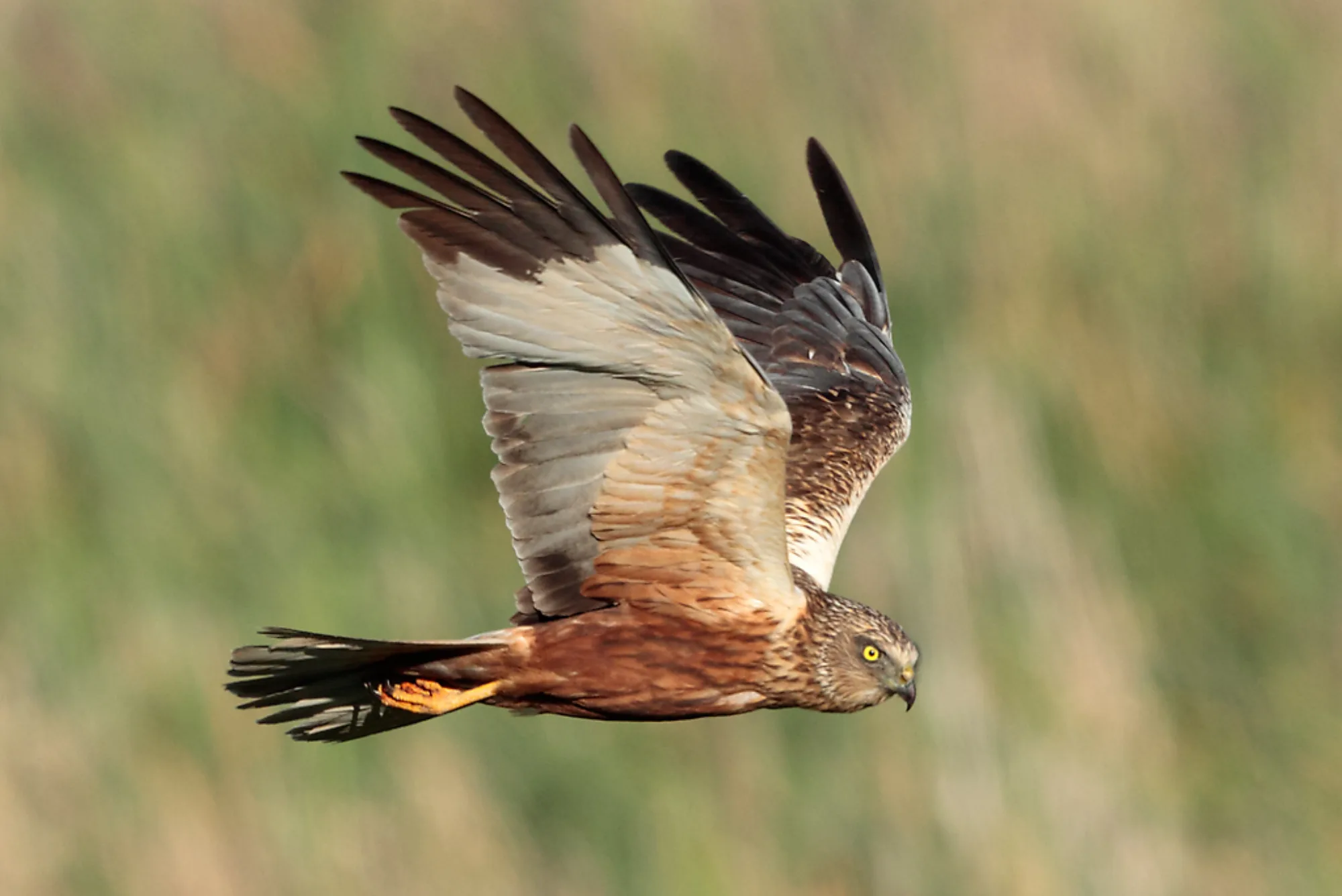
Watch for the Western Marsh Harrier gliding low over open ground, its broad wings held in a shallow V and its legs often dangling. This large bird of prey measures 48 to 56 cm long, with a wingspan of 115 to 130 cm. Males show a mix of reddish-brown, grey and black in flight, with pale heads and shoulders. Females are mostly chocolate-brown, with lighter yellowish colouring on the head, throat and shoulders. Young birds resemble females but usually have less yellow, especially on their shoulders.
Breeding birds occur across Europe and northwestern Africa, eastwards through the northern Middle East and into Central Asia. Wetlands with plenty of common reed are favoured habitat, though the bird also uses farmland and grassland, particularly alongside marshes. Most populations migrate or disperse, with some spending winter in southern or western Europe and others travelling to Africa or parts of Asia. In Morocco, Algeria and Tunisia, one subspecies remains throughout the year. Although usually less social than other harriers in winter, around 100 gather to roost at Keoladeo National Park in India each November and December.
The harrier hunts over flat ground for prey that includes frogs and reptiles, as well as insects, small birds and mammals. During the breeding season it defends a territory, and usually builds its ground nest among reeds, using sticks, reeds and grasses. It also nests in arable fields. A normal clutch contains three to eight eggs, and the young leave the nest after 30 to 40 days. Persecution, habitat destruction and heavy pesticide use caused declines across many areas. Shooting along Mediterranean migration routes remains a threat, as do disturbance during breeding and lead shot poisoning.
Written from the English Wikipedia article Western marsh harrier (CC BY-SA 4.0).
- Records
- 906,242
- Countries
- 127
- Atlas places
- 25
- Chobe National Park· Botswana
- Ngorongoro Conservation Area· Tanzania
- Serengeti National Park· Tanzania
- Volcanoes National Park· Rwanda
- Akagera National Park· Rwanda
- Queen Elizabeth National Park· Uganda
- Aberdare National Park· Kenya
- Amboseli National Park· Kenya
- Annapurna Conservation Area· Nepal
- Arusha National Park· Tanzania
- Bangweulu Wetlands· Zambia
- Chitwan National Park· Nepal
- Hell's Gate National Park· Kenya
- Kasanka National Park· Zambia
- Koshi Tappu Wildlife Reserve· Nepal
- Lake Manyara National Park· Tanzania
- Lake Mburo National Park· Uganda
- Lake Nakuru National Park· Kenya
- Maasai Mara National Reserve· Kenya
- Murchison Falls National Park· Uganda
- Nairobi National Park· Kenya
- Okavango Delta· Botswana
- Tarangire National Park· Tanzania
- Udawalawe National Park· Sri Lanka
- Yala National Park· Sri Lanka
These are open occurrence records, so they show where people looked for and recorded the Western Marsh Harrier as much as where it lives. Cells are up to 25 km across, and every location is generalised to its cell.
Generalised encounter areas, not exact locations. Each shape is a grid cell coloured by how likely the species is there.
- Very likelySpain25 km zone · high confidence · 148484 records · updated 86 days ago
- Very likelyBelgium25 km zone · high confidence · 137133 records · updated 86 days ago
- Very likelyUnited Kingdom25 km zone · high confidence · 117268 records · updated 86 days ago
- Very likelyGeorgia25 km zone · high confidence · 61113 records · updated 86 days ago
- Very likelyNetherlands25 km zone · high confidence · 43305 records · updated 86 days ago
- Very likelyFrance25 km zone · high confidence · 39684 records · updated 86 days ago
- Very likelyNorway25 km zone · high confidence · 38069 records · updated 86 days ago
- Very likelyIndia25 km zone · high confidence · 34559 records · updated 86 days ago
- Very likelySenegal25 km zone · high confidence · 33711 records · updated 86 days ago
- Very likelyMali25 km zone · high confidence · 32261 records · updated 86 days ago
Conservation status not assessed here yet, so every location is generalised to its grid cell.