White-throated Dipper
Cinclus cinclus
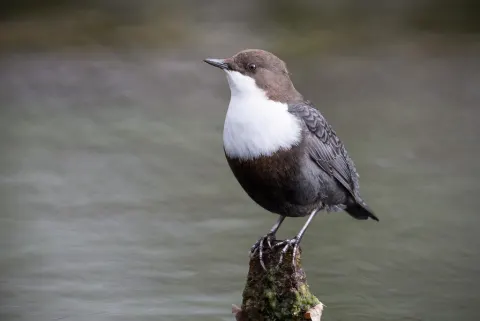
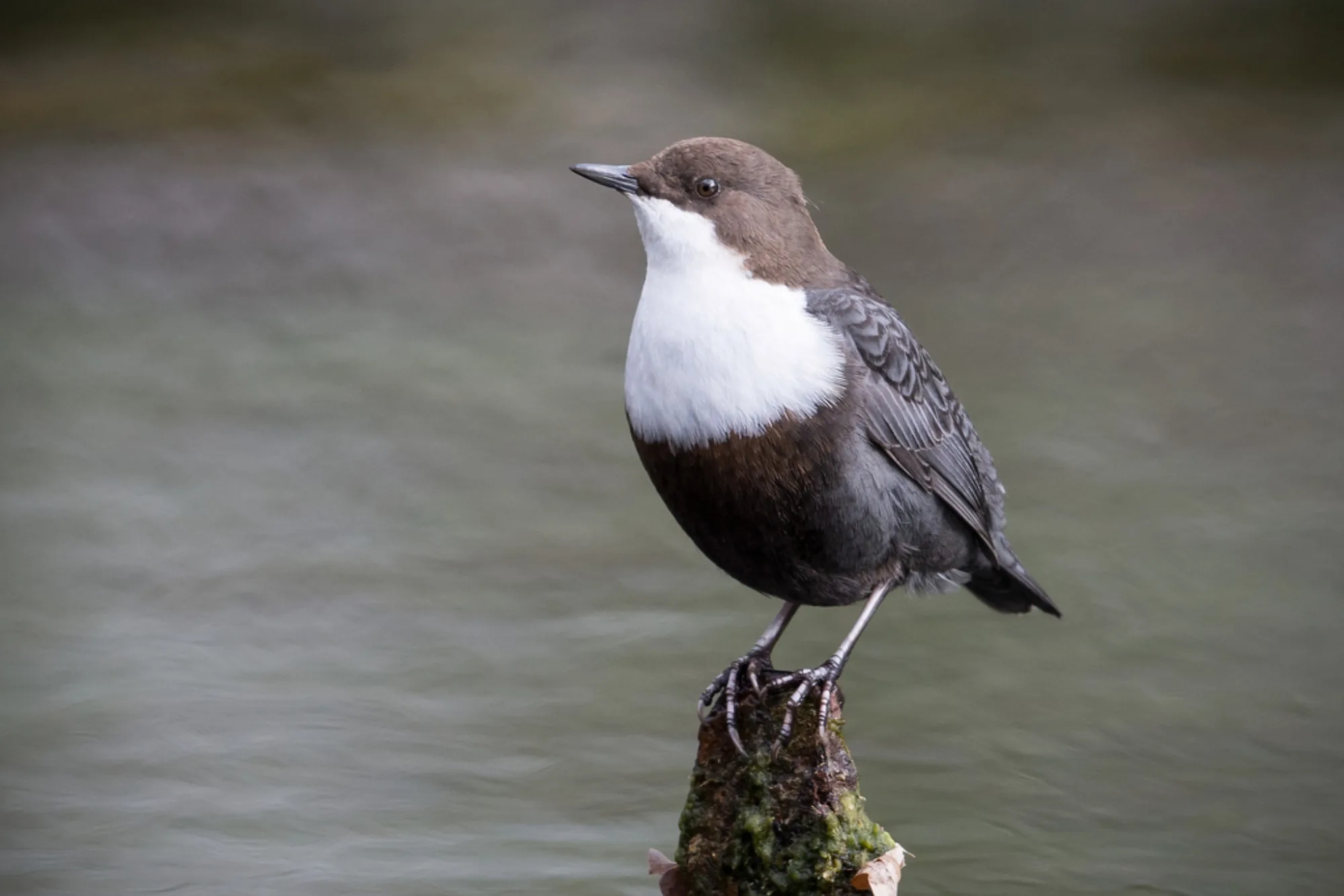
Beside a fast-flowing stream, look for a round, short-tailed bird bobbing on a rock with its tail raised. The White-throated Dipper measures about 18 cm and has a brown head, dark back and striking white throat and upper breast. In some adults, a chestnut band below the white merges into a black belly and flanks; young birds are greyish brown without the chestnut band. Its flight is fast and direct, with rapidly whirring wings and a shrill call.
This aquatic bird ranges from Europe through the Middle East and Central Asia to the Indian subcontinent, favouring swift rivers, streams and the lakes they feed. When hill streams freeze in winter, some move down to the lowlands or even the coast, while others stay where water remains open. Dippers enter the water from a perch or plunge in with a small splash, then swim underwater using their wings. A trail of rising bubbles can reveal their course beneath the surface. They eat aquatic invertebrates, including insect larvae, beetles and freshwater molluscs, as well as fish and small amphibians. They also search banks and rocks for land-dwelling invertebrates.
Pairs defend a territory and build a domed nest of moss, grass stems and leaves, usually close to or above water. Rocky ledges, cavities and bridges can all provide nest sites. Four or five eggs are usual, and both parents feed the chicks after they hatch. The young leave the nest at around 22 days, but their parents continue feeding them afterwards. Predatory fish can take dippers, although only one such case involving this species has been recorded.
Written from the English Wikipedia article White-throated dipper (CC BY-SA 4.0).
- Records
- 118,707
- Countries
- 20
No atlas park has a record of the White-throated Dipper in or around it yet.
These are open occurrence records, so they show where people looked for and recorded the White-throated Dipper as much as where it lives. Cells are up to 25 km across, and every location is generalised to its cell.
Generalised encounter areas, not exact locations. Each shape is a grid cell coloured by how likely the species is there.
- Very likelyNorway25 km zone · high confidence · 47207 records · updated 80 days ago
- Very likelyFrance25 km zone · high confidence · 23409 records · updated 80 days ago
- Very likelyFinland25 km zone · high confidence · 12162 records · updated 80 days ago
- Very likelySweden25 km zone · high confidence · 11804 records · updated 80 days ago
- Very likelyUnited Kingdom25 km zone · high confidence · 9817 records · updated 80 days ago
- Very likelySpain25 km zone · high confidence · 4788 records · updated 80 days ago
- Very likelyAustria25 km zone · high confidence · 2822 records · updated 80 days ago
- Very likelyItaly25 km zone · high confidence · 1065 records · updated 80 days ago
- Very likelyLuxembourg25 km zone · high confidence · 884 records · updated 80 days ago
- Very likelyIreland25 km zone · high confidence · 876 records · updated 80 days ago
Conservation status not assessed here yet, so every location is generalised to its grid cell.