Black Stork
Ciconia nigra
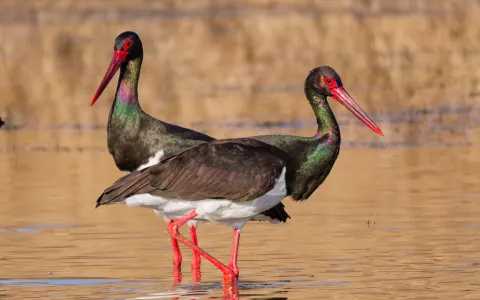
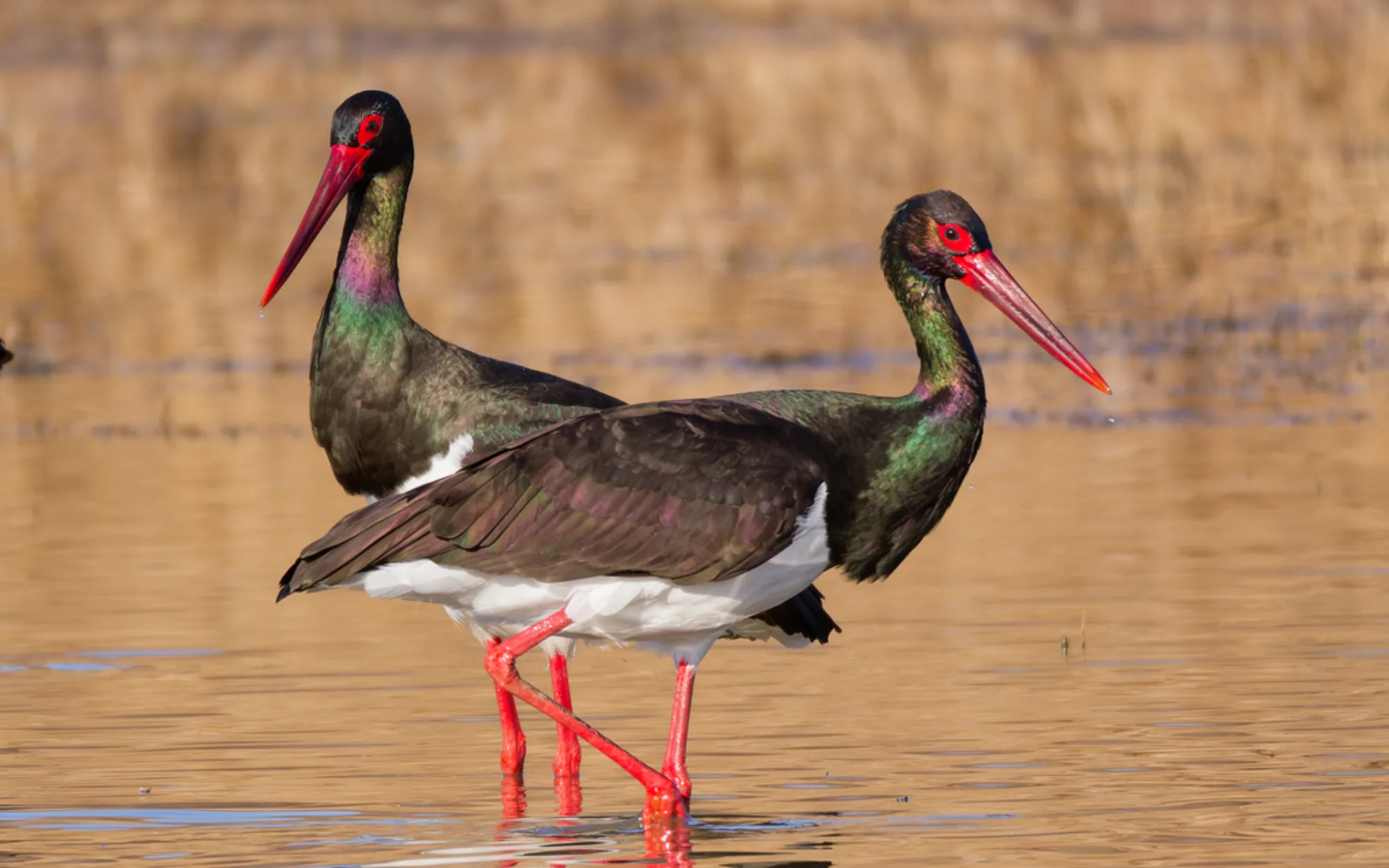
Shy and wary around people, the Black Stork is a large bird most often encountered alone or in a pair near water. Adults have glossy black plumage with a purplish green sheen, a white underside, and red legs and a pointed red beak. They measure 95 to 100 cm in length, with a wingspan of 145 to 155 cm. Young birds are browner and less glossy, with greyish-green legs and bills.
The species breeds in scattered parts of Europe, with its range extending east through the Palearctic as far as the Pacific coast. It favours wooded country, including marshy wetlands with broadleaved or coniferous trees, and hills and mountains threaded with creeks. Ponds, rivers, lake edges and estuaries are among the places it uses. Many populations migrate long distances: European birds winter in tropical Africa, while an isolated population in southern Africa remains there year-round. On migration or in winter, birds may gather in flocks of up to 100.
Black Storks feed mainly on fish, but also take amphibians, insects and other small animals. They wade slowly through shallow water in search of prey, sometimes spreading their wings to shade the water. Breeding pairs usually build large stick nests in forest trees, although they also nest on boulders or under ledges in mountainous areas. Both parents incubate the two to five eggs, and the young take 60 to 71 days to fledge. Wetland drainage has reduced the population in Iran, while hunters threaten the birds in parts of southern Europe and Asia. Drought has affected Lake Faguibine in Mali, a stopover on the western migration route.
Written from the English Wikipedia article Black stork (CC BY-SA 4.0).
- Records
- 96,268
- Countries
- 40
- Atlas places
- 11
- Kruger National Park· South Africa
- Chitwan National Park· Nepal
- Jim Corbett National Park· India
- Kanha National Park· India
- Ranthambore National Park· India
- Annapurna Conservation Area· Nepal
- Arusha National Park· Tanzania
- Koshi Tappu Wildlife Reserve· Nepal
- Manas National Park· India
- Nairobi National Park· Kenya
- Zambezi National Park· Zimbabwe
These are open occurrence records, so they show where people looked for and recorded the Black Stork as much as where it lives. Cells are up to 25 km across, and every location is generalised to its cell.
Generalised encounter areas, not exact locations. Each shape is a grid cell coloured by how likely the species is there.
- Very likelySpain25 km zone · high confidence · 21875 records · updated 80 days ago
- Very likelyFrance25 km zone · high confidence · 12425 records · updated 80 days ago
- Very likelyIsrael25 km zone · high confidence · 10977 records · updated 80 days ago
- Very likelyPalestinian Territories25 km zone · high confidence · 5280 records · updated 80 days ago
- Very likelyTürkiye25 km zone · high confidence · 5015 records · updated 80 days ago
- Very likelyGeorgia25 km zone · high confidence · 4963 records · updated 80 days ago
- Very likelyIndia25 km zone · high confidence · 4794 records · updated 80 days ago
- Very likelyGreece25 km zone · high confidence · 3691 records · updated 80 days ago
- Very likelyPortugal25 km zone · high confidence · 3070 records · updated 80 days ago
- Very likelyJordan25 km zone · high confidence · 2663 records · updated 80 days ago
Conservation status not assessed here yet, so every location is generalised to its grid cell.