White Stork
Ciconia ciconia
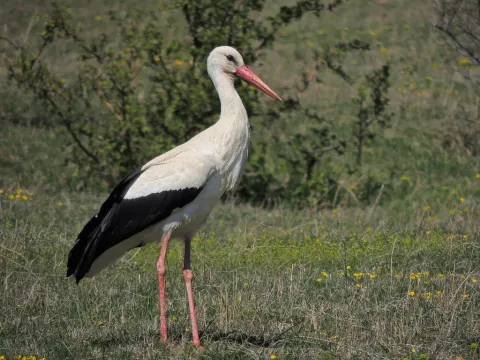
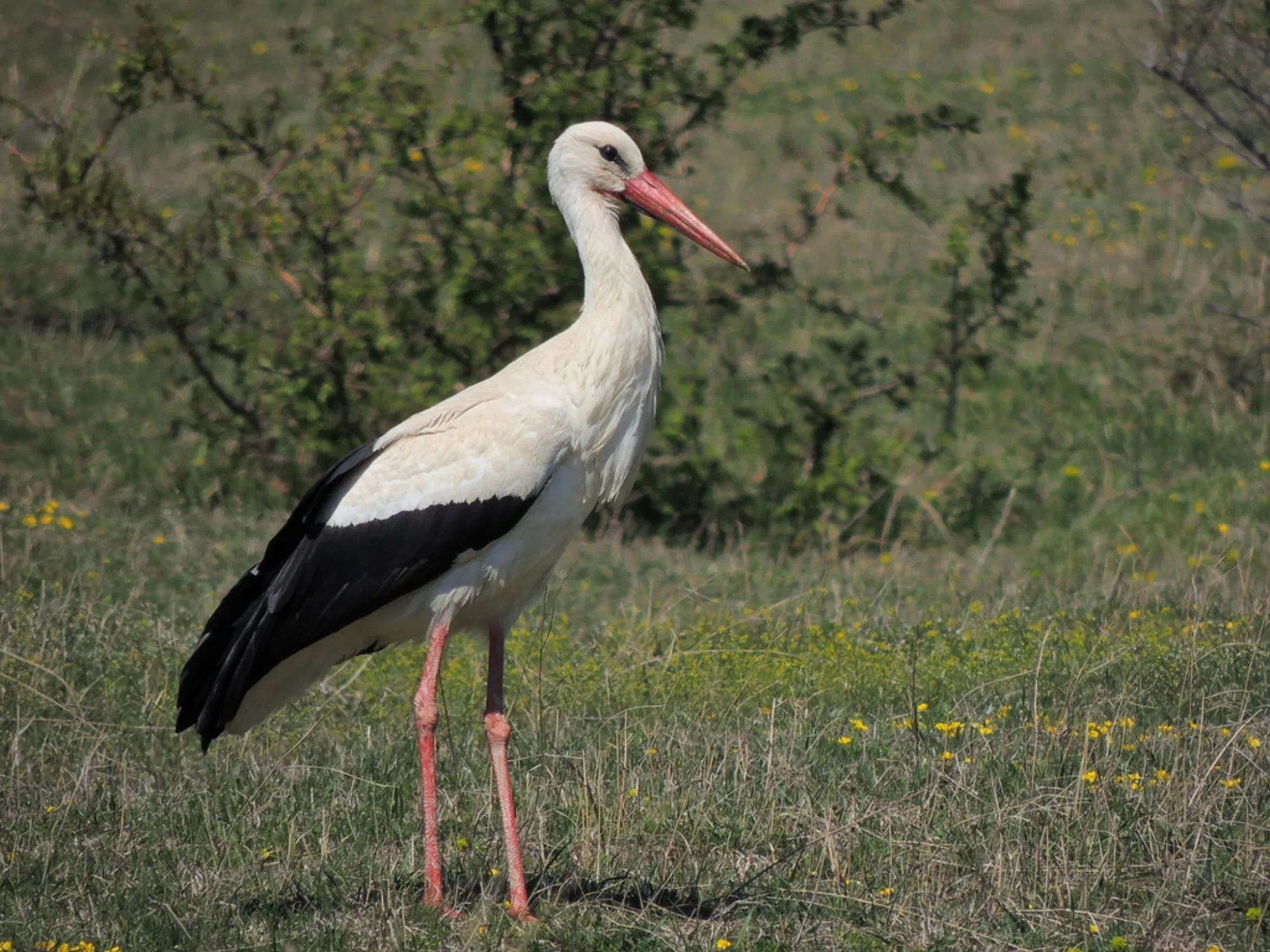
With its white body, black wings and long red legs, the White Stork (Ciconia ciconia) is a conspicuous bird on the ground. Adults have long, pointed red beaks and measure 100 to 115 cm from beak to tail, with a wingspan of 155 to 215 cm. In flight, the neck stretches forward and the legs project beyond the tail, while slow, regular wingbeats alternate with soaring. Listen, too, for the noisy clatter of an adult's beak, used in encounters with other storks.
White storks breed across parts of Europe, northwestern Africa, Asia and southern Africa, and spend the winter in Africa or on the Indian subcontinent. They favour grassy meadows, farmland and shallow wetlands, especially open grassland that is wet or periodically flooded. On migration between Europe and Africa, they travel around the Mediterranean via the Levant or the Strait of Gibraltar, relying on rising warm air to soar. Flocks can number in the thousands along migration routes and at African wintering grounds.
These birds hunt mainly by day, taking insects, earthworms, amphibians, reptiles and small mammals, among other prey, from short vegetation or shallow water. Pairs build large stick nests in trees, on buildings or on artificial platforms, often returning to a nest year after year. Both parents feed the young, which leave the nest 58 to 64 days after hatching and continue to receive food for a further 7 to 20 days. Wetland loss, collisions with overhead power lines, persistent pesticides and illegal hunting threaten the species. Rubber bands mistaken for earthworms can also cause fatal blockages, while cool, wet weather around hatching can increase chick deaths.
Written from the English Wikipedia article White stork (CC BY-SA 4.0).
- Records
- 468,867
- Countries
- 100
- Atlas places
- 24
- Serengeti National Park· Tanzania
- uKhahlamba-Drakensberg Park· South Africa
- Ngorongoro Conservation Area· Tanzania
- Kidepo Valley National Park· Uganda
- Chobe National Park· Botswana
- Etosha National Park· Namibia
- Hwange National Park· Zimbabwe
- Maasai Mara National Reserve· Kenya
- Okavango Delta· Botswana
- South Luangwa National Park· Zambia
- Volcanoes National Park· Rwanda
- Akagera National Park· Rwanda
- Amboseli National Park· Kenya
- Bwabwata National Park· Namibia
- Kruger National Park· South Africa
- Lake Manyara National Park· Tanzania
- Lake Nakuru National Park· Kenya
- Mapungubwe National Park· South Africa
- Murchison Falls National Park· Uganda
- Nairobi National Park· Kenya
- Namib-Naukluft· Namibia
- Queen Elizabeth National Park· Uganda
- Table Mountain National Park· South Africa
- Zambezi National Park· Zimbabwe
These are open occurrence records, so they show where people looked for and recorded the White Stork as much as where it lives. Cells are up to 25 km across, and every location is generalised to its cell.
Generalised encounter areas, not exact locations. Each shape is a grid cell coloured by how likely the species is there.
- Very likelySpain25 km zone · high confidence · 196179 records · updated 86 days ago
- Very likelyPortugal25 km zone · high confidence · 90419 records · updated 86 days ago
- Very likelyFrance25 km zone · high confidence · 44181 records · updated 86 days ago
- Very likelyBelgium25 km zone · high confidence · 27899 records · updated 86 days ago
- Very likelyGermany25 km zone · high confidence · 10661 records · updated 86 days ago
- Very likelySwitzerland25 km zone · high confidence · 9803 records · updated 86 days ago
- Very likelyNetherlands25 km zone · high confidence · 9491 records · updated 86 days ago
- Very likelyPalestinian Territories25 km zone · high confidence · 6823 records · updated 86 days ago
- Very likelyTürkiye25 km zone · high confidence · 6358 records · updated 86 days ago
- Very likelyMorocco25 km zone · high confidence · 5637 records · updated 86 days ago
Conservation status not assessed here yet, so every location is generalised to its grid cell.