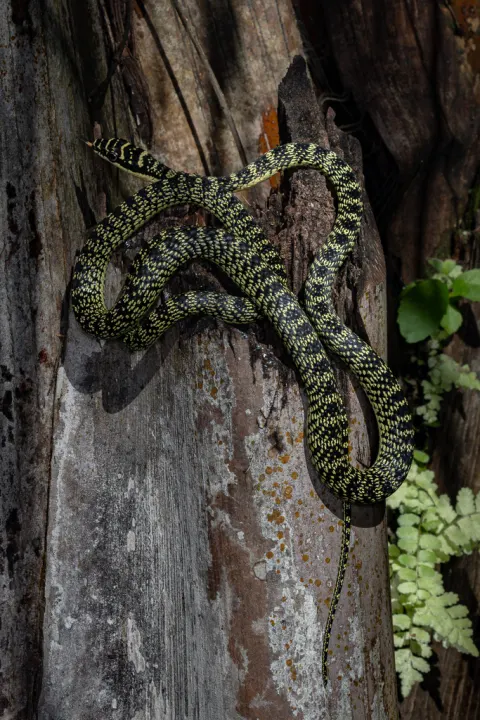
Golden Flying Snake
Chrysopelea ornata
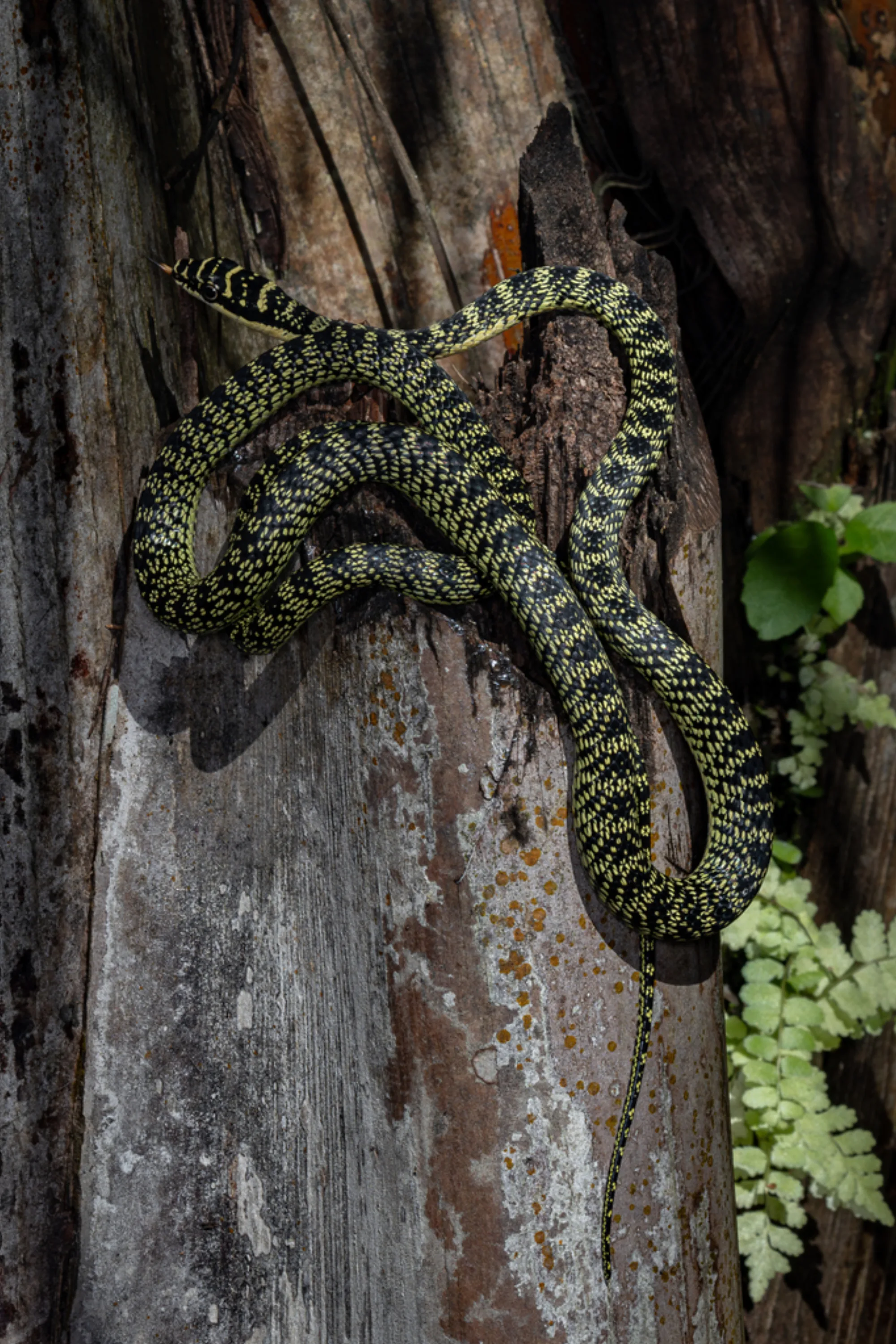
A flash of green and gold in the trees may be a Golden Flying Snake, a mildly venomous snake found across South and Southeast Asia. Its slender body is usually green, marked by a black cross-hatched pattern and touches of yellow or gold. Its head is flattened, with a blunt snout and large, round-pupilled eyes, and it can measure from 11.5 to 130 cm long. Some snakes have reddish or orange flower-shaped spots, while a form more common in Southeast Asia lacks these spots and has less prominent black crossbars.
Its range includes India, Sri Lanka, Nepal, Bangladesh, Myanmar, Thailand, Malaysia, Laos, Cambodia, Vietnam and parts of China; it has also been introduced to Singapore. It lives in forests and is well adapted to places inhabited by people. In southern Thailand, it may shelter in bungalow thatch, coconut palm crowns, beneath tree roots or in potted plants. Active by day and at home in trees, it climbs small branches, rough trunks and even vertical rock faces. It can glide between trees, sometimes travelling as far as 100 m, and may also launch from a tree to the ground. Gliding helps it pursue prey or escape predators, including birds and other reptiles. It eats small tree-dwelling animals such as lizards, bats and rodents, and may also take bird eggs and insects.
Little is known about its breeding, although females lay six to 12 elongated eggs. These fast-moving snakes tend to flee when disturbed, but may bite if handled. People sometimes kill them or cook them for food, and many are exported for the exotic pet trade. Their nervous temperament and difficulty adjusting to captivity can make survival in captivity difficult.
Written from the English Wikipedia article Chrysopelea ornata (CC BY-SA 4.0).
- Records
- 132
- Countries
- 10
- Atlas places
- 1
These are open occurrence records, so they show where people looked for and recorded the Golden Flying Snake as much as where it lives. Cells are up to 25 km across, and every location is generalised to its cell.
Generalised encounter areas, not exact locations. Each shape is a grid cell coloured by how likely the species is there.
- Very likelyThailand25 km zone · medium confidence · 81 records · updated 80 days ago
- Very likelyCambodia25 km zone · medium confidence · 17 records · updated 80 days ago
- Very likelyMyanmar (Burma)25 km zone · medium confidence · 12 records · updated 80 days ago
- Very likelyVietnam25 km zone · medium confidence · 8 records · updated 80 days ago
- LikelyIndia25 km zone · medium confidence · 7 records · updated 80 days ago
- LikelyChina25 km zone · medium confidence · 2 records · updated 80 days ago
- LikelySingapore25 km zone · medium confidence · 2 records · updated 80 days ago
- LikelyLaos25 km zone · medium confidence · 1 record · updated 80 days ago
- LikelySri Lanka25 km zone · medium confidence · 1 record · updated 80 days ago
- PossibleMalaysia25 km zone · medium confidence · 1 record · updated 80 days ago
Conservation status not assessed here yet, so every location is generalised to its grid cell.