Golden Pheasant
Chrysolophus pictus
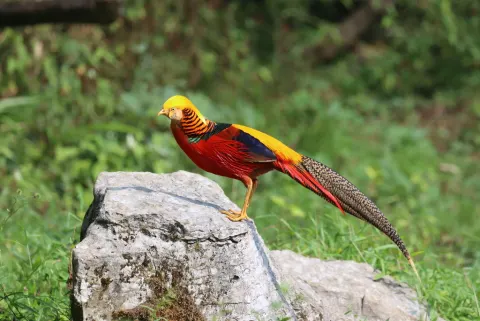
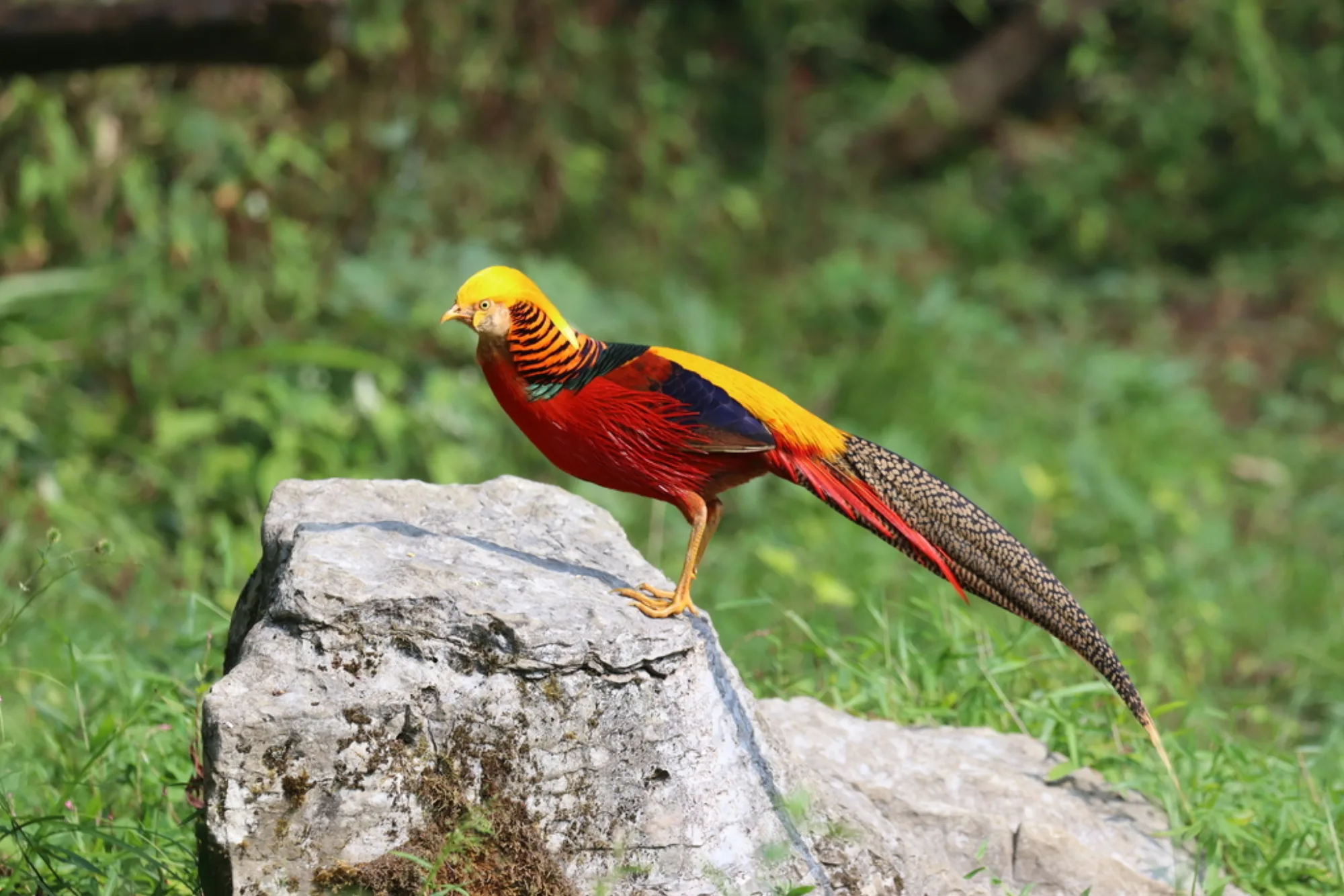
A golden crest and bright red body make the male Golden Pheasant easy to recognise when it comes into view. This gamebird also has a golden rump, green upper back and blue feathers on its wings. Its orange cape can open into a black and orange fan that covers its face apart from the eyes. An adult male is approximately 100 cm long, with the tail making up about two-thirds of that length. The female is less conspicuous, with mottled brown plumage and a buff face and throat. Both sexes have yellow legs and bills.
Native to mountain forests in western China, the species also has established feral populations in places including the United Kingdom, Canada, Australia and New Zealand. English birds occur chiefly in Norfolk and Suffolk, and the populations in Scotland have died out. On Maui, introduced birds inhabit the windward slope at elevations of 1,700 to 2,400 m. Golden Pheasants forage on the ground for grain, leaves and invertebrates, and spend much of the day there before roosting in trees at night. They can manage short, clumsy flights, but prefer to run and hide from predators. In winter, flocks forage near settlements at forest edges, eating mainly wheat leaves and seeds. Their diet also includes berries and grubs. During the breeding season, the male gives a metallic call. Females lay 8 to 12 eggs, which are incubated for around 22 to 23 days. British populations declined sharply after their high point in the 1980s and 1990s, as releases decreased and growing goshawk populations preyed on the birds.
Written from the English Wikipedia article Golden pheasant (CC BY-SA 4.0).
- Records
- 2,275
- Countries
- 11
- Atlas places
- 1
These are open occurrence records, so they show where people looked for and recorded the Golden Pheasant as much as where it lives. Cells are up to 25 km across, and every location is generalised to its cell.
Generalised encounter areas, not exact locations. Each shape is a grid cell coloured by how likely the species is there.
- Very likelyChina25 km zone · medium confidence · 1149 records · updated 80 days ago
- Very likelyUnited Kingdom25 km zone · medium confidence · 884 records · updated 80 days ago
- Very likelyUnited States25 km zone · medium confidence · 179 records · updated 80 days ago
- LikelyNew Zealand25 km zone · medium confidence · 25 records · updated 80 days ago
- LikelyCanada25 km zone · medium confidence · 17 records · updated 80 days ago
- PossibleTaiwan25 km zone · medium confidence · 7 records · updated 80 days ago
- PossibleAustralia25 km zone · medium confidence · 4 records · updated 80 days ago
- PossibleFrance25 km zone · medium confidence · 4 records · updated 80 days ago
- PossibleItaly25 km zone · medium confidence · 4 records · updated 80 days ago
- UncommonBelgium25 km zone · medium confidence · 1 record · updated 80 days ago
Conservation status not assessed here yet, so every location is generalised to its grid cell.