Maned Wolf
Chrysocyon brachyurus
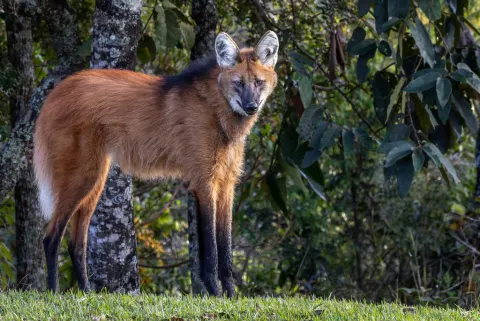
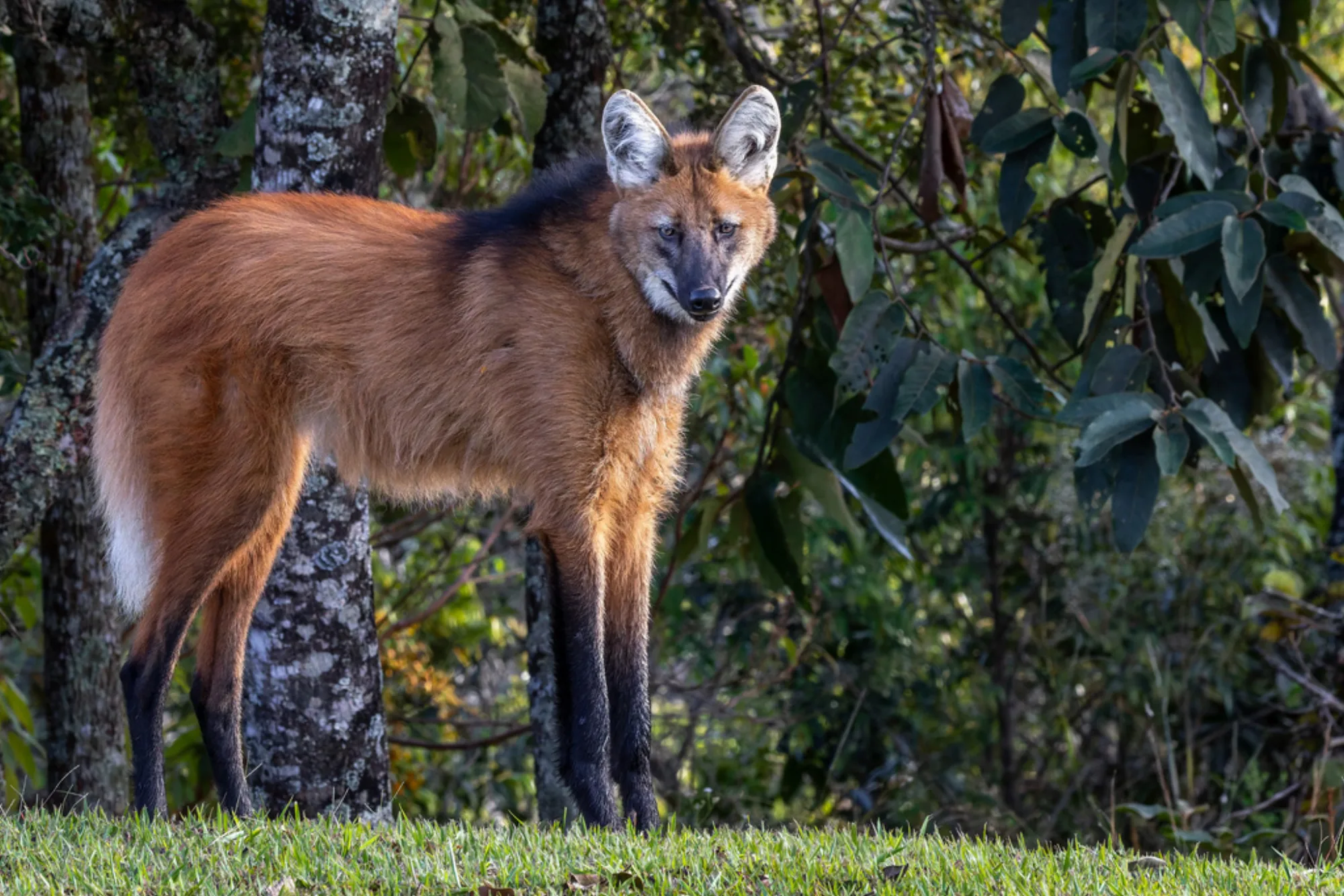
With its long black legs, large ears and reddish coat, the Maned Wolf cuts a distinctive figure in South America's open landscapes. Its markings recall a red fox, but this large canine is neither a fox nor a wolf. A black mane runs from its neck towards its shoulders, and a white tuft marks the tip of its tail. Adults weigh 20 to 30 kg and can stand 110 cm at the shoulder. The species occurs in Brazil, Paraguay, Argentina, Bolivia and far southeastern Peru, and is very rare in Uruguay. It favours open and semi-open country, particularly grasslands dotted with bushes and trees, as well as scrub prairies and forests.
Usually solitary, the Maned Wolf hunts alone, often between sundown and midnight, turning its large ears towards sounds in the grass. It also uses scent marks to communicate and gives a loud call called a roar-bark. On cold or cloudy days it may be active throughout the day, while warmer weather can send it into more sheltered areas to rest. Its varied diet includes small mammals, birds, insects, roots and fruit, with the tomato-like wolf apple its most common food. By passing intact seeds, it helps disperse the plants whose fruits it eats. Litters usually contain two to six dark-furred pups, which depend on their parents for food during their first year. Habitat loss, traffic and diseases passed on by domestic and feral dogs all threaten the species, and dogs can also attack it. In some places, farmers retaliate when maned wolves prey on domestic birds.
Written from the English Wikipedia article Maned wolf (CC BY-SA 4.0).
- Records
- 282
- Countries
- 2
- Atlas places
- 3
These are open occurrence records, so they show where people looked for and recorded the Maned Wolf as much as where it lives. Cells are up to 25 km across, and every location is generalised to its cell.
Generalised encounter areas, not exact locations. Each shape is a grid cell coloured by how likely the species is there.
- Very likelyArgentina25 km zone · medium confidence · 209 records · updated 80 days ago
- Very likelyBrazil25 km zone · medium confidence · 73 records · updated 80 days ago
Conservation status not assessed here yet, so every location is generalised to its grid cell.