Painted Turtle
Chrysemys picta
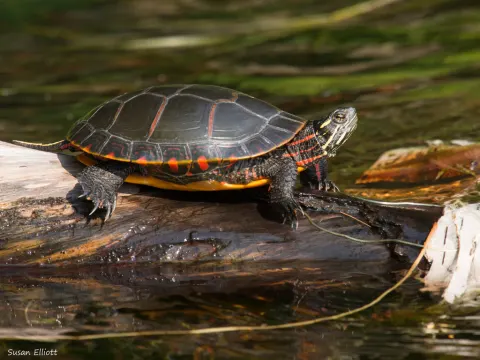
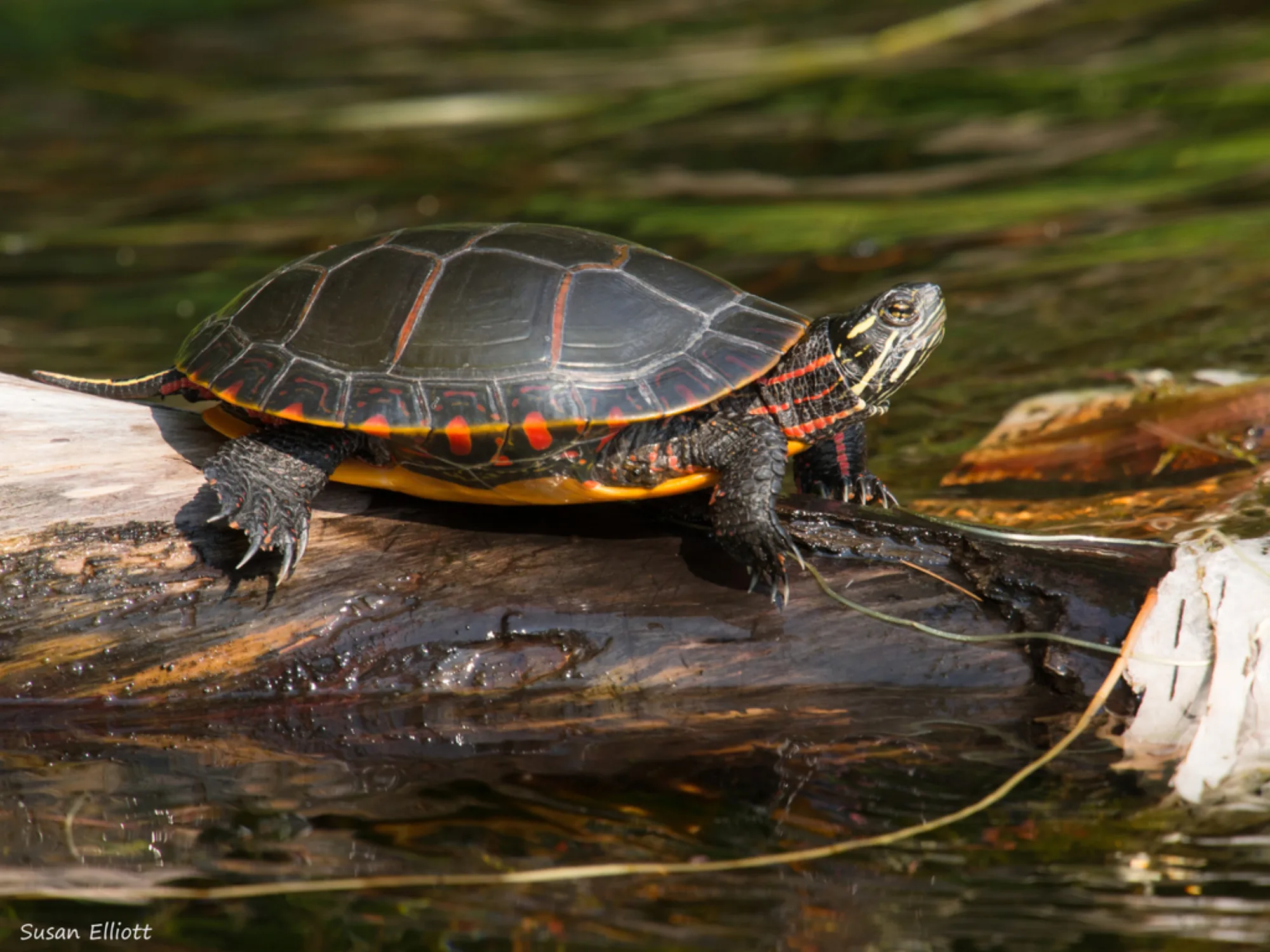
Look for the Painted Turtle on a log or rock beside quiet freshwater, where it may spend hours basking in the sun. This North American pond turtle has a smooth, dark upper shell and olive to black skin, marked with red, orange or yellow stripes. Its face has yellow stripes and a yellow spot behind each eye. Adults are 13 to 25 cm long, with males generally smaller than females.
The turtle ranges between the Atlantic and Pacific coasts, reaching southern Canada in the north and northern Mexico in the south. It favours slow, shallow water, including marshes, creeks, ponds and lake shores, with soft bottoms, aquatic plants and places to bask. Large wetlands with emergent vegetation and long periods of inundation are favoured too. During the day, turtles warm themselves out of the water before returning to feed. They eat aquatic plants and algae as well as insects, crustaceans and fish, and can find prey even in cloudy water. Young turtles eat mostly animals, becoming more herbivorous as they grow. In winter, they usually spend an inactive period in mud at the bottom of the water, although some southern populations may remain active.
Painted turtles mate in spring and autumn, and females dig nests on land between late spring and midsummer. Some hatchlings spend winter in the nest and emerge the following spring. Eggs and young turtles are vulnerable to many predators, while the hard shells of adults offer protection, though raccoons and other animals still prey on them. Loss of habitat and deaths on roads have lowered the population, although the turtle can also live in places disturbed by people.
Written from the English Wikipedia article Painted turtle (CC BY-SA 4.0).
- Records
- 5,605
- Countries
- 2
- Atlas places
- 3
These are open occurrence records, so they show where people looked for and recorded the Painted Turtle as much as where it lives. Cells are up to 25 km across, and every location is generalised to its cell.
Generalised encounter areas, not exact locations. Each shape is a grid cell coloured by how likely the species is there.
- Very likelyUnited States25 km zone · high confidence · 5033 records · updated 80 days ago
- Very likelyCanada25 km zone · medium confidence · 572 records · updated 80 days ago
Conservation status not assessed here yet, so every location is generalised to its grid cell.