Owston's Palm Civet
Chrotogale owstoni
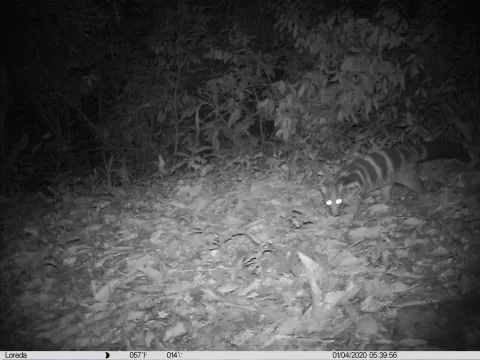
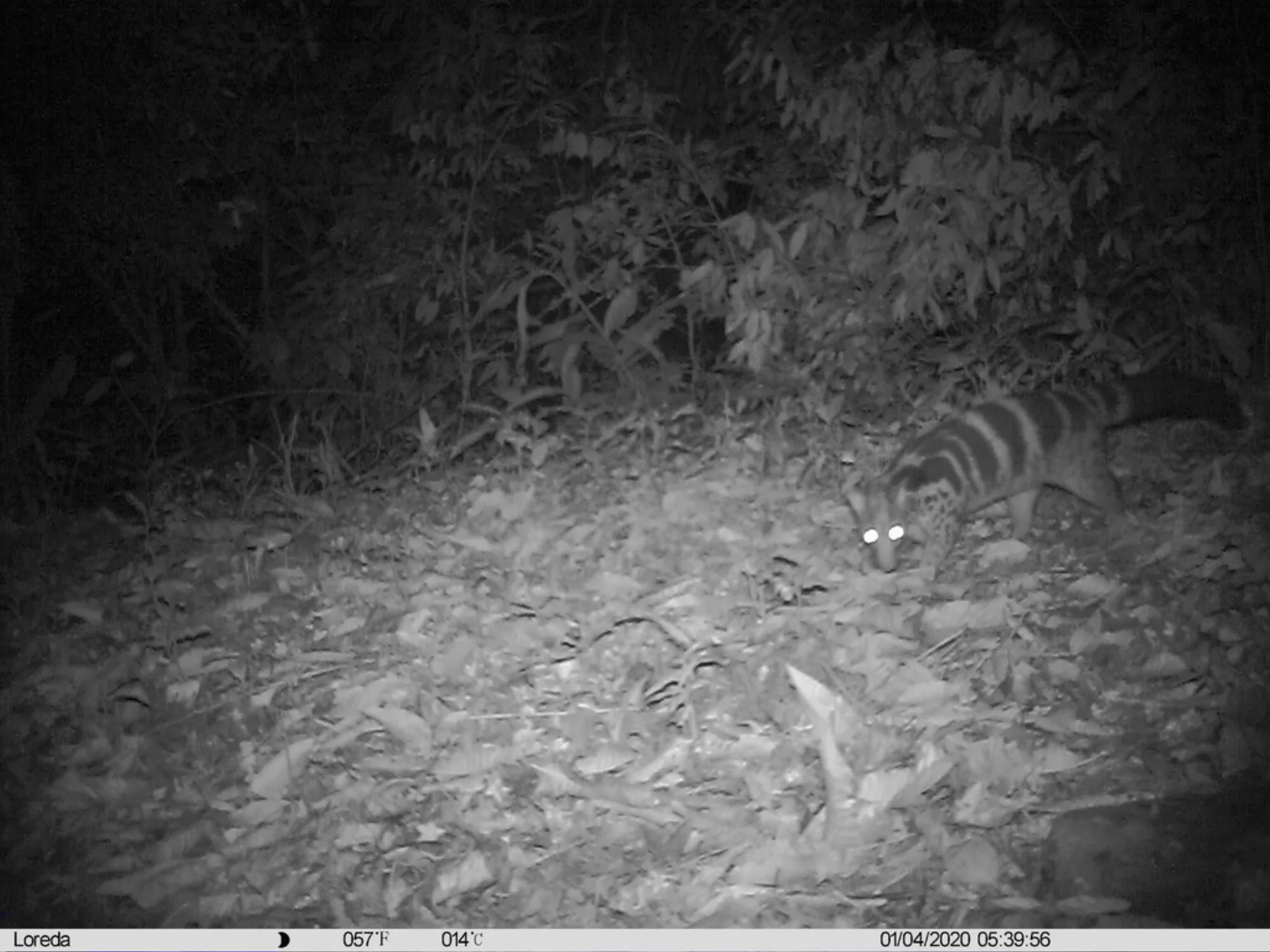
Defined by its striking appearance, the Owston's palm civet is a slender viverrid marked by a buff-grey body and four bold black bands across its back. These dark stripes stretch from the eyes to the start of the tail, which is itself solid black for the final two-thirds of its length. This mid-sized mammal measures 57 cm with a 43 cm tail and weighs between 1.8 and 2.7 kg. While both sexes share similar markings, females feature orange fur on their lower bellies, while males display an orange patch on their chests.
This species is native to the lowland evergreen forests of Laos, Vietnam, and a small area of southern China. It prefers moist tropical and subtropical environments, including limestone forests, and is never found west of the Mekong River. Primarily terrestrial and solitary, these civets are active during the night. They spend much of their time on the forest floor searching for fruits and soft-bodied prey such as earthworms and insects, though they occasionally climb into trees to sleep.
Populations are currently declining due to habitat destruction and hunting. Although they are not always the primary target, many animals are killed by snares meant for other mammals. In some regions, hundreds of these traps are set per kilometer to meet the urban demand for wild meat. Because the species is slow to mature, taking up to 24 months to reach sexual maturity, the impact of over-exploitation is severe. Conservation efforts now focus on reducing snaring and establishing captive populations for future release.
Written from the English Wikipedia article Owston's palm civet (CC BY-SA 4.0).
- Atlas places
- 0
These are open occurrence records, so they show where people looked for and recorded the Owston's Palm Civet as much as where it lives. Cells are up to 25 km across, and every location is generalised to its cell.
No encounter zones yet
Where and when you can expect to see Owston's Palm Civet is calculated from observation density. No zones have been computed for this species yet.