Clown Loach
Chromobotia macracanthus
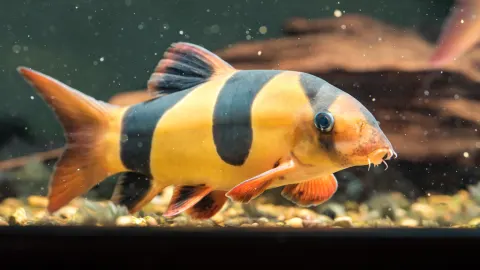
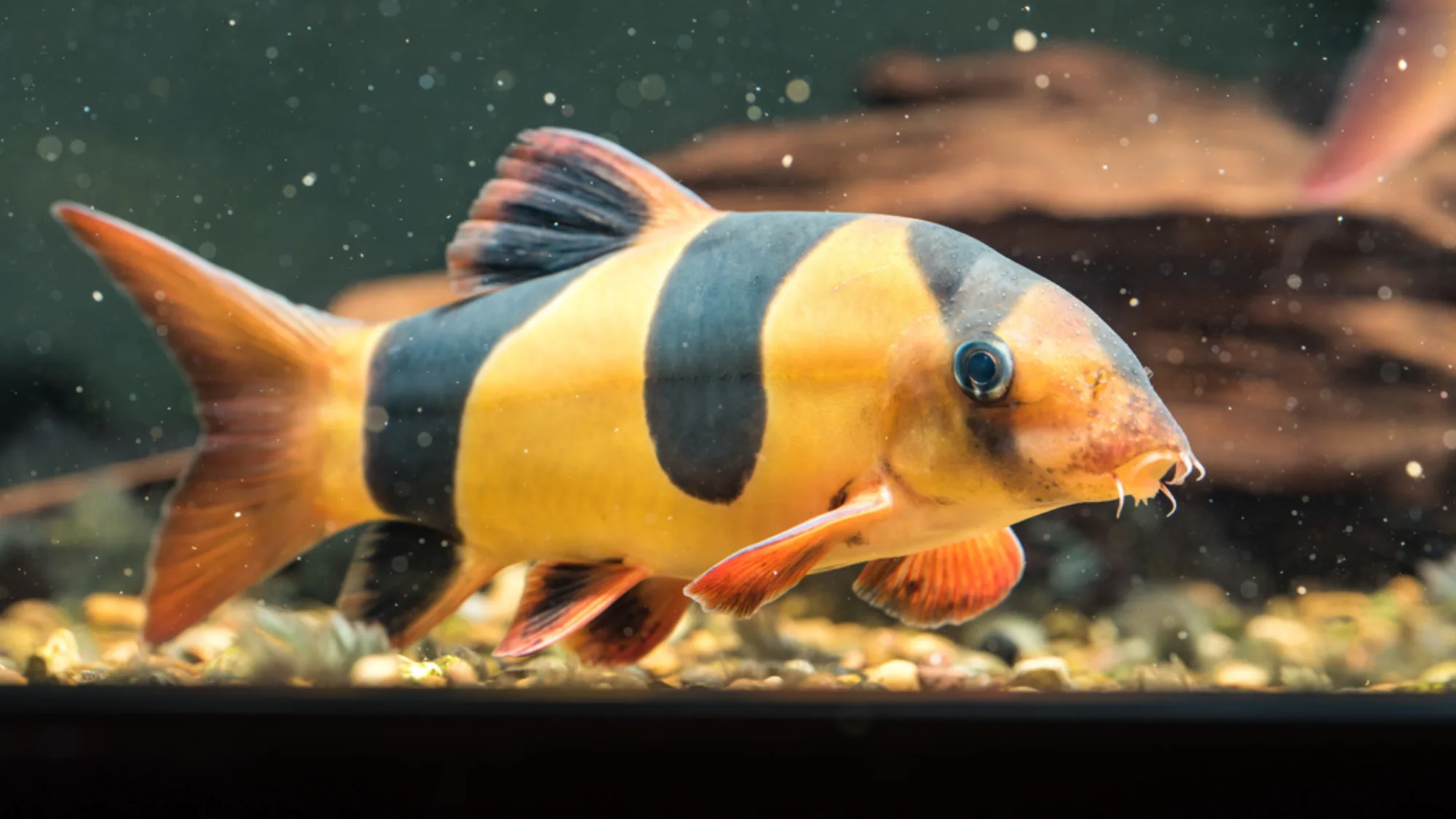
Found in the inland waters of Sumatra and Borneo, these tropical freshwater fish are easily identified by their striking orange bodies marked with three thick, black, vertical bands. The Clown Loach has a long, compressed shape and a large head with four pairs of barbels around a downward-facing mouth. On the islands of Borneo, their pelvic fins show a mix of black and reddish-orange, while fish from Sumatra have entirely reddish-orange fins. Travellers should watch for a movable spine hidden in a groove beneath the eye, which the fish can extend as a defence mechanism. Though they typically reach 15 to 20 cm in length, some wild specimens can grow as large as 40 to 50 cm. These long-lived fish can survive for up to 30 years.
In their native Indonesian habitat, these fish prefer clear streams but move into murky rivers or flooded plains for 7 to 8 months of the year during monsoon seasons. They are active in subdued light and often seek shade or cover to rest during the day. Their diet consists of worms, crustaceans, and plant matter, and they are known to eat bladder snails. They are social creatures that produce audible clicking sounds by grinding their teeth when they are being territorial or happy. Sometimes they exhibit odd behaviours like swimming on their sides or upside down, which is normal for the species. While they are popular worldwide, they face threats from over-exploitation, which has led to new conservation efforts and the development of artificial breeding techniques.
Written from the English Wikipedia article Clown loach (CC BY-SA 4.0).
- Atlas places
- 0
These are open occurrence records, so they show where people looked for and recorded the Clown Loach as much as where it lives. Cells are up to 25 km across, and every location is generalised to its cell.
No encounter zones yet
Where and when you can expect to see Clown Loach is calculated from observation density. No zones have been computed for this species yet.
Conservation status not assessed here yet, so every location is generalised to its grid cell.