Black-headed Gull
Chroicocephalus ridibundus
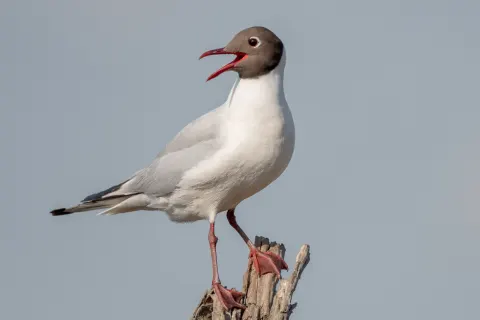
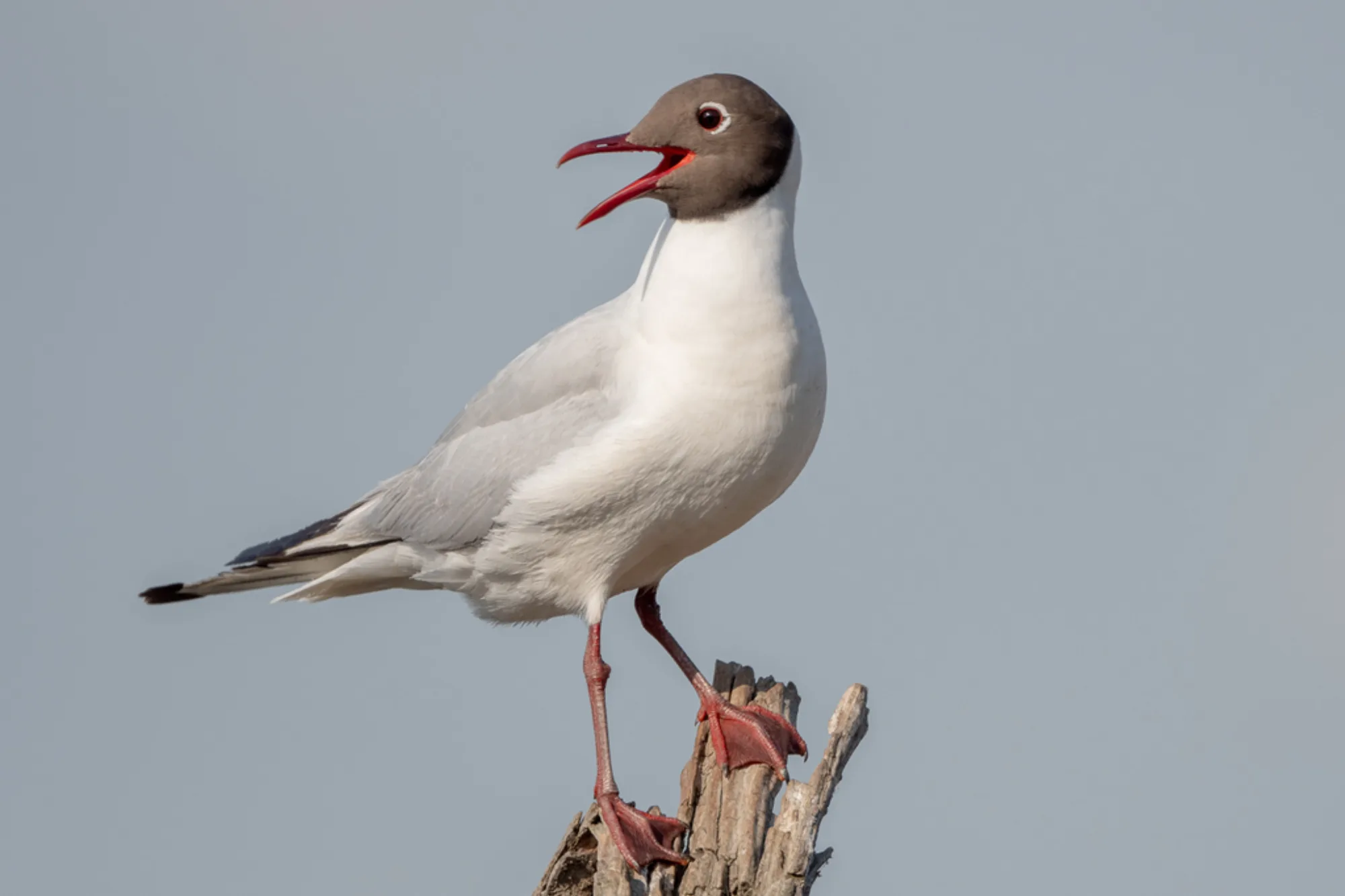
In summer, the Black-headed Gull wears a chocolate-brown hood that can look black at a distance, along with a red bill and legs. This small gull has a white neck, belly and tail, a pale grey back and wings, and black wing tips. In winter the hood disappears, leaving a pair of dark marks above and behind each eye. Look for the white front edge of the outer wing in flight. Young birds start out mottled brown, with a black band on the tail, and take two years to reach maturity.
The species breeds from Iceland and Ireland across Europe and northern Asia to Japan and eastern China, as well as locally in coastal eastern Canada. Many migrate south and west for winter, reaching northern Africa and southern Asia, while others remain in milder parts of northwestern Europe. It nests on the ground in colonies in reed beds, marshes and on lake islands, but is rarely seen far out at sea. In winter it gathers with other gulls to feed and roost, and its calls are especially noisy around breeding colonies.
An opportunistic feeder, it takes insects, fish, seeds, worms, scraps and carrion, as well as invertebrates in ploughed fields. Parents remove eggshells after hatching, helping to conceal the nest from predators, and feed their chicks by bringing up food onto the ground. Eggs can be taken by birds, foxes, stoats and other Black-headed Gulls, which can also take newly hatched chicks. Avian influenza has also caused heavy losses: an outbreak in 2023 killed over 4,000 in Great Britain by early May, with similarly high mortality reported in several other European countries.
Written from the English Wikipedia article Black-headed gull (CC BY-SA 4.0).
- Records
- 1,777,178
- Countries
- 140
- Atlas places
- 15
- Ngorongoro Conservation Area· Tanzania
- Queen Elizabeth National Park· Uganda
- Dorob National Park· Namibia
- Koshi Tappu Wildlife Reserve· Nepal
- Lake Manyara National Park· Tanzania
- Table Mountain National Park· South Africa
- Aberdare National Park· Kenya
- Annapurna Conservation Area· Nepal
- Chitwan National Park· Nepal
- Hell's Gate National Park· Kenya
- Lake Nakuru National Park· Kenya
- Murchison Falls National Park· Uganda
- Nairobi National Park· Kenya
- Namib-Naukluft· Namibia
- Walvis Bay· Namibia
These are open occurrence records, so they show where people looked for and recorded the Black-headed Gull as much as where it lives. Cells are up to 25 km across, and every location is generalised to its cell.
Generalised encounter areas, not exact locations. Each shape is a grid cell coloured by how likely the species is there.
- Very likelyUnited Kingdom25 km zone · high confidence · 628454 records · updated 86 days ago
- Very likelyNorway25 km zone · high confidence · 168833 records · updated 86 days ago
- Very likelyBelgium25 km zone · high confidence · 151460 records · updated 86 days ago
- Very likelyFinland25 km zone · high confidence · 143373 records · updated 86 days ago
- Very likelyFrance25 km zone · high confidence · 105787 records · updated 86 days ago
- Very likelySpain25 km zone · high confidence · 70437 records · updated 86 days ago
- Very likelyDenmark25 km zone · high confidence · 61159 records · updated 86 days ago
- Very likelyPortugal25 km zone · high confidence · 56180 records · updated 86 days ago
- Very likelyIceland25 km zone · high confidence · 29803 records · updated 86 days ago
- Very likelyNetherlands25 km zone · high confidence · 29621 records · updated 86 days ago
Conservation status not assessed here yet, so every location is generalised to its grid cell.