Pygmy Hippopotamus
Choeropsis liberiensis
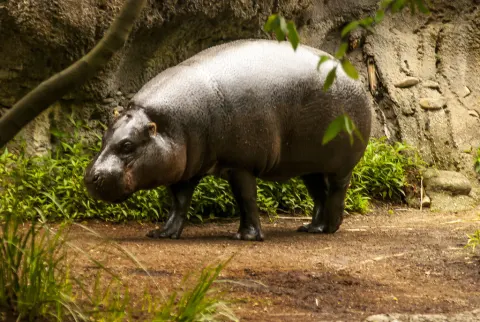
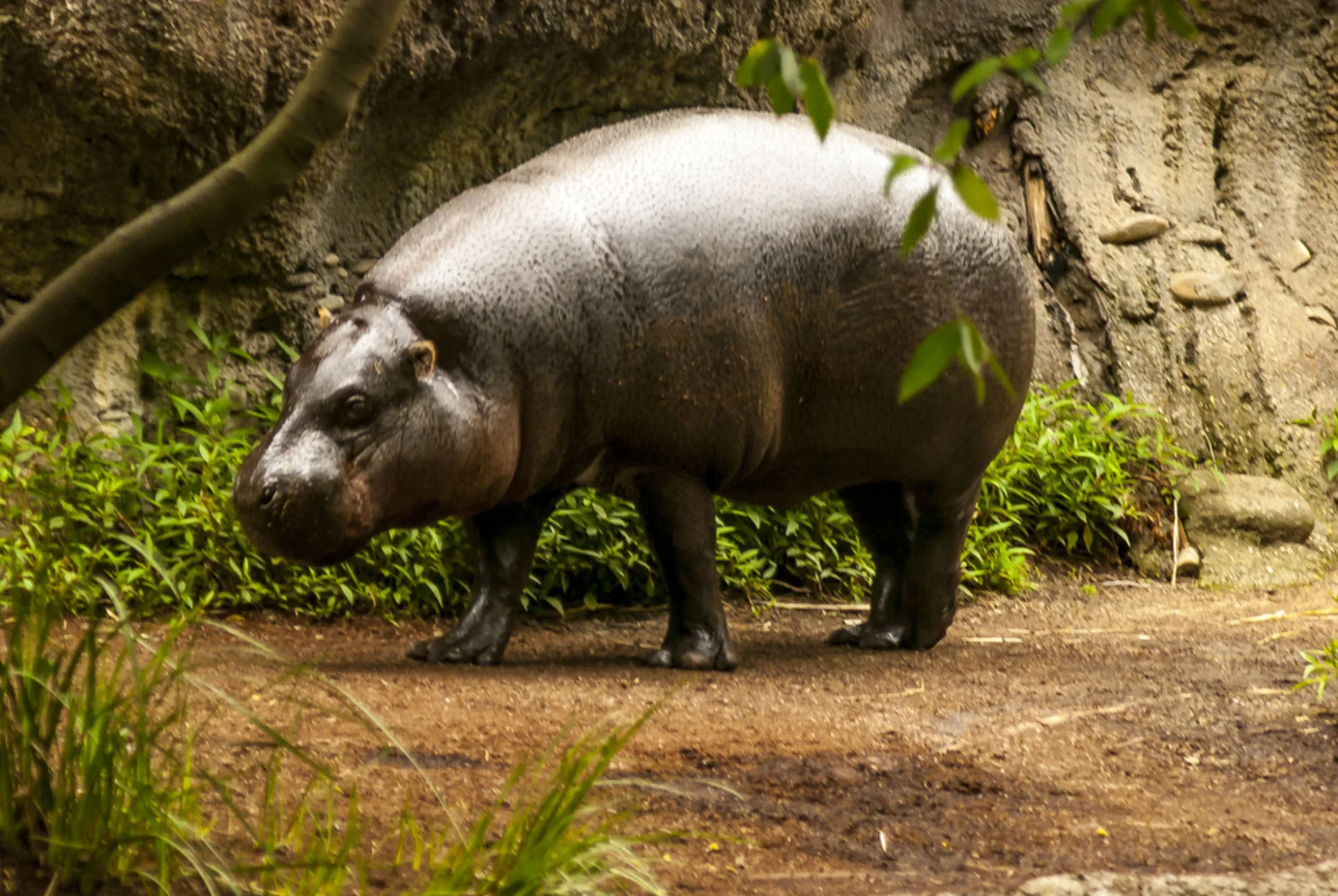
A glimpse of a Pygmy Hippopotamus reveals a compact, round-bodied animal on four short legs, with a back that slopes forward. Its skin is greenish-black or brown, fading to creamy grey underneath. Adults stand about 75 to 100 cm at the shoulder and weigh 180 to 275 kg, far less than their common hippopotamus relatives. This shy, nocturnal animal lives chiefly in Liberia's forests and swamps, with smaller groups found elsewhere in West Africa, including Guinea, Ivory Coast and Sierra Leone. Water helps it stay cool and prevents its skin from drying out.
Pygmy hippos usually live alone or in small groups, often a pair or a mother with her calf. They spend much of the day concealed in rivers, sometimes using hollows or burrows in the banks. At dusk they leave the water to feed, following animal trails through dense forest. Their diet includes ferns, broad-leaved plants, shoots, sedges and fruit fallen on the forest floor. A single calf is usually born, although twins occur, and birth can take place on land or in water. Before weaning, a calf stays hidden in the water while its mother forages, and she returns to nurse it.
The greatest threat to wild pygmy hippos is habitat loss, as forests are logged, settled and cleared for agriculture. Shrinking forests also divide populations, reducing the genetic diversity available to breeding animals. In Liberia, pygmy hippos are illegally hunted for food, while young animals face predators including leopards, West African crocodiles and Central African rock pythons.
Written from the English Wikipedia article Pygmy hippopotamus (CC BY-SA 4.0).
- Records
- 0
- Countries
- 2
No atlas park has a record of the Pygmy Hippopotamus in or around it yet.
These are open occurrence records, so they show where people looked for and recorded the Pygmy Hippopotamus as much as where it lives. Cells are up to 25 km across, and every location is generalised to its cell.
Generalised encounter areas, not exact locations. Each shape is a grid cell coloured by how likely the species is there.
- Very likelyLiberia25 km zone · low confidence · 0 records · updated 80 days ago
Conservation status not assessed here yet, so every location is generalised to its grid cell.