Dryas Monkey
Chlorocebus dryas
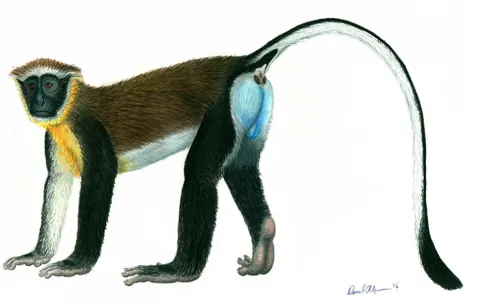
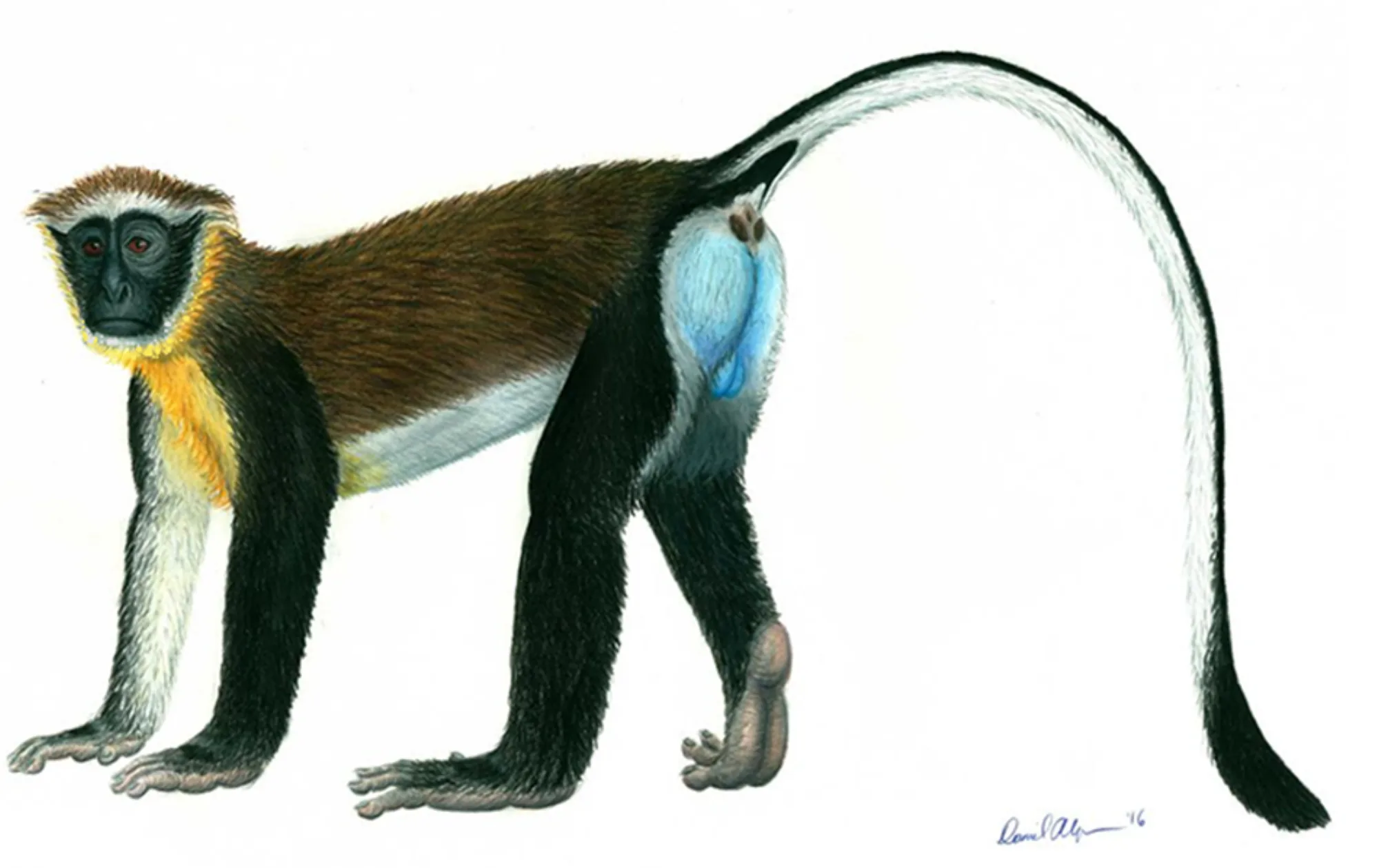
Often referred to as the Salonga monkey or ekele, the Dryas Monkey is a little-known primate found exclusively within the Congo Basin. These animals live only on the left bank of the Congo River, where they favor secondary forests, though they also venture into swampy regions, lowlands, and riverside areas. Small in stature, adults typically measure between 40 and 55 cm with a long tail. They are distinguished by a dark muzzle and a short, white beard. While males have a grayish chestnut back and white buttocks, females and their young lack these white patches on the rear and shoulders.
These social monkeys move through the trees on all four limbs, forming groups of up to 30 individuals. Each troop usually contains many females and their offspring but only a single male. To communicate, they use vocalizations and distinct visual signals; for instance, a monkey might stare with its eyebrows raised or bob its head as a sign of aggression. Their diet consists primarily of seasonal plant life, such as flowers, fruits, and fresh leaves. When these items are scarce, they supplement their meals with small invertebrates like insects.
Estimates suggest the total population may be fewer than 200 individuals, though their rare nature makes exact counting difficult. While some live in the Kokolopori Reserve and Lomami National Park, they face significant pressure from human activities. Logging leads to habitat loss, and the species is frequently poached for its meat. A general lack of information about these primates further complicates efforts to protect them from these dangers in the wild, where they typically live for 10 to 15 years.
Written from the English Wikipedia article Dryas monkey (CC BY-SA 4.0).
- Records
- 5
- Countries
- 1
- Atlas places
- 0
These are open occurrence records, so they show where people looked for and recorded the Dryas Monkey as much as where it lives. Cells are up to 25 km across, and every location is generalised to its cell.
Generalised encounter areas, not exact locations. Each shape is a grid cell coloured by how likely the species is there.
- Very likelyCongo - Kinshasa50 km zone · medium confidence · 5 records · updated 1 day ago