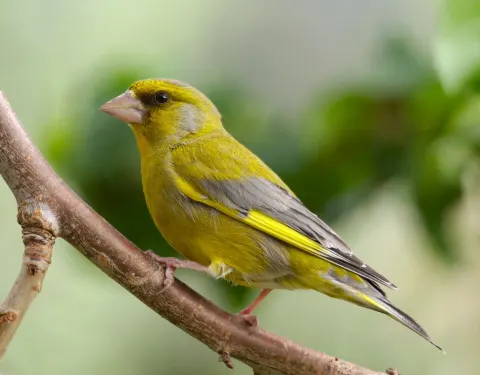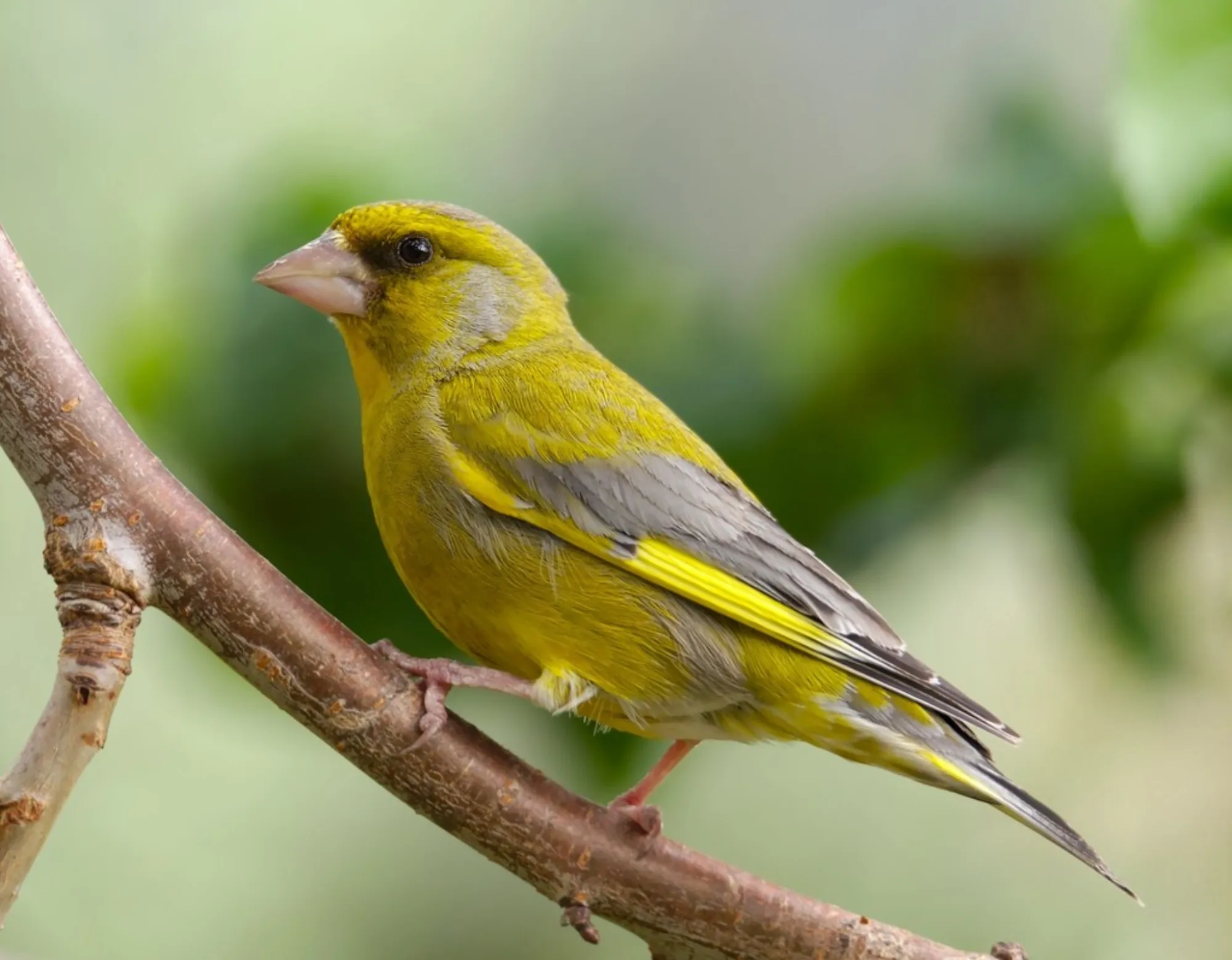
European Greenfinch
Chloris chloris
Look for the European Greenfinch in gardens, farmland hedges and along woodland edges, particularly where vegetation is thick. This small finch resembles a house sparrow in build and size, but has mainly green plumage, with yellow in its wings and tail. Females and young birds are duller, with brown tones on their backs, and the bird has a thick, conical bill. Its song mixes trills and twittering with wheezes, while the male also makes a display flight described as butterfly-like.
The species is widespread across Europe, North Africa and Southwest Asia, and has been introduced to Australia, New Zealand, Uruguay and Argentina. Most birds stay in the same area year-round, although some populations from the far north move south. Greenfinches search for food in trees and bushes as well as on the ground. They eat a wide range of seeds, along with fruit, berries, flowers, buds and some arthropods. During the breeding season, the female builds a nest in a tree or bush, accompanied by the male. She incubates the eggs while he brings her food, and both adults feed the chicks. A pair produces two or three broods each year.
Disease has taken a toll on greenfinches in parts of their range. In Great Britain, dead greenfinches found from 2005 onwards were infected with the parasite Trichomonas gallinae, and the disease later spread to other European countries. In Great Britain, greenfinch numbers fell to roughly 2.8 million, having stood at about 4.3 million. Finland saw a similar decline after the disease arrived in 2008.
Written from the English Wikipedia article European greenfinch (CC BY-SA 4.0).
- Records
- 1,406,198
- Countries
- 80
No atlas park has a record of the European Greenfinch in or around it yet.
These are open occurrence records, so they show where people looked for and recorded the European Greenfinch as much as where it lives. Cells are up to 25 km across, and every location is generalised to its cell.
Generalised encounter areas, not exact locations. Each shape is a grid cell coloured by how likely the species is there.
- Very likelyNorway25 km zone · high confidence · 287155 records · updated 86 days ago
- Very likelyFinland25 km zone · high confidence · 221561 records · updated 86 days ago
- Very likelyUnited Kingdom25 km zone · high confidence · 175951 records · updated 86 days ago
- Very likelySpain25 km zone · high confidence · 120373 records · updated 86 days ago
- Very likelySweden25 km zone · high confidence · 109262 records · updated 86 days ago
- Very likelyPortugal25 km zone · high confidence · 99153 records · updated 86 days ago
- Very likelyFrance25 km zone · high confidence · 80935 records · updated 86 days ago
- Very likelyBelgium25 km zone · high confidence · 73684 records · updated 86 days ago
- Very likelyNew Zealand25 km zone · high confidence · 27356 records · updated 86 days ago
- Very likelyPalestinian Territories25 km zone · high confidence · 20540 records · updated 86 days ago
Conservation status not assessed here yet, so every location is generalised to its grid cell.