Frill Shark
Chlamydoselachus anguineus
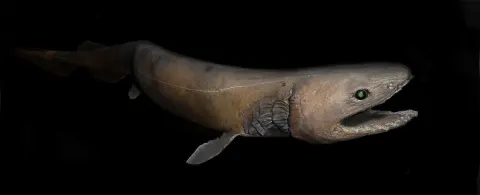
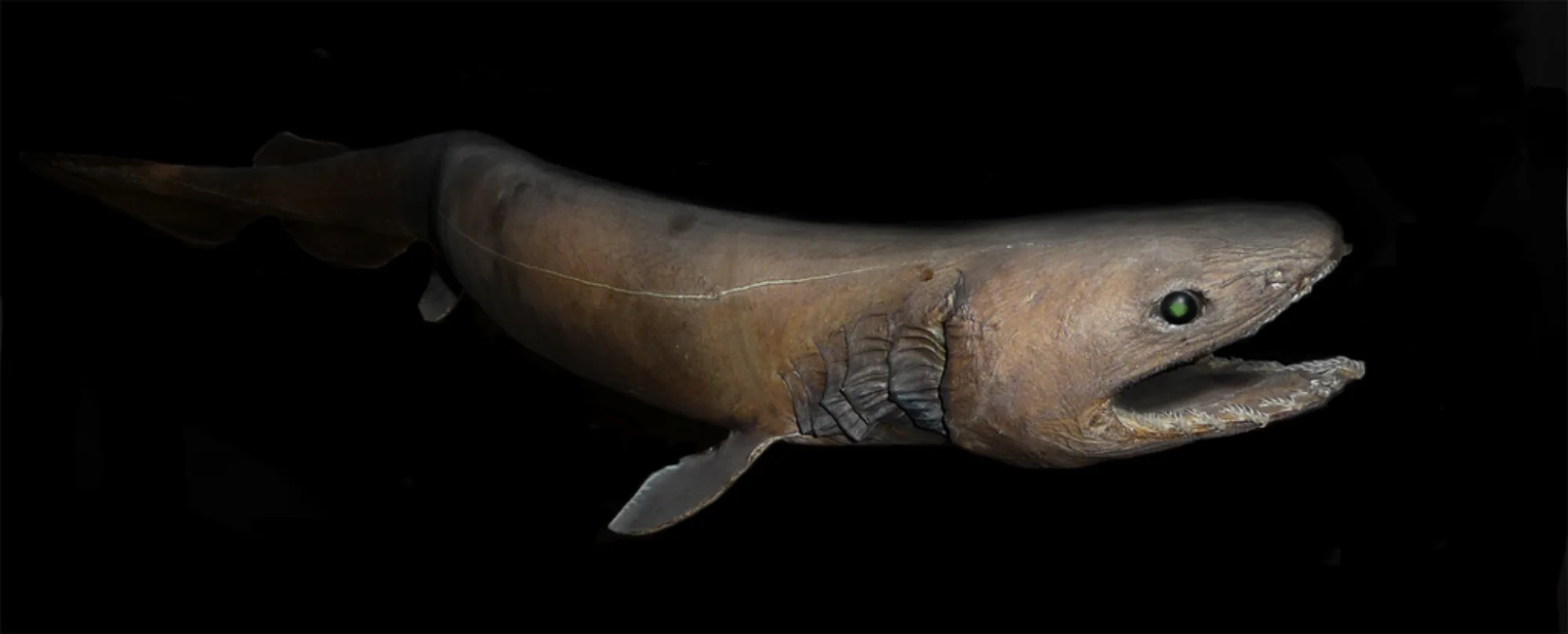
With its long, eel-like body and fringed throat, the Frill Shark looks unlike many sharks a traveller might expect to see. Its skin ranges from dark brown to grey, and its broad, flat head has a short, rounded snout. Six pairs of gill slits give it its frilled appearance, while several fins sit towards the tail. Females have been recorded at up to 2.0 m long.
Frill Sharks occur in parts of the Atlantic and Pacific, from waters off northern Norway and western Ireland to those around Japan, New Zealand and California. They favour productive waters along the outer continental shelf and continental slope, usually staying close to the seabed. In Japan's Suruga Bay, they are most common at depths of 50 to 200 m, but move into deeper, cooler water when the upper water warms between August and November. They tend to live alone, although a large catch over a Mid-Atlantic Ridge seamount included more than 30 individuals.
The sharks eat squid and other cephalopods, as well as smaller sharks and bony fish, and may rise to the surface to feed at night. They can bend and lunge like an eel, swallowing prey whole with the help of long jaws and needle-like teeth. There is no distinct breeding season, and embryos develop inside the mother, feeding on yolk before birth. Pregnancy can last up to 3.5 years, with litters of 2 to 15 pups. Commercial fishing catches Frill Sharks accidentally in trawl nets, gillnets and longlines. Overfishing can also deplete their food sources, while their slow reproduction adds to the pressure.
Written from the English Wikipedia article Frilled shark (CC BY-SA 4.0).
- Records
- 28
- Countries
- 5
No atlas park has a record of the Frill Shark in or around it yet.
These are open occurrence records, so they show where people looked for and recorded the Frill Shark as much as where it lives. Cells are up to 25 km across, and every location is generalised to its cell.
Generalised encounter areas, not exact locations. Each shape is a grid cell coloured by how likely the species is there.
- Very likelyAustralia25 km zone · medium confidence · 22 records · updated 80 days ago
- PossibleNew Zealand25 km zone · medium confidence · 3 records · updated 80 days ago
- PossibleTaiwan25 km zone · medium confidence · 3 records · updated 80 days ago
- UncommonNamibia25 km zone · low confidence · 0 records · updated 80 days ago
- UncommonUnited Kingdom25 km zone · low confidence · 0 records · updated 80 days ago
Conservation status not assessed here yet, so every location is generalised to its grid cell.