Frilled Lizard
Chlamydosaurus kingii
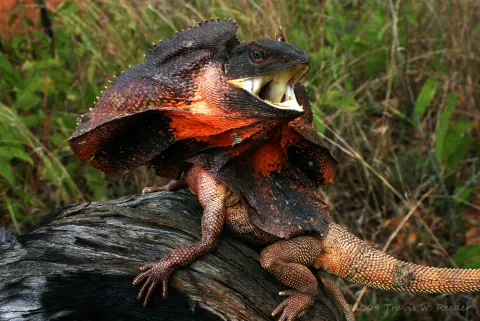
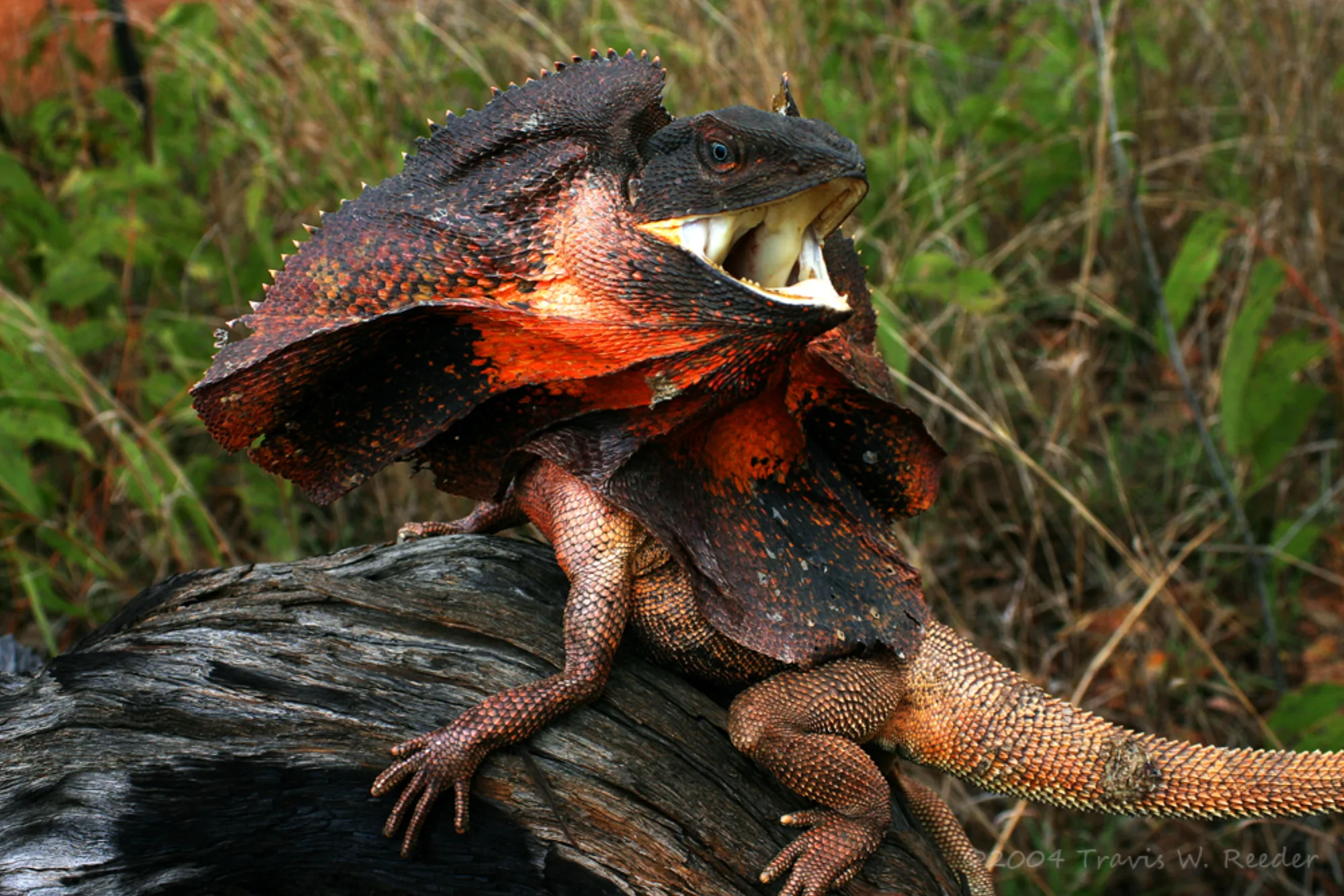
A folded collar can make the Frilled Lizard look almost understated as it rests on a tree. When spread, that frill forms a disc around 30 cm across, with colours ranging from red and orange to yellow or white. Its body may be grey, brown, orangish-brown or black, and its long tail accounts for most of its length. From head to tail tip, it can reach 90 cm, with males larger than females.
The species lives in northern Australia and southern New Guinea, mainly in savannahs and sclerophyll woodlands. It favours elevated, well-drained places with a variety of trees, mostly eucalypts, and relatively little vegetation on the ground. Active by day, it spends most of its time in trees, coming down to feed, interact with other lizards or move to another tree. Sightings near the ground are more likely during the wet season, when the lizard is more active. In the dry season it uses larger trees and stays higher up, seeking shade in the canopy as the day gets hotter.
From a tree, it watches for insects and other small invertebrates, then climbs down and runs towards its prey on two legs. Termites are particularly important food in the dry season, while moth larvae become important in the wet season. If threatened by a bird of prey, larger lizard or snake, it can spread its frill, gape, hiss and lash its tail, or flee and hide. Breeding takes place in the late dry and early wet seasons, and females lay eggs in shallow cavities they dig. Some wild populations may be threatened by collection for the pet trade, and feral cats may also pose a threat.
Written from the English Wikipedia article Frilled lizard (CC BY-SA 4.0).
- Records
- 1,761
- Countries
- 2
- Atlas places
- 3
These are open occurrence records, so they show where people looked for and recorded the Frilled Lizard as much as where it lives. Cells are up to 25 km across, and every location is generalised to its cell.
Generalised encounter areas, not exact locations. Each shape is a grid cell coloured by how likely the species is there.
- Very likelyAustralia25 km zone · medium confidence · 1737 records · updated 80 days ago
- Very likelyPapua New Guinea25 km zone · medium confidence · 24 records · updated 80 days ago
Conservation status not assessed here yet, so every location is generalised to its grid cell.