Jamaican Boa
Chilabothrus subflavus
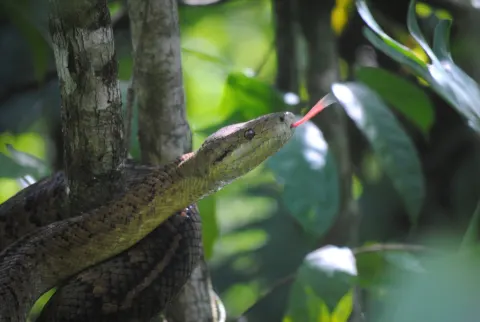
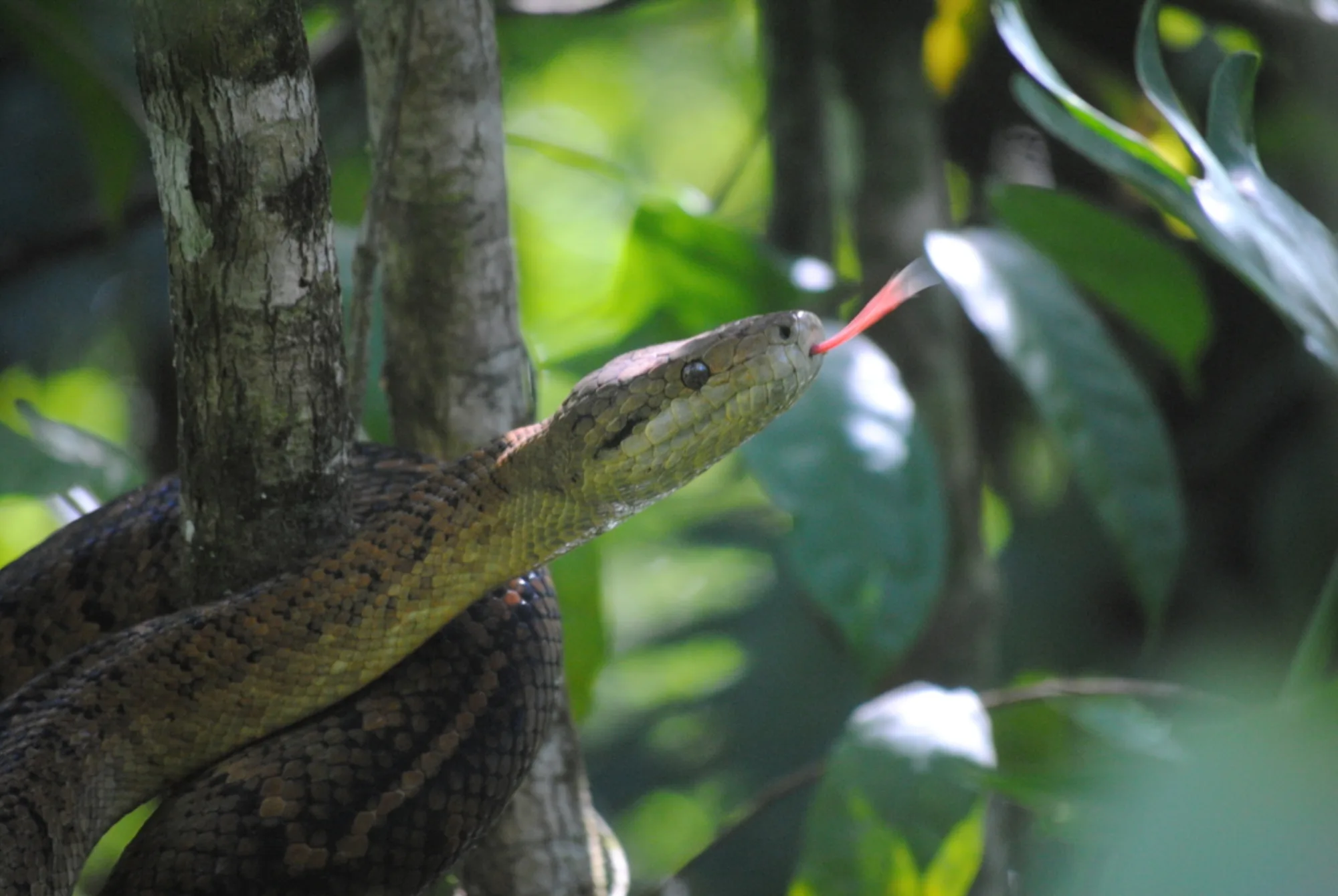
Reaching lengths of up to 2 metres, the Jamaican boa is a non-venomous snake easily identified by its changing colours. Its head and front sections are a golden-green hue marked with black zigzag bars, while the rear of the body transitions into solid black. Once found across much of the mainland and nearby islands, this elusive predator is now restricted to about 9% of Jamaica's land area. Significant populations remain in the Cockpit Country, the Blue Mountains, and the Hellshire Hills.
This snake is mainly active at night and spends much of its time in the trees, though it may emerge at dusk or dawn depending on the weather and food availability. During the day, it hides in rock crevices, hollow trees, or termite nests. It is a versatile hunter that uses both ambush and active tracking to catch prey. The boa often hangs from vines to snatch bats or raids nests to eat birds, including endemic parrots. It also enters farms to hunt rats and chickens, and sometimes eats invasive cane toads, though their toxins can be lethal.
Since the late 19th century, these boas have faced a constant decline. The arrival of the small Indian mongoose in 1872 caused sightings to drop, and these introduced predators continue to threaten the population. Human activity is another major factor, as the destruction of forests forces the snakes into settled areas where they are often caught and killed by people.
Written from the English Wikipedia article Jamaican boa (CC BY-SA 4.0).
- Records
- 1
- Countries
- 1
- Atlas places
- 0
These are open occurrence records, so they show where people looked for and recorded the Jamaican Boa as much as where it lives. Cells are up to 25 km across, and every location is generalised to its cell.
Generalised encounter areas, not exact locations. Each shape is a grid cell coloured by how likely the species is there.
- Very likelyJamaica25 km zone · medium confidence · 1 record · updated 1 day ago
Conservation status not assessed here yet, so every location is generalised to its grid cell.