Common Snapping Turtle
Chelydra serpentina
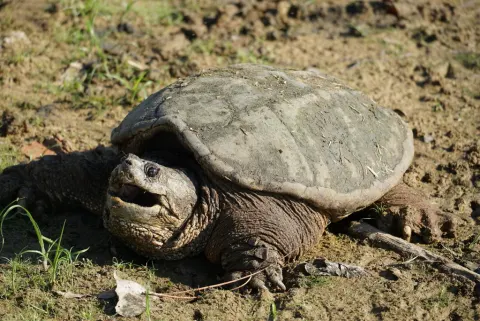
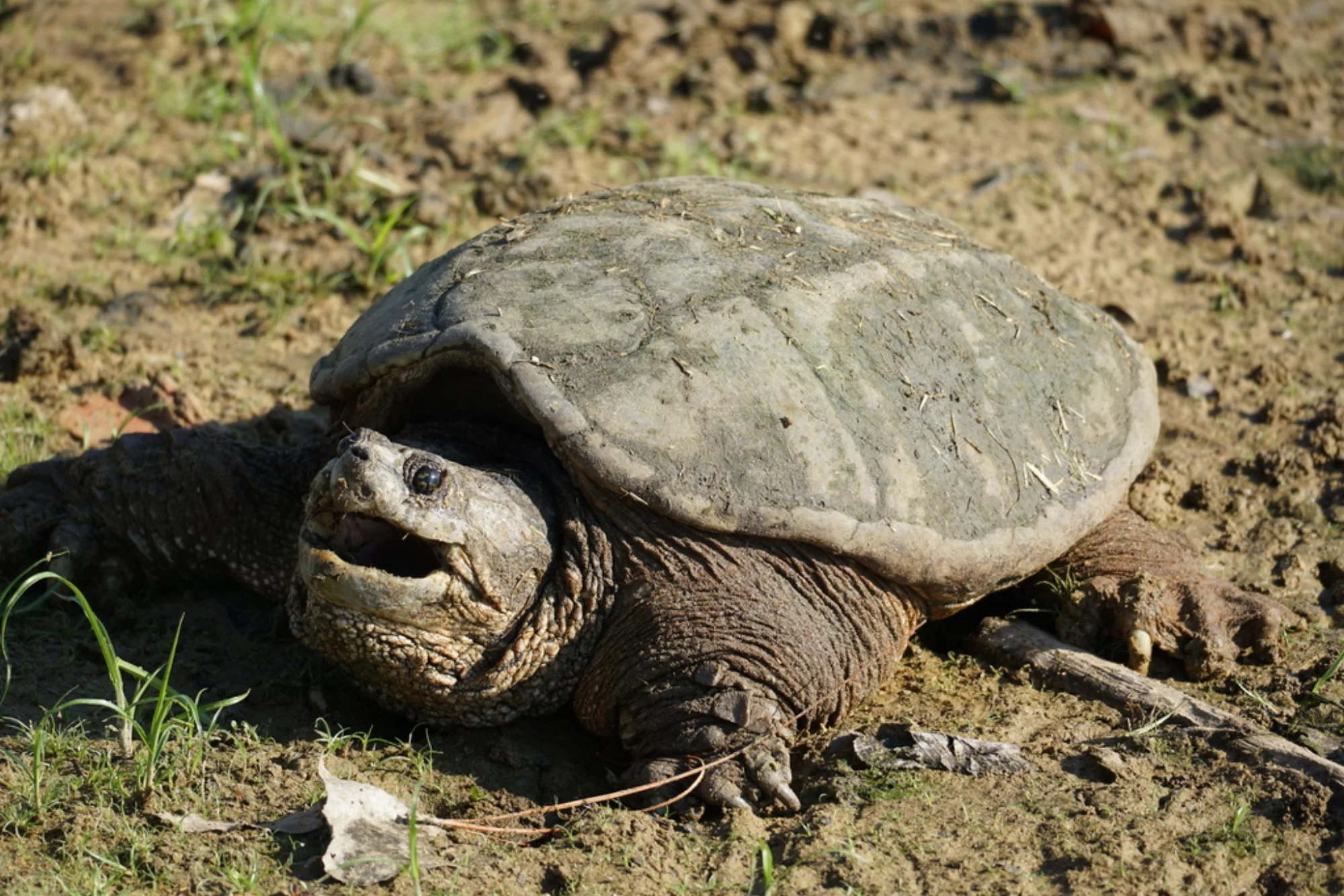
Powerful beak-like jaws and a long, mobile neck give the Common Snapping Turtle a distinctive profile. This large freshwater turtle has a muscular build and a ridged upper shell, ranging in colour from tan to brown or black; the ridges are usually more pronounced in young animals. Adults commonly have a shell length of 25 to 47 cm and usually weigh 4.5 to 16 kg. Males are larger than females, and the species continues to grow throughout its life.
Its natural range reaches from southeastern Canada to Florida, with Nova Scotia at its eastern extent and the edge of the Rocky Mountains to the southwest. Look for it in shallow ponds and streams, often among abundant aquatic vegetation, although it can occupy most permanent bodies of water and sometimes enters brackish estuaries. In shallow water it may rest beneath the muddy bottom, exposing its head and stretching its neck to breathe. It sometimes basks at the surface with only its shell showing; in the north, it also uses fallen logs in early spring. On land it can be combative, but in water it usually slips away or shelters under mud or grass when disturbed.
The turtle scavenges carrion and eats considerable aquatic vegetation, while also ambushing prey ranging from invertebrates and fish to frogs, reptiles, birds and small mammals. Females travel over land to sandy nesting sites, sometimes far from water, and typically lay 25 to 80 eggs each year. Eggs and young face many predators, including raccoons, foxes and skunks. Habitat degradation and collection for the pet trade have contributed to declines, while road deaths can severely reduce populations in urban wetlands.
Written from the English Wikipedia article Common snapping turtle (CC BY-SA 4.0).
- Records
- 4,230
- Countries
- 4
- Atlas places
- 2
These are open occurrence records, so they show where people looked for and recorded the Common Snapping Turtle as much as where it lives. Cells are up to 25 km across, and every location is generalised to its cell.
Generalised encounter areas, not exact locations. Each shape is a grid cell coloured by how likely the species is there.
- Very likelyUnited States25 km zone · medium confidence · 3200 records · updated 80 days ago
- Very likelyCanada25 km zone · medium confidence · 965 records · updated 80 days ago
- Very likelyMexico25 km zone · medium confidence · 54 records · updated 80 days ago
- Very likelyFrance25 km zone · medium confidence · 11 records · updated 80 days ago
Conservation status not assessed here yet, so every location is generalised to its grid cell.