Common Snake-necked Turtle
Chelodina longicollis
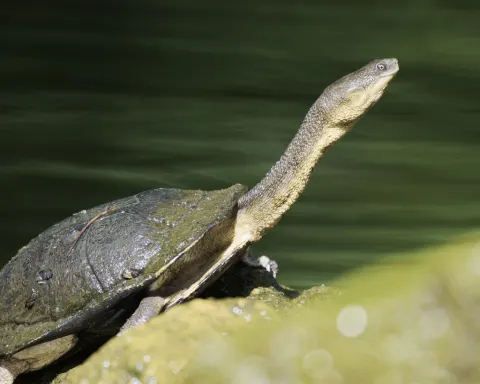
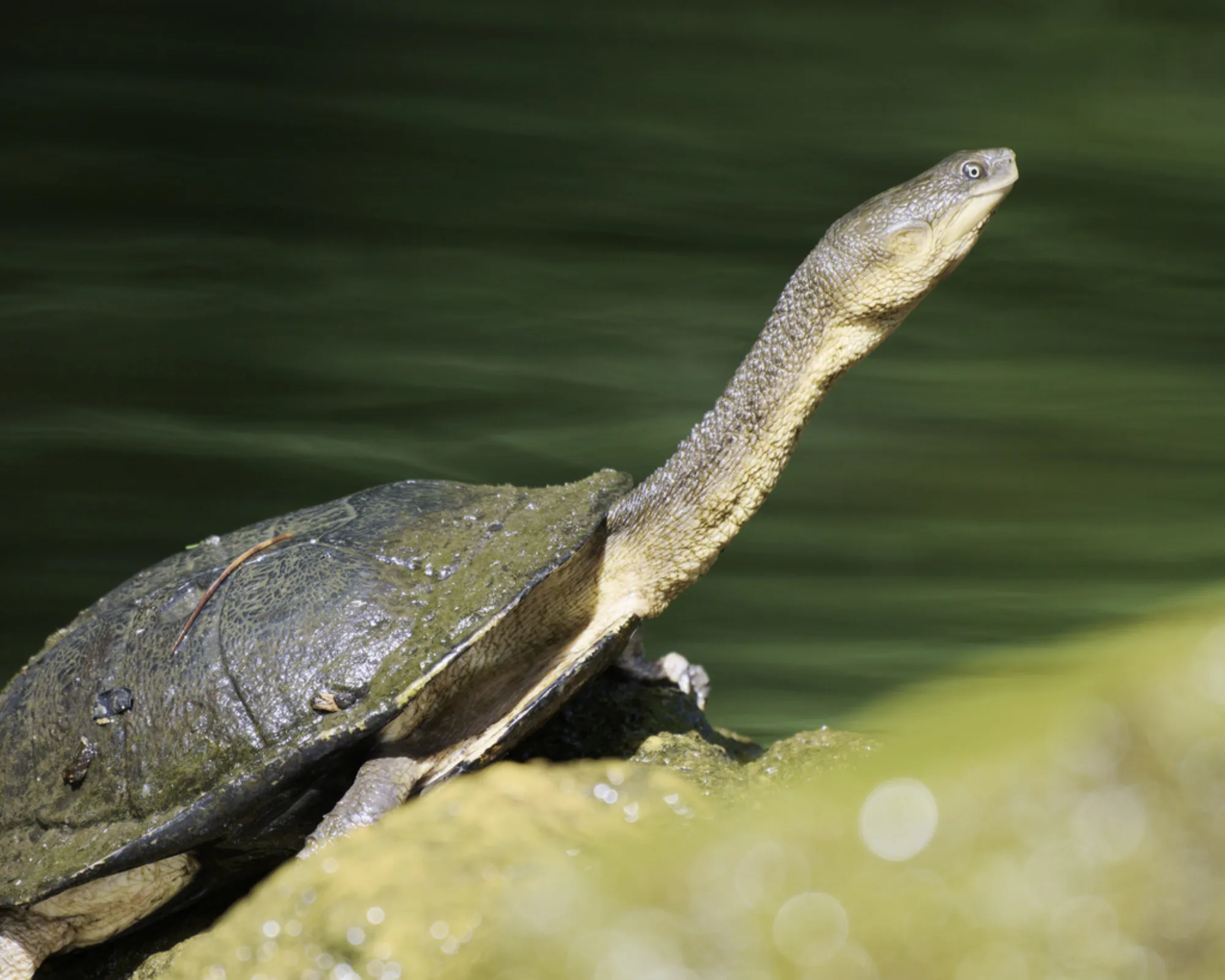
With a long, narrow neck and a broad, flattened shell, the Common Snake-necked Turtle is a distinctive freshwater turtle of eastern Australia. Its upper shell is usually black, though it can be brown, while the underside ranges from cream to yellow and has black-edged seams. The neck is grey to black above and cream underneath, as is the narrow head, and can reach approximately 60% of the upper shell's length. When drawing in its head, the turtle bends it sideways into the shell; if threatened, it can release an offensive-smelling fluid, a defence that has earned it the name "stinker".
The species occurs across southeastern Australia, from west of Adelaide to the Fitzroy River in Queensland, with a range that includes Victoria, New South Wales and the Northern Territory. It lives in a wide variety of water bodies and can tolerate cold conditions, including southerly and high-altitude temperate climates. One turtle was found spending winter in a New England Tablelands pool that had frozen completely for 15 days. An opportunistic carnivore, it eats animals ranging from insects and worms to frogs, small fish, crustaceans and molluscs, as well as carrion. In early summer, females deposit two to ten eggs along the banks of their aquatic habitat; the young hatch three to five months later and may be eaten by fish and birds. Females can lay one to three clutches each year.
Foxes eat turtle eggs in South Australia and may also eat the turtles themselves. River regulation and roadkill are considered threats to freshwater turtles in the Murray River, where conservation work includes protecting nesting sites and monitoring turtle numbers.
Written from the English Wikipedia article Eastern long-necked turtle (CC BY-SA 4.0).
- Records
- 22,556
- Countries
- 1
- Atlas places
- 2
These are open occurrence records, so they show where people looked for and recorded the Common Snake-necked Turtle as much as where it lives. Cells are up to 25 km across, and every location is generalised to its cell.
Generalised encounter areas, not exact locations. Each shape is a grid cell coloured by how likely the species is there.
- Very likelyAustralia25 km zone · high confidence · 22556 records · updated 80 days ago
Conservation status not assessed here yet, so every location is generalised to its grid cell.