Red Gurnard
Chelidonichthys cuculus
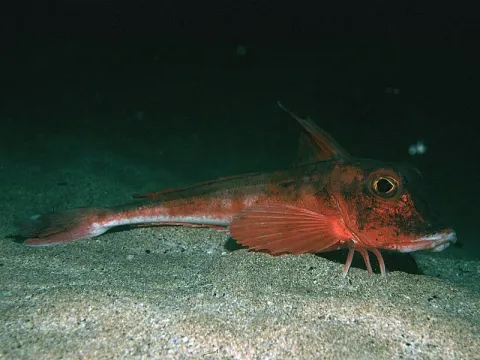
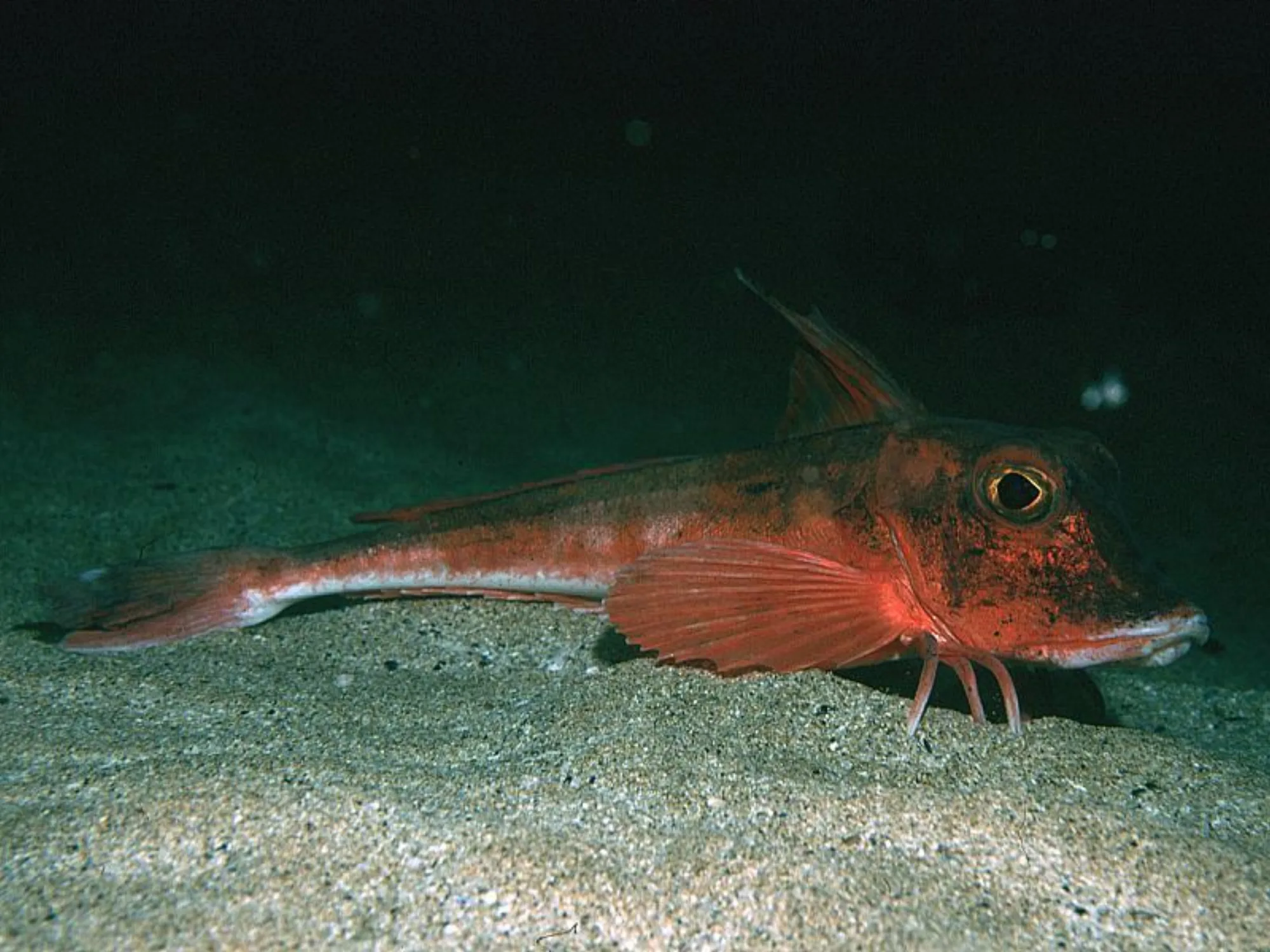
Bright red across its upper body and pale underneath, the Red Gurnard is a seabed fish with a large, angular head and a steep snout. Its pelvic fins are pink, while its back and side fins are yellowish and the base of its anal fin is white. It can reach 70 cm in total length, although more typical fork lengths are 27.6 cm for males and 20.4 cm for females.
In the eastern Atlantic, its range extends from southern Scotland to Mauritania, taking in the island groups of Madeira, the Azores and the Canaries. It has also been recorded infrequently from Norway, and occurs throughout the Mediterranean and in the Black Sea. Usually found at depths of 30 to 250 m, it favours sandy or gravelly seabeds but also occurs over rock and mud. It sometimes gathers in schools and can make sounds described as a frog-like croak. Separate, enlarged rays on its side fins help it detect prey. In an Adriatic Sea study, more than 90% of its diet consisted of malacostracan crustaceans, with smaller amounts of fish, molluscs and echinoderms. Red gurnards spawn in summer, reach sexual maturity at around 26.6 cm and have a maximum reported age of 21 years.
Fishing brings the species into contact with people across its range. In the Atlantic it is not commercially exploited, though fish caught incidentally may be eaten, and a fishery off Cornwall is attracting growing but limited economic interest. Mediterranean fisheries also have a modest commercial interest in the species, and the catch is sold fresh, chilled or frozen.
Written from the English Wikipedia article Red gurnard (CC BY-SA 4.0).
- Records
- 952
- Countries
- 8
No atlas park has a record of the Red Gurnard in or around it yet.
These are open occurrence records, so they show where people looked for and recorded the Red Gurnard as much as where it lives. Cells are up to 25 km across, and every location is generalised to its cell.
Generalised encounter areas, not exact locations. Each shape is a grid cell coloured by how likely the species is there.
- Very likelyUnited Kingdom25 km zone · medium confidence · 319 records · updated 80 days ago
- Very likelyFrance25 km zone · medium confidence · 252 records · updated 80 days ago
- Very likelyPortugal25 km zone · medium confidence · 236 records · updated 80 days ago
- Very likelyIsle of Man25 km zone · medium confidence · 135 records · updated 80 days ago
- PossibleNorway25 km zone · medium confidence · 6 records · updated 80 days ago
- PossibleMalta25 km zone · medium confidence · 4 records · updated 80 days ago
- PossibleBelgium25 km zone · low confidence · 0 records · updated 80 days ago
- UncommonSpain25 km zone · low confidence · 0 records · updated 80 days ago
Conservation status not assessed here yet, so every location is generalised to its grid cell.