Humphead Wrasse
Cheilinus undulatus
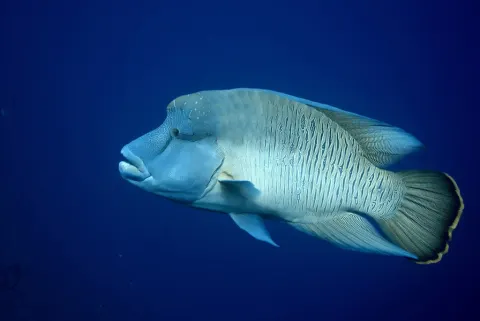
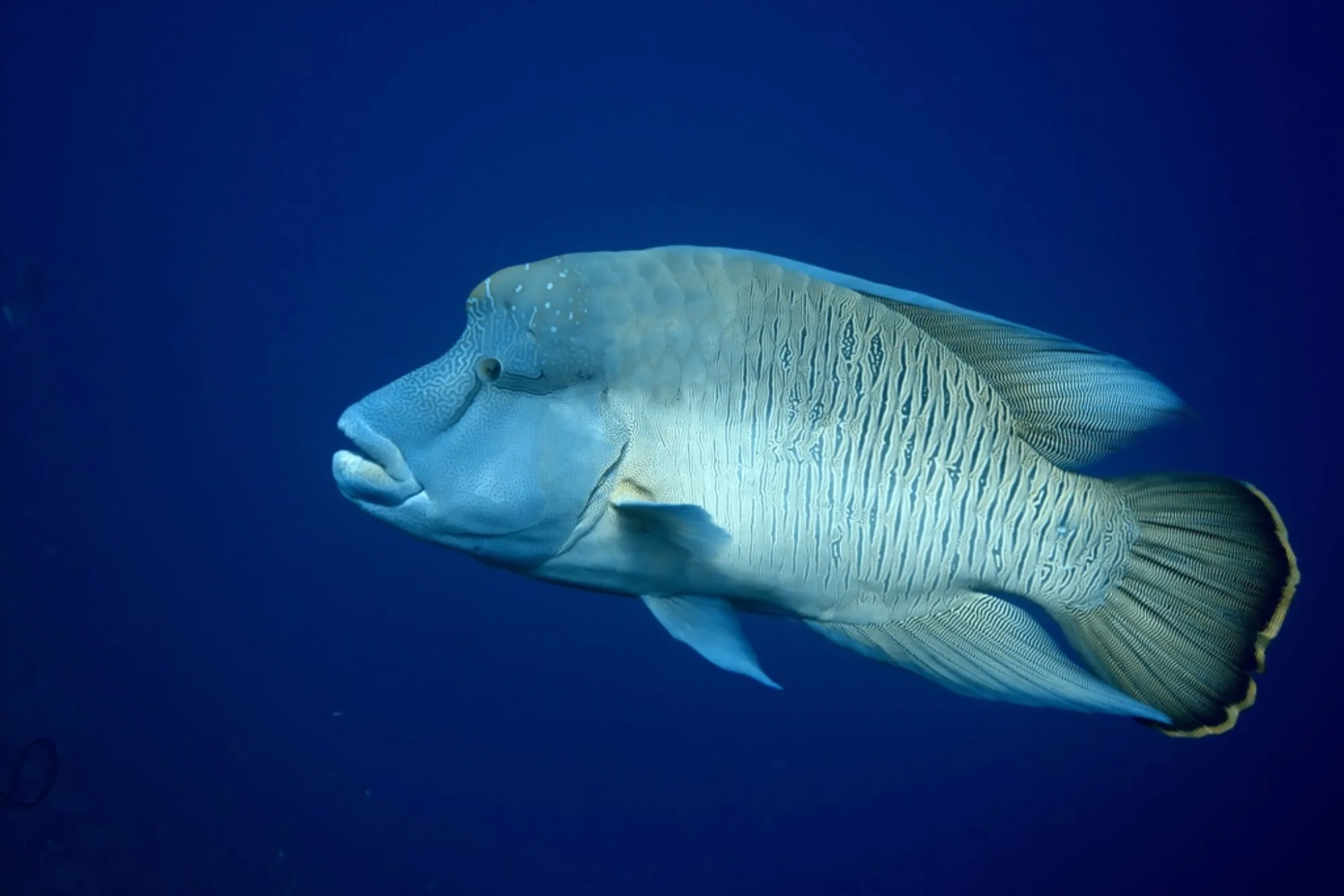
Look for the Humphead Wrasse on coral reefs in parts of the Indian and Pacific Oceans, as well as off eastern Africa near the entrance to the Red Sea. The largest wrasse species, it has thick lips, two black lines behind the eyes and, in larger adults, a prominent forehead hump. Its colour ranges from olive to green or purplish-blue, with yellow wavy lines or a net-like pattern on the head. Males can reach 229 centimetres and 191 kilograms, although the average length is around 60 centimetres. Adults usually live alone, though they also appear in pairs or small groups. They favour reef slopes, channels and lagoons, while juveniles shelter among dense branching corals, bushy algae or seagrasses.
A top reef predator, the wrasse eats mostly invertebrates, including molluscs, sea urchins and crustaceans, as well as other fish. It can uncover buried prey by blowing water at the sand, and may crack sea urchins against a rock. It sometimes hunts cooperatively with the roving coral grouper. Adults gather to spawn at the down-current end of a reef at certain times of year, and their young eventually settle on or near reefs. The fish can live for around 30 years, but breeds slowly. Severe overfishing for the live reef food-fish trade is its primary threat. Habitat loss, destructive fishing with bombs and cyanide, and the trade in juveniles for marine aquaria also contribute to its decline. Illegal, unreported and unregulated fishing persists, including smuggling across the Malaysia-Philippines border.
Written from the English Wikipedia article Humphead wrasse (CC BY-SA 4.0).
- Records
- 1,641
- Countries
- 30
- Atlas places
- 2
These are open occurrence records, so they show where people looked for and recorded the Humphead Wrasse as much as where it lives. Cells are up to 25 km across, and every location is generalised to its cell.
Generalised encounter areas, not exact locations. Each shape is a grid cell coloured by how likely the species is there.
- Very likelyAmerican Samoa25 km zone · medium confidence · 234 records · updated 80 days ago
- Very likelyU.S. Outlying Islands25 km zone · medium confidence · 214 records · updated 80 days ago
- Very likelyAustralia25 km zone · medium confidence · 203 records · updated 80 days ago
- Very likelyMicronesia25 km zone · medium confidence · 157 records · updated 80 days ago
- Very likelyEgypt25 km zone · medium confidence · 150 records · updated 80 days ago
- Very likelyFrench Polynesia25 km zone · medium confidence · 141 records · updated 80 days ago
- Very likelyNew Caledonia25 km zone · medium confidence · 113 records · updated 80 days ago
- Very likelyGuam25 km zone · medium confidence · 52 records · updated 80 days ago
- Very likelyNorthern Mariana Islands25 km zone · medium confidence · 50 records · updated 80 days ago
- Very likelyPhilippines25 km zone · medium confidence · 50 records · updated 80 days ago
Conservation status not assessed here yet, so every location is generalised to its grid cell.