Northern Rubber Boa
Charina bottae
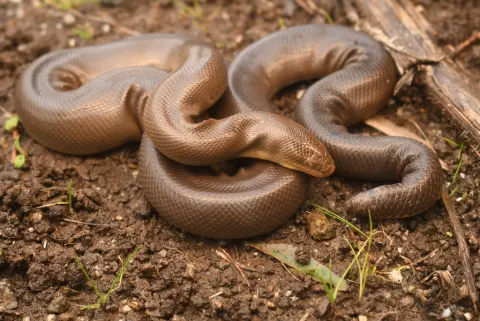
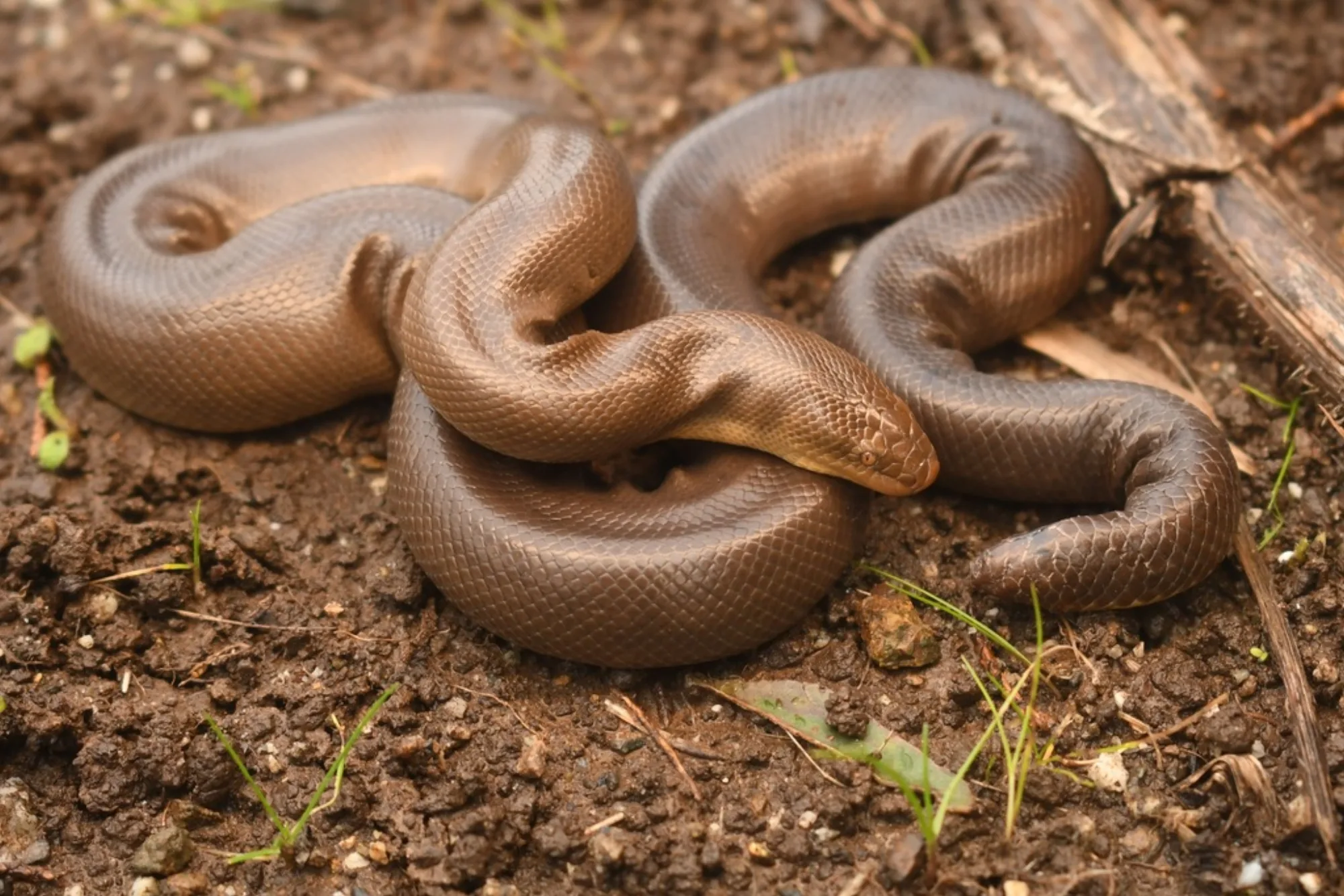
With its blunt head and similarly shaped tail, the Northern Rubber Boa can look as though it has two heads. This small, nonvenomous boa grows to 38 to 84 cm as an adult. Its loose, sometimes wrinkled skin has small, smooth, shiny scales that give it a rubbery appearance. Most are tan to dark brown with paler undersides, though some are olive-green, yellow or orange.
Native to western North America, the snake ranges across the western United States, reaching western Utah and Montana, with its range extending from central California north to southern British Columbia. It occupies a wide range of habitats, including grasslands, meadows, chaparral, deciduous and conifer forests, and high alpine areas. It can live from sea level to above 3,000 m, provided it has shelter, warmth, moisture and prey. Rocks, logs, leaf litter and burrows offer cover, where it spends much of its time. Mostly active at night and probably around dawn and dusk, it is rarely encountered and spends winter in underground dens.
The boa feeds chiefly on young mammals such as shrews, voles and mice, but also takes prey including salamanders, lizards, eggs, birds and other snakes. When it finds a nest of young mammals, it may eat the whole litter while using its tail to fend off their mother. It gives birth to live young between August and November, usually in litters of 1 to 5, and females reproduce on average once every four years. Many predators can eat rubber boas, including birds of prey, coyotes, raccoons and cats; when threatened, the snake coils around its head and presents its tail as a decoy.
Written from the English Wikipedia article Rubber boa (CC BY-SA 4.0).
- Records
- 377
- Countries
- 2
- Atlas places
- 3
These are open occurrence records, so they show where people looked for and recorded the Northern Rubber Boa as much as where it lives. Cells are up to 25 km across, and every location is generalised to its cell.
Generalised encounter areas, not exact locations. Each shape is a grid cell coloured by how likely the species is there.
- Very likelyUnited States25 km zone · medium confidence · 325 records · updated 80 days ago
- Very likelyCanada25 km zone · medium confidence · 52 records · updated 80 days ago
Conservation status not assessed here yet, so every location is generalised to its grid cell.