Killdeer
Charadrius vociferus
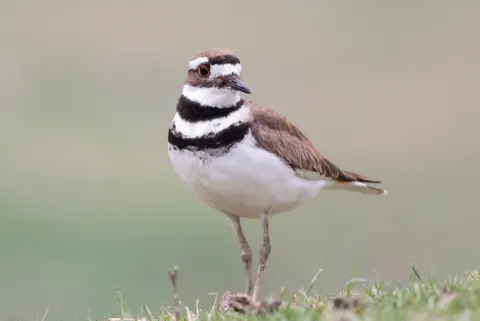
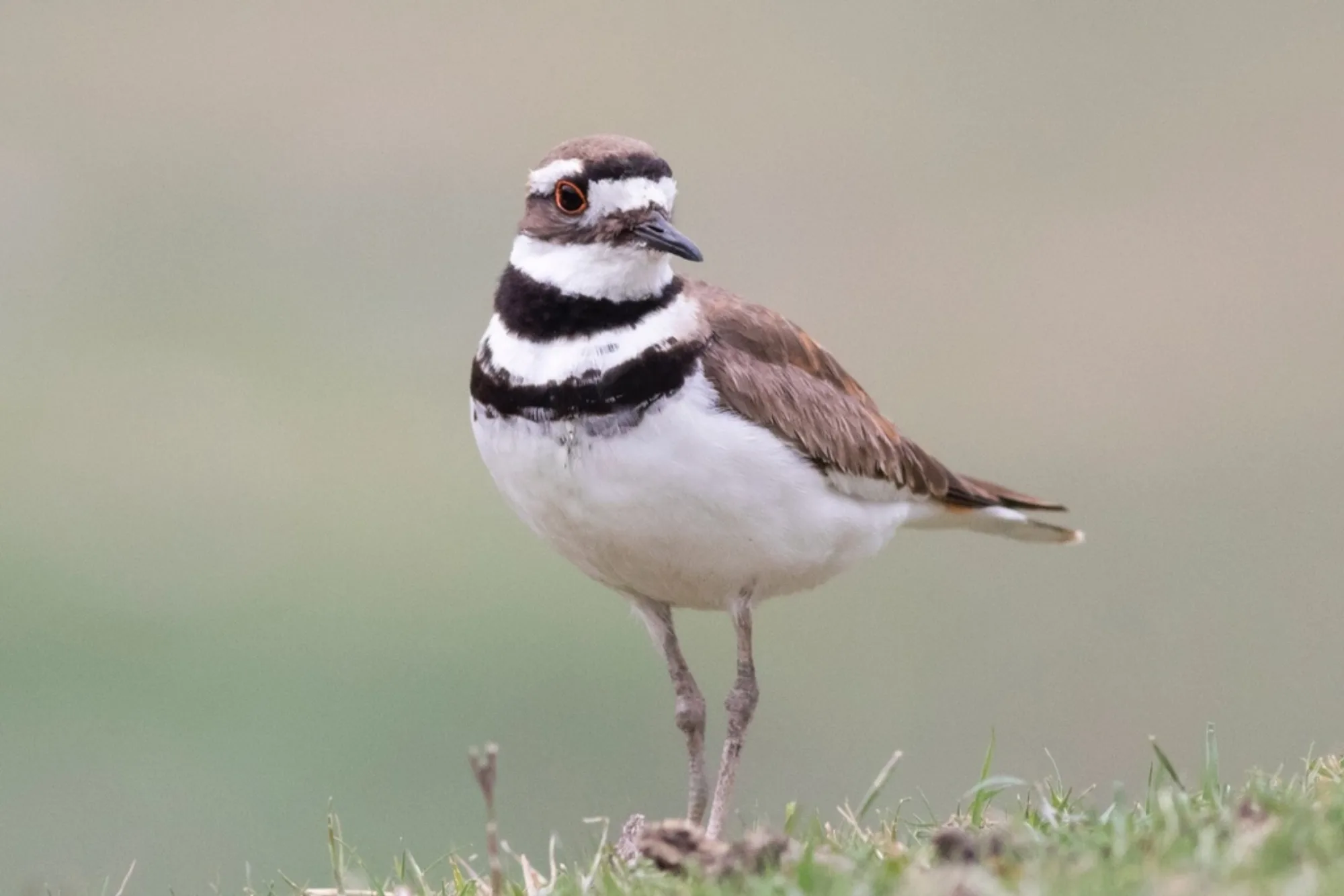
A shrill call sounding like “kill deer” often gives this large American plover away. The Killdeer is tall and slender, with a relatively long tail, brown upperparts, a white belly and two black bands across its white breast. Look also for a red eye ring and, in flight, a white stripe across the wing. Adults measure 20 to 28 cm in length.
Its breeding grounds extend south from southern Canada and Alaska's southeastern region through Mexico, reaching Panama in fewer places. Some northern birds migrate, while others remain year-round in the southern half of the breeding range. Killdeer also live throughout the year in parts of the Caribbean and western South America. Outside the breeding season, look for them on beaches, coastal wetlands and fields. They feed mainly on insects, especially beetles and flies, but also take other small creatures and some seeds. Fields with short vegetation, cattle and standing water are favoured feeding places; around a full moon, the birds feed more at night.
For nesting, Killdeer choose open fields and other flat places with short vegetation, sometimes using rooftops. The nest is a shallow scrape, often with white material such as pebbles or fragments of shell. Both parents incubate the four to six marked eggs for 22 to 28 days. After hatching, they lead the chicks to feeding areas with dense vegetation where they can hide; the chicks feed themselves and fledge at about 31 days. The population has declined, and predators including gulls, crows, raccoons and skunks take Killdeer. Parents may distract a predator by calling and pretending to have an injured wing.
Written from the English Wikipedia article Killdeer (CC BY-SA 4.0).
- Records
- 2,827,586
- Countries
- 47
No atlas park has a record of the Killdeer in or around it yet.
These are open occurrence records, so they show where people looked for and recorded the Killdeer as much as where it lives. Cells are up to 25 km across, and every location is generalised to its cell.
Generalised encounter areas, not exact locations. Each shape is a grid cell coloured by how likely the species is there.
- Very likelyUnited States25 km zone · high confidence · 2445753 records · updated 86 days ago
- Very likelyCanada25 km zone · high confidence · 286458 records · updated 86 days ago
- Very likelyMexico25 km zone · high confidence · 34830 records · updated 86 days ago
- Very likelyPuerto Rico25 km zone · high confidence · 8881 records · updated today
- Very likelyPeru25 km zone · high confidence · 7778 records · updated today
- Very likelyCuba25 km zone · high confidence · 5391 records · updated today
- Very likelyBahamas25 km zone · high confidence · 5117 records · updated today
- Very likelyBelize25 km zone · high confidence · 4625 records · updated today
- Very likelyAruba25 km zone · high confidence · 3768 records · updated today
- Very likelyBermuda25 km zone · high confidence · 3698 records · updated today
Conservation status not assessed here yet, so every location is generalised to its grid cell.