Piping Plover
Charadrius melodus
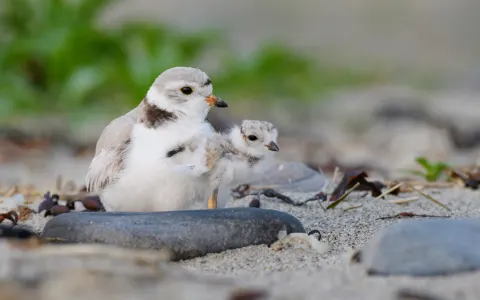
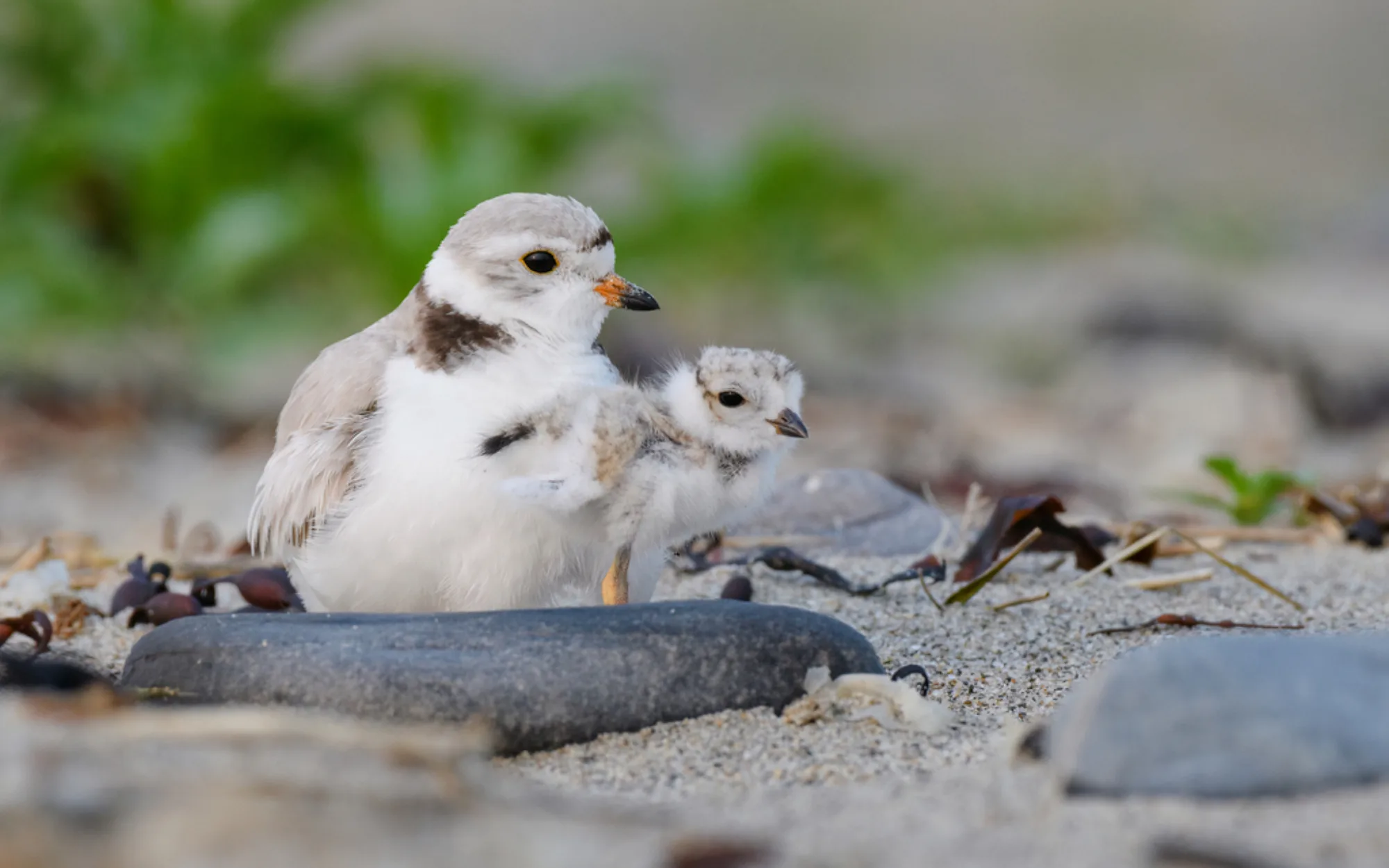
A pale bird on pale sand, the Piping Plover can be difficult to spot when it stands still, though its soft, bell-like whistles may give it away first. This small North American shorebird has a rounded head, a short bill with an orange base and black tip, and yellow-orange legs. In the breeding season, adults show black markings across the forehead and breast, which become less pronounced outside that season. Watch for its characteristic movement: a quick run across the beach followed by a pause.
Piping Plovers spend much of their lives along sandy or stony coastlines, often choosing dry, elevated ground away from the water. Their breeding range includes the Atlantic coast, the Great Lakes shores and parts of the Canadian and American Midwest. In winter, they travel south to the Gulf of Mexico, the southern US Atlantic coast and the Caribbean. They search for insects, marine worms and crustaceans, often near the water's edge or among material left by the high tide. Nests are shallow scrapes high on the shore, where shells and debris help conceal them. Both parents incubate the eggs, and chicks can walk within hours of hatching. Adults warn chicks of danger and may pretend to have a broken wing to draw predators away.
Crows, cats, raccoons and foxes threaten nests, while storms, high winds and unusually high tides can harm eggs or chicks. Development and the loss of habitat have contributed to declines, as has human activity around nesting places, and disturbance can cause parents to abandon nests or chicks. If a bird appears distressed, give it space to avoid unintended consequences.
Written from the English Wikipedia article Piping plover (CC BY-SA 4.0).
- Records
- 261,179
- Countries
- 6
- Atlas places
- 1
These are open occurrence records, so they show where people looked for and recorded the Piping Plover as much as where it lives. Cells are up to 25 km across, and every location is generalised to its cell.
Generalised encounter areas, not exact locations. Each shape is a grid cell coloured by how likely the species is there.
- Very likelyUnited States25 km zone · high confidence · 247763 records · updated 80 days ago
- Very likelyCanada25 km zone · high confidence · 11615 records · updated 80 days ago
- Very likelyCuba25 km zone · high confidence · 768 records · updated 80 days ago
- Very likelyBahamas25 km zone · high confidence · 550 records · updated 80 days ago
- Very likelyMexico25 km zone · high confidence · 292 records · updated 80 days ago
- LikelyBermuda25 km zone · high confidence · 191 records · updated 80 days ago
Conservation status not assessed here yet, so every location is generalised to its grid cell.