Giant Snakehead
Channa micropeltes
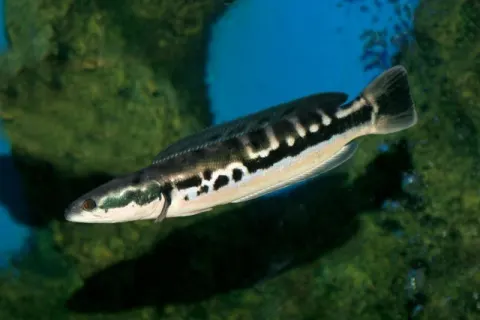
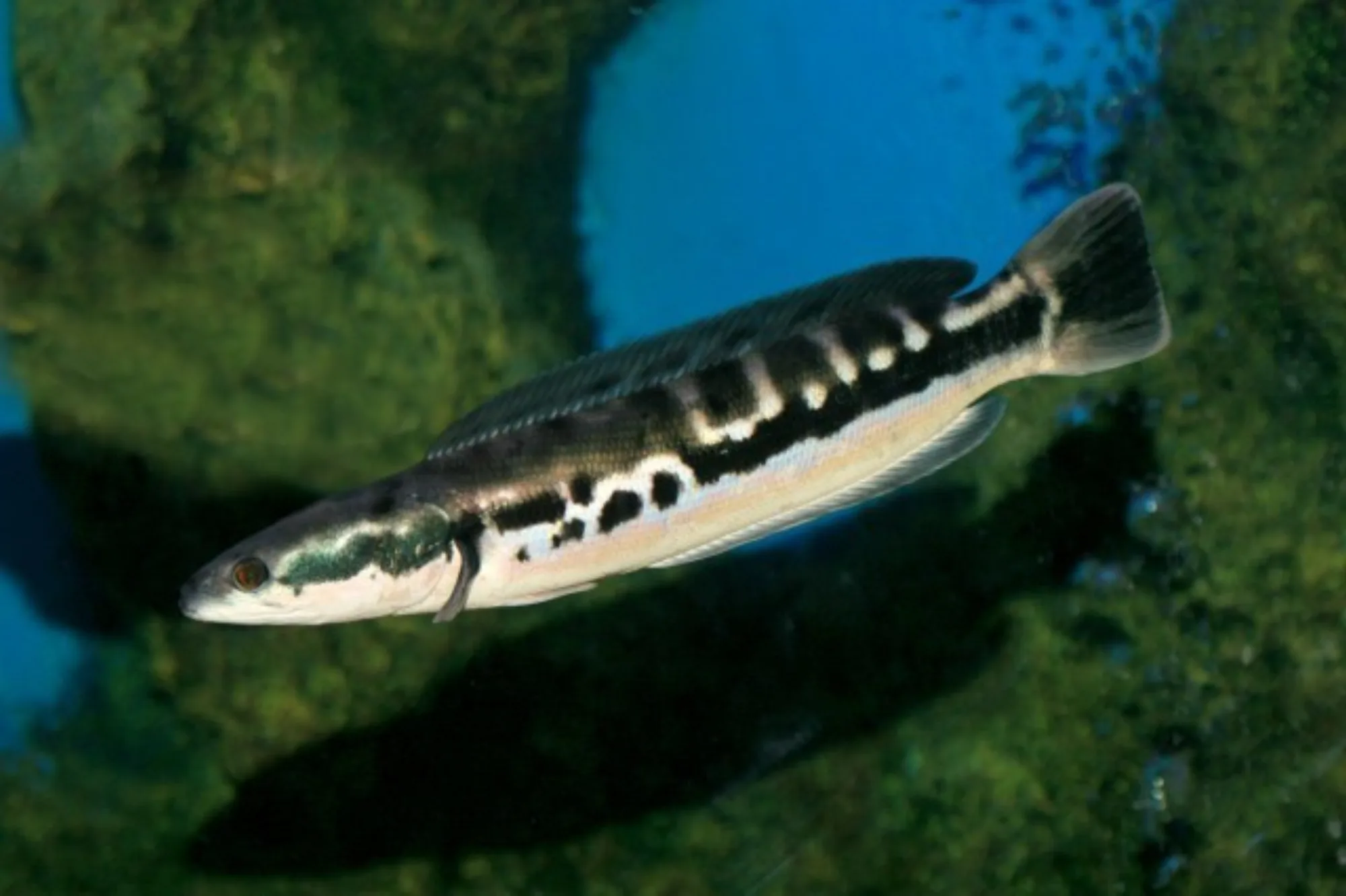
Few freshwater fish in Southeast Asia match the Giant Snakehead for size: it can reach 1.8 m in length and weigh 30 kg. Young fish are red, with orange and black stripes appearing along their sides after about two months. As they mature, the red and stripes disappear, and a bluish-black and white pattern develops across the upper body. This fish comes from Southeast Asian freshwater habitats and occurs on the Malay Peninsula and in Indonesia. It can survive in stagnant water with little oxygen by coming to the surface for a gulp of air. In muddy or swampy areas, it can also breathe air and crawl onto land, travelling short distances, though it cannot hunt there.
A voracious predator, the Giant Snakehead chases and eats prey small enough to fit in its mouth. It has been used to control overpopulation of tilapia in ponds and cages, where the two fish can be raised together. People also culture it in ponds and reservoirs as a game fish, valued for the strong fight it puts up when hooked. The fish is eaten too, including grilled preparations sold by street vendors in Thailand. Young fish are commonly sold as pets, and some are sold as food for larger carnivorous fish. In Taiwan, where the species has become established, a targeted fishery catches mature females before they spawn in an attempt to control it in Sun Moon Lake. The fish has also been introduced elsewhere, and in Sri Lanka its presence in the Deduru Oya reservoir has been reported as a threat to other fish and the freshwater fishing industry.
Written from the English Wikipedia article Channa micropeltes (CC BY-SA 4.0).
- Records
- 34
- Countries
- 8
No atlas park has a record of the Giant Snakehead in or around it yet.
These are open occurrence records, so they show where people looked for and recorded the Giant Snakehead as much as where it lives. Cells are up to 25 km across, and every location is generalised to its cell.
Generalised encounter areas, not exact locations. Each shape is a grid cell coloured by how likely the species is there.
- Very likelySingapore25 km zone · medium confidence · 12 records · updated 80 days ago
- Very likelyTaiwan25 km zone · medium confidence · 10 records · updated 80 days ago
- Very likelyThailand25 km zone · medium confidence · 10 records · updated 80 days ago
- PossibleCambodia25 km zone · medium confidence · 1 record · updated 80 days ago
- PossibleMalaysia25 km zone · medium confidence · 1 record · updated 80 days ago
- PossibleHong Kong SAR China25 km zone · low confidence · 0 records · updated 80 days ago
- RareBrunei25 km zone · low confidence · 0 records · updated 80 days ago
- RareIndonesia25 km zone · low confidence · 0 records · updated 80 days ago
Conservation status not assessed here yet, so every location is generalised to its grid cell.