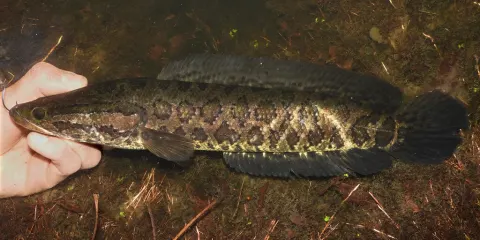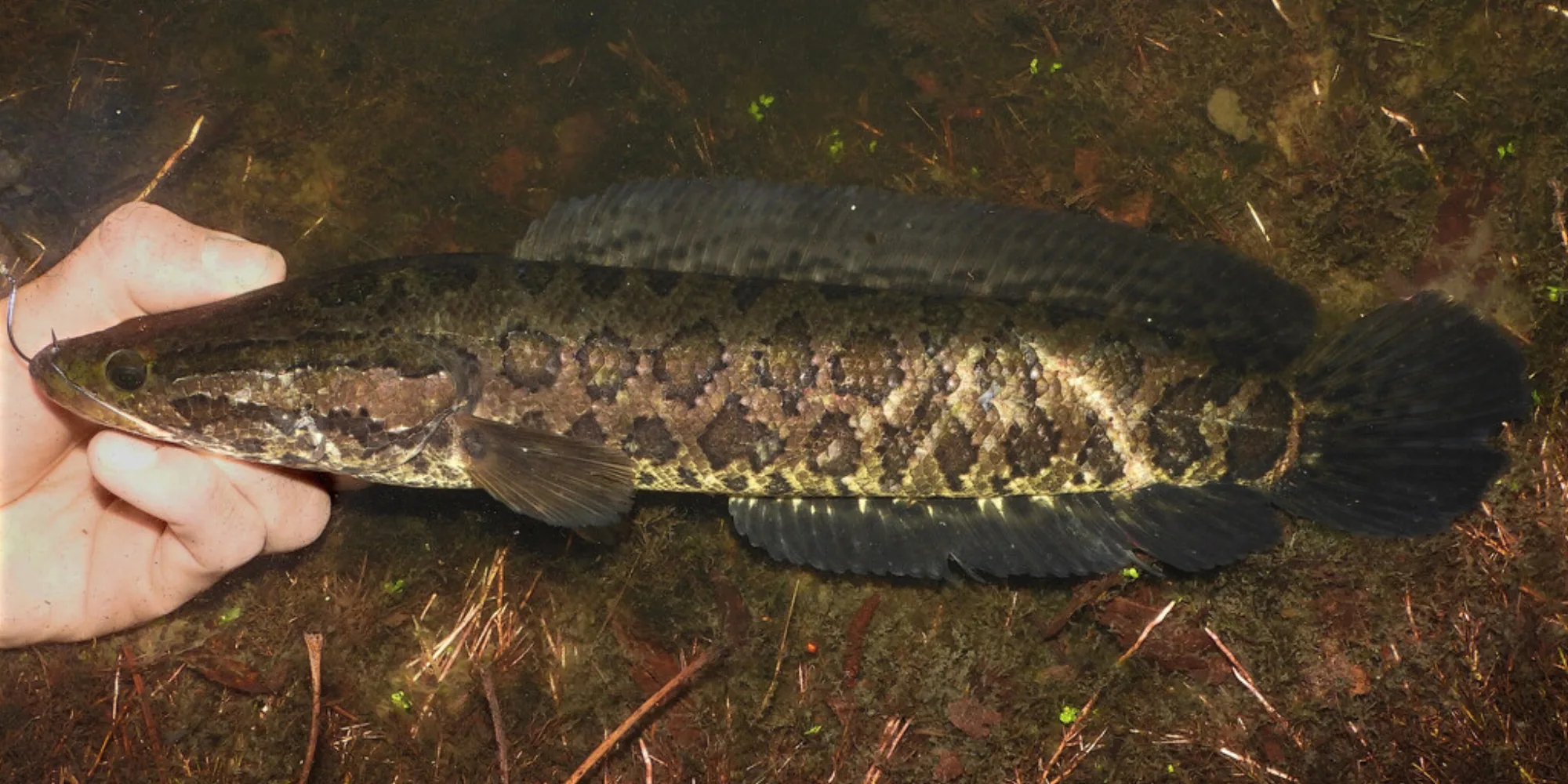
Northern Snakehead
Channa argus
Golden tan to pale brown, the Northern Snakehead has dark blotches along its sides and saddle-like markings across its back. Its long dorsal fin, large mouth and elongated head give a traveller several features to look for. Scales continue from its body onto its head, and it lacks the black spot near the tail seen on the similar eyespot bowfin. It is generally reported to grow up to 100 cm long, although specimens approaching 150 cm are known.
This freshwater fish is native to temperate East Asia, with a range extending south to Hainan from the Amur River watershed of Siberia and Manchuria. Its native countries include China, Russia, North Korea and South Korea. It has also established populations in Central Asia and North America after being exported beyond its native range. Look for it in still water with muddy bottoms and aquatic plants, or in slow, murky, swampy streams. The fish can breathe air as well as in water and can survive outside water for several days. Young fish may be able to wriggle short distances over land, though adults cannot. Fish make up most of its diet, supplemented by crustaceans, other invertebrates and amphibians.
Northern snakeheads reach maturity at three or four years old, when they are about 30 to 35 cm long. Each year, a female may produce 100,000 eggs, which are guarded by the parents. In some places where snakeheads have been introduced, people have tried to eliminate them: officials drained a Maryland pond and destroyed the fish found there. Waters in New York have also been treated with poison after the species was found.
Written from the English Wikipedia article Northern snakehead (CC BY-SA 4.0).
- Records
- 5,131
- Countries
- 6
No atlas park has a record of the Northern Snakehead in or around it yet.
These are open occurrence records, so they show where people looked for and recorded the Northern Snakehead as much as where it lives. Cells are up to 25 km across, and every location is generalised to its cell.
Generalised encounter areas, not exact locations. Each shape is a grid cell coloured by how likely the species is there.
- Very likelyUnited States25 km zone · medium confidence · 5053 records · updated 80 days ago
- LikelyJapan25 km zone · medium confidence · 49 records · updated 80 days ago
- LikelySouth Korea25 km zone · medium confidence · 22 records · updated 80 days ago
- PossibleChina25 km zone · medium confidence · 6 records · updated 80 days ago
- PossibleKazakhstan25 km zone · medium confidence · 1 record · updated 80 days ago
- RareHong Kong SAR China25 km zone · low confidence · 0 records · updated 80 days ago
Conservation status not assessed here yet, so every location is generalised to its grid cell.