Veiled Chameleon
Chamaeleo calyptratus
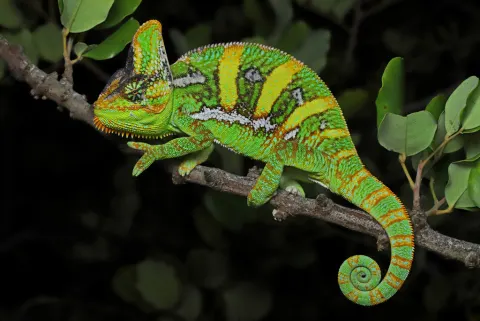
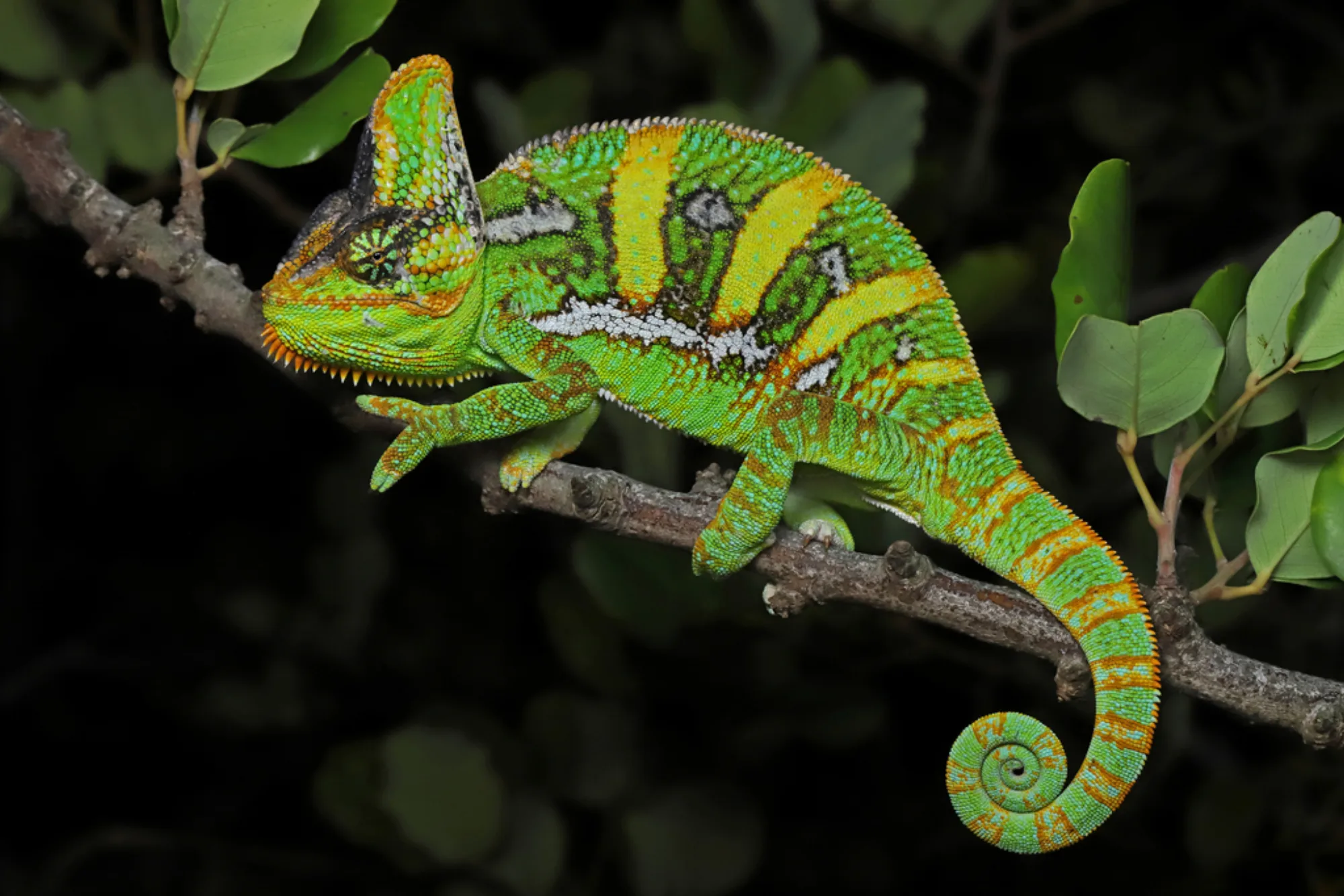
A raised, veil-like crest gives the Veiled Chameleon its name and makes it distinctive among the trees and large plants it inhabits. Both sexes develop this head crest as they mature, with the largest adults reaching about 5 cm. Males grow 43 to 61 cm long, including the tail, while females are shorter and have thicker bodies. Adult females are green with pale or warm-coloured mottling; males are brighter, with more distinct yellow or blue bands. Hatchlings begin life pastel green, gaining stripes and other colours as they mature.
Native to Yemen and Saudi Arabia, the species inhabits plateaus, mountains and valleys in the semi-arid and tropical south-west of the Arabian Peninsula. Its tail grips branches, while its independently moving eyes help it watch for potential threats. A long, sticky tongue lets it catch insects at a distance; small prey makes up most of its diet, and green insects appear to be a favourite. It also eats plants, including fruit and vegetables, which may provide water during the dry season. Its colours change with social interactions, reproduction and stress: males may brighten before approaching a rival, while stressed chameleons tend to darken.
Veiled chameleons breed several times a year, and females bury clutches of up to 85 eggs in sand. Embryos can remain dormant in their eggs before development begins, with temperature playing a role in the delay. The species is highly susceptible to stress, and captive animals can suffer infections, nutritional problems and other illnesses. The account does not identify specific threats to wild populations; in Hawaii, introduced chameleons are captured and removed to control their numbers.
Written from the English Wikipedia article Veiled chameleon (CC BY-SA 4.0).
- Records
- 41
- Countries
- 3
- Atlas places
- 1
These are open occurrence records, so they show where people looked for and recorded the Veiled Chameleon as much as where it lives. Cells are up to 25 km across, and every location is generalised to its cell.
Generalised encounter areas, not exact locations. Each shape is a grid cell coloured by how likely the species is there.
- Very likelyUnited States25 km zone · medium confidence · 38 records · updated 80 days ago
- LikelyYemen25 km zone · medium confidence · 3 records · updated 80 days ago
- RareTaiwan25 km zone · low confidence · 0 records · updated 80 days ago
Conservation status not assessed here yet, so every location is generalised to its grid cell.