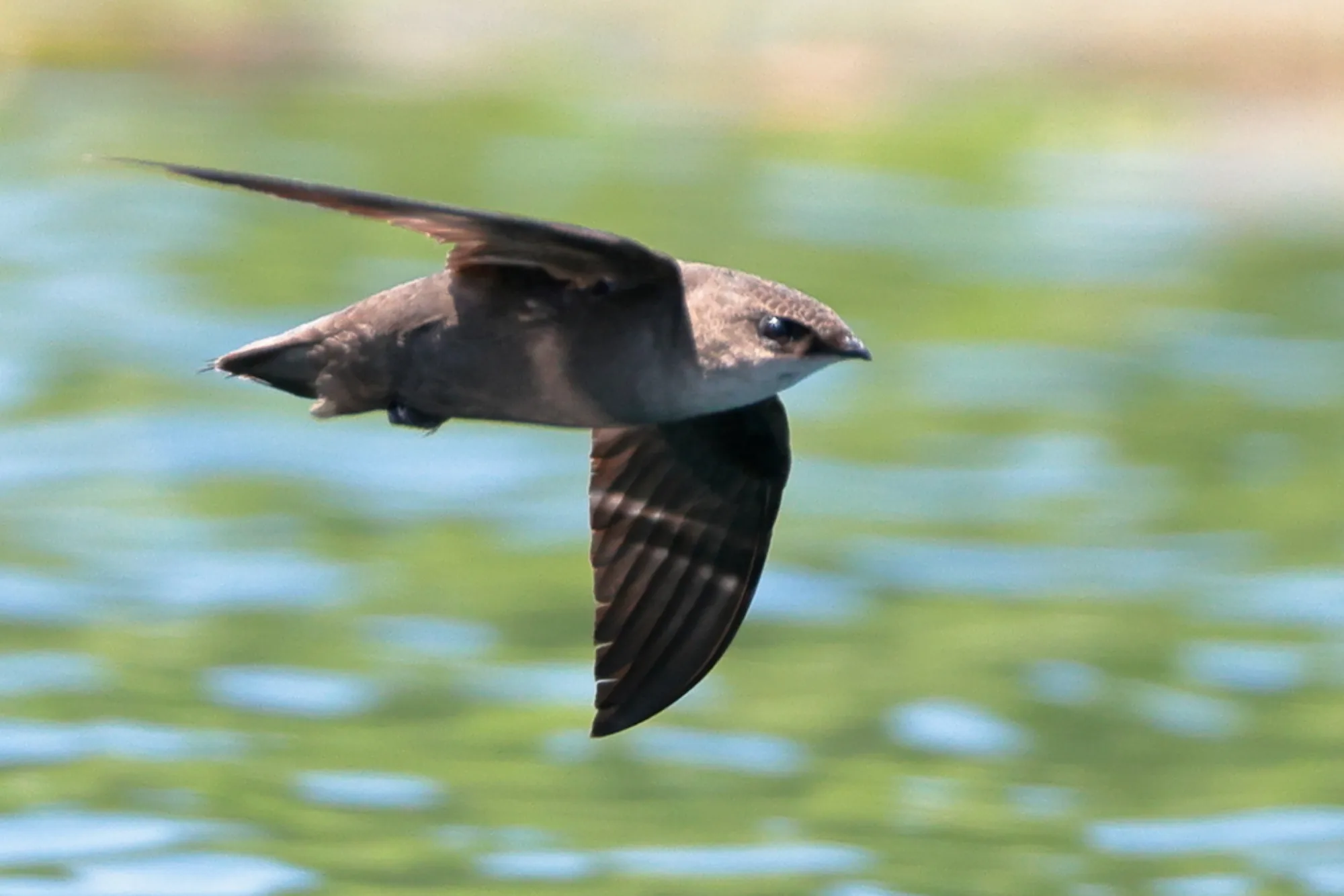
Chimney Swift
Chaetura pelagica
Look up for the Chimney Swift, a medium-sized, sooty bird with long, slender wings and a short tail. Its plumage is dark olive above and greyish brown below, with a noticeably paler throat. In flight, it alternates rapid, quivering wingbeats with longer glides, often changing direction swiftly. Its call is a rapid series of high-pitched chirps.
Chimney Swifts breed across much of the eastern United States and southern eastern Canada, then migrate to South America for the winter. Look for them above savanna and open country, as well as humid forests and wooded hillsides. Sociable and seldom alone, they usually hunt in small groups and gather in communal roosts after the breeding season, sometimes numbering hundreds or thousands. They drink and bathe on the wing, and cling to vertical surfaces when at rest. Flying insects make up most of their food, but they also catch airborne spiders and sometimes take prey from tree foliage.
Pairs generally stay together for life and build a shallow nest of twigs, using saliva to stick it to a vertical surface. Most nests are now inside chimneys, although a few birds still use hollow trees. The female typically lays 4 to 5 white eggs; both parents incubate them, and the young hatch after 19 days and leave the nest a month later. Numbers have fallen sharply across much of the species' range, although the reasons remain largely unclear. Pesticide use may have changed its insect food supply, while vehicles can strike birds hunting low over roads after sudden temperature drops. Severe storms during migration can also affect survival, and artificial light at night has been found to alter how birds enter communal roosts.
Written from the English Wikipedia article Chimney swift (CC BY-SA 4.0).
- Records
- 1,798,010
- Countries
- 3
- Atlas places
- 2
These are open occurrence records, so they show where people looked for and recorded the Chimney Swift as much as where it lives. Cells are up to 25 km across, and every location is generalised to its cell.
Generalised encounter areas, not exact locations. Each shape is a grid cell coloured by how likely the species is there.
- Very likelyUnited States25 km zone · high confidence · 1707351 records · updated 80 days ago
- Very likelyCanada25 km zone · high confidence · 80372 records · updated 80 days ago
- Very likelyMexico25 km zone · high confidence · 10287 records · updated 80 days ago
Conservation status not assessed here yet, so every location is generalised to its grid cell.