Basking Shark
Cetorhinus maximus
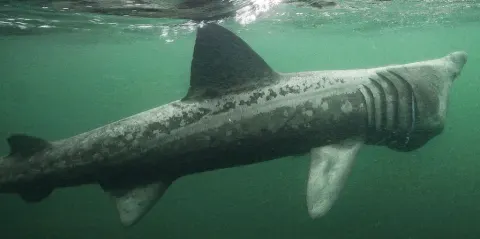
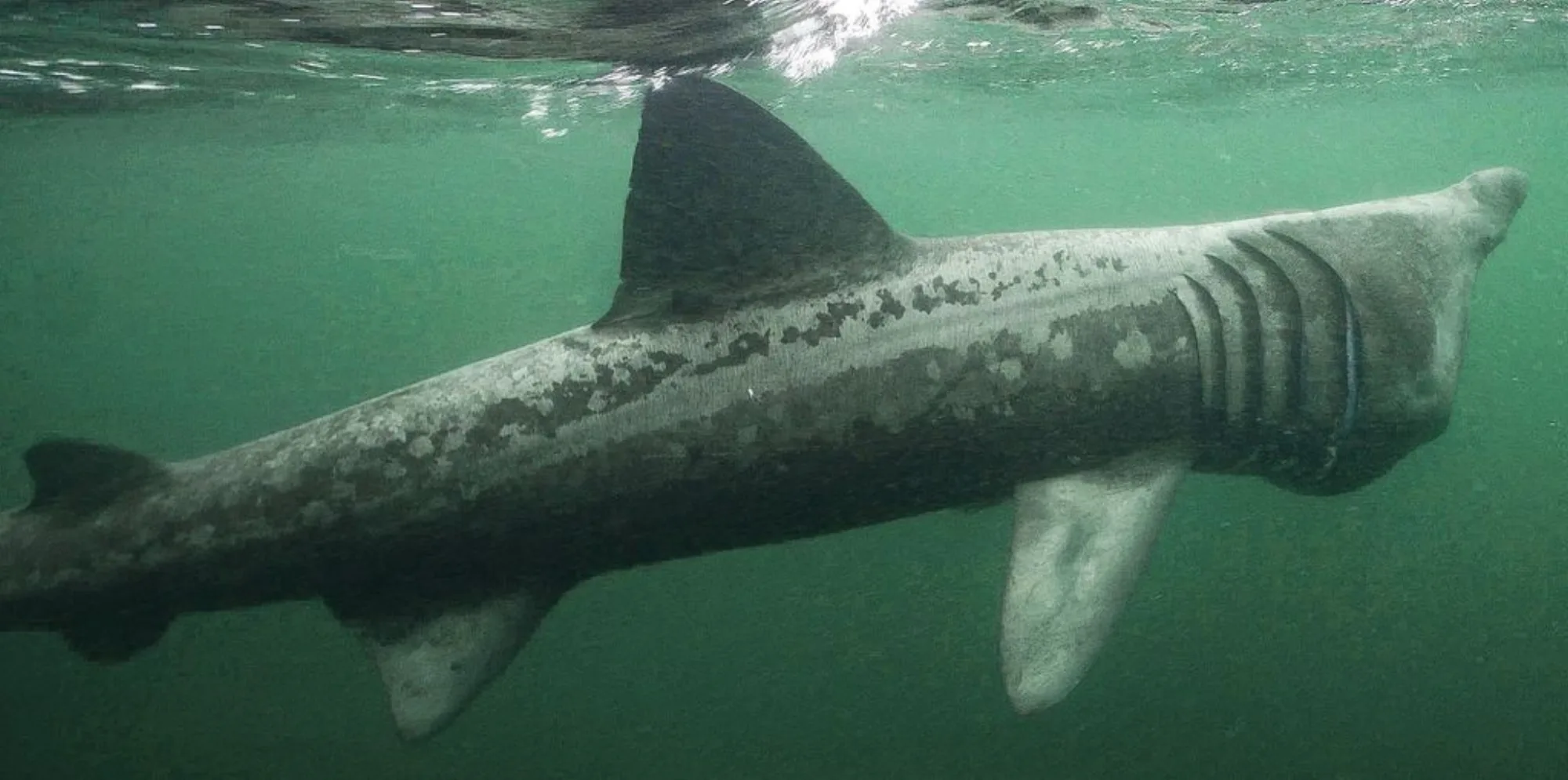
A huge mouth at the surface can give away a Basking Shark, the second-largest living fish after the whale shark. Typically reaching 7.9 m, it has mottled, greyish-brown skin and a white interior to its mouth. Its pointed snout, long gill slits and crescent-shaped tail help distinguish it, while the dorsal fin of a large individual may flop to one side above the water.
Basking sharks roam temperate oceans worldwide, travelling with the seasons and following concentrations of plankton. They live around continental shelves and sometimes enter brackish water; sightings near shore include bays with narrow entrances. Although frequently visible at the surface, they also spend time in deeper water, particularly in winter. They usually travel alone but gather around dense patches of zooplankton, especially in summer, sometimes forming small shoals. Slow swimmers, they feed with their mouths open, filtering zooplankton, tiny fish and invertebrates from the water. They can also breach, jumping clear of the sea, though the reason for this behaviour remains uncertain. Basking sharks are harmless to humans and tolerate approaching boats and divers, sometimes circling the latter.
Much about their breeding remains uncertain: pregnancy is thought to last more than a year, and the number of young is unknown. The young are born fully developed, at 1.5 to 2 m long. Fishing has taken a heavy toll, with overexploitation reducing populations until some disappeared. Basking sharks are also caught accidentally in trawl nets, and demand for their fins and other body parts adds to the pressure.
Written from the English Wikipedia article Basking shark (CC BY-SA 4.0).
- Records
- 16,680
- Countries
- 8
No atlas park has a record of the Basking Shark in or around it yet.
These are open occurrence records, so they show where people looked for and recorded the Basking Shark as much as where it lives. Cells are up to 25 km across, and every location is generalised to its cell.
Generalised encounter areas, not exact locations. Each shape is a grid cell coloured by how likely the species is there.
- Very likelyUnited Kingdom25 km zone · high confidence · 9972 records · updated 80 days ago
- Very likelyIsle of Man25 km zone · medium confidence · 4952 records · updated 80 days ago
- Very likelyFrance25 km zone · high confidence · 889 records · updated 80 days ago
- Very likelyUnited States25 km zone · medium confidence · 492 records · updated 80 days ago
- Very likelyIreland25 km zone · medium confidence · 253 records · updated 80 days ago
- LikelyCanada25 km zone · medium confidence · 78 records · updated 80 days ago
- LikelyGuernsey25 km zone · medium confidence · 27 records · updated 80 days ago
- LikelyAustralia25 km zone · medium confidence · 17 records · updated 80 days ago
Conservation status not assessed here yet, so every location is generalised to its grid cell.