Sika Deer
Cervus nippon
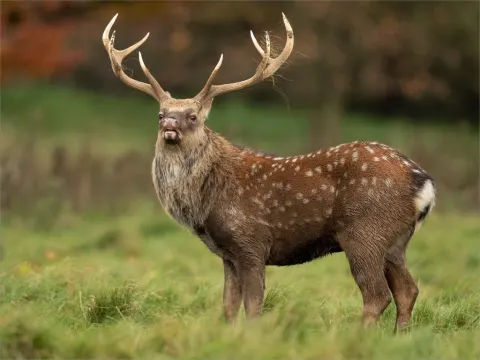
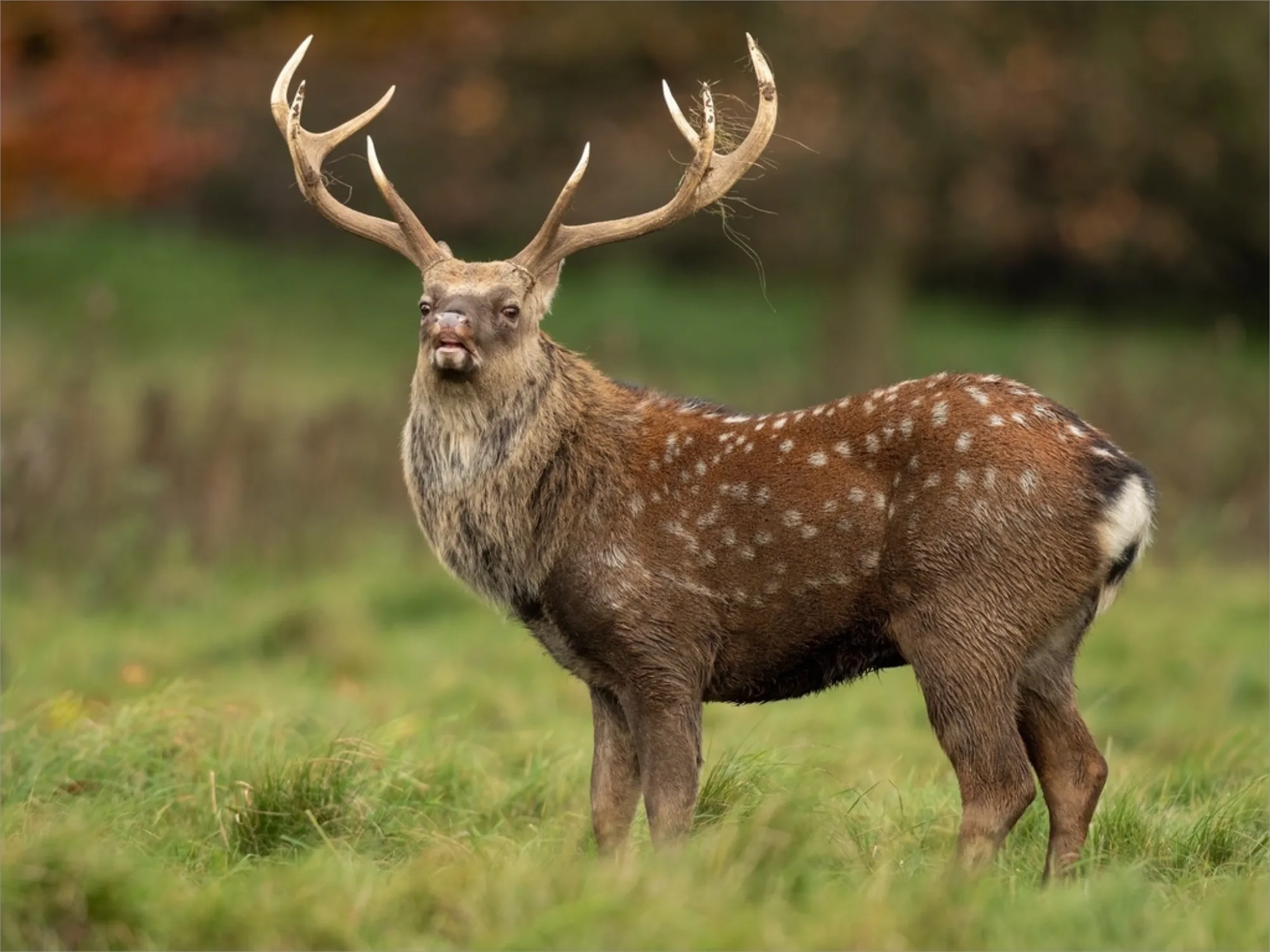
In the forests of East Asia, the Sika Deer can be recognised by its compact build, slender legs and, in many places, a spotted coat. Adults keep their spots, although the markings vary by region and can be nearly invisible in Japanese and Taiwanese deer. Coat colours range from mahogany to black, with white individuals also known; in winter, the coat grows darker and shaggier. Males are much larger than females, carry upright antlers and develop a mane on the neck in winter.
Native to much of East Asia, sika deer have also been introduced to places including New Zealand, Europe and the United States. They favour temperate and subtropical forests with dense undergrowth and occasional clearings, where they forage. They can be active throughout the day, but tend to become nocturnal where human disturbance is heavy. Some live alone, others in single-sex groups, and large herds gather in autumn and winter. Their calls range from soft whistles to loud screams. During the autumn rut, males defend territories and keep groups of females; rival males may fight fiercely. After a seven-month pregnancy, a female gives birth to a single fawn and hides it in thick undergrowth. The youngster waits quietly for her to return and feed it.
Hunting and habitat loss have greatly reduced sika numbers in China, while a lack of suitable habitat has hindered reintroduction there. Sika are also hunted across their original range and in many places where they were introduced. Their predators include tigers, wolves, leopards and brown bears, while lynx and golden eagles take fawns.
Written from the English Wikipedia article Sika deer (CC BY-SA 4.0).
- Records
- 7,342
- Countries
- 12
No atlas park has a record of the Sika Deer in or around it yet.
These are open occurrence records, so they show where people looked for and recorded the Sika Deer as much as where it lives. Cells are up to 25 km across, and every location is generalised to its cell.
Generalised encounter areas, not exact locations. Each shape is a grid cell coloured by how likely the species is there.
- Very likelyJapan25 km zone · high confidence · 3108 records · updated 80 days ago
- Very likelyUnited Kingdom25 km zone · high confidence · 1385 records · updated 80 days ago
- Very likelyGermany25 km zone · high confidence · 1310 records · updated 80 days ago
- Very likelySwitzerland25 km zone · high confidence · 458 records · updated 80 days ago
- Very likelyIreland25 km zone · medium confidence · 403 records · updated 80 days ago
- Very likelyDenmark25 km zone · high confidence · 279 records · updated 80 days ago
- Very likelyFrance25 km zone · medium confidence · 242 records · updated 80 days ago
- Very likelyUnited States25 km zone · medium confidence · 111 records · updated 80 days ago
- LikelyCzechia25 km zone · medium confidence · 18 records · updated 80 days ago
- LikelyChina25 km zone · medium confidence · 17 records · updated 80 days ago
Conservation status not assessed here yet, so every location is generalised to its grid cell.