Red Deer
Cervus elaphus
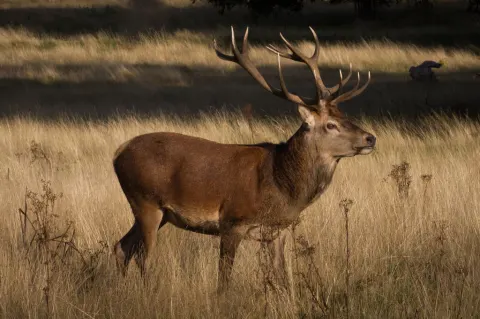
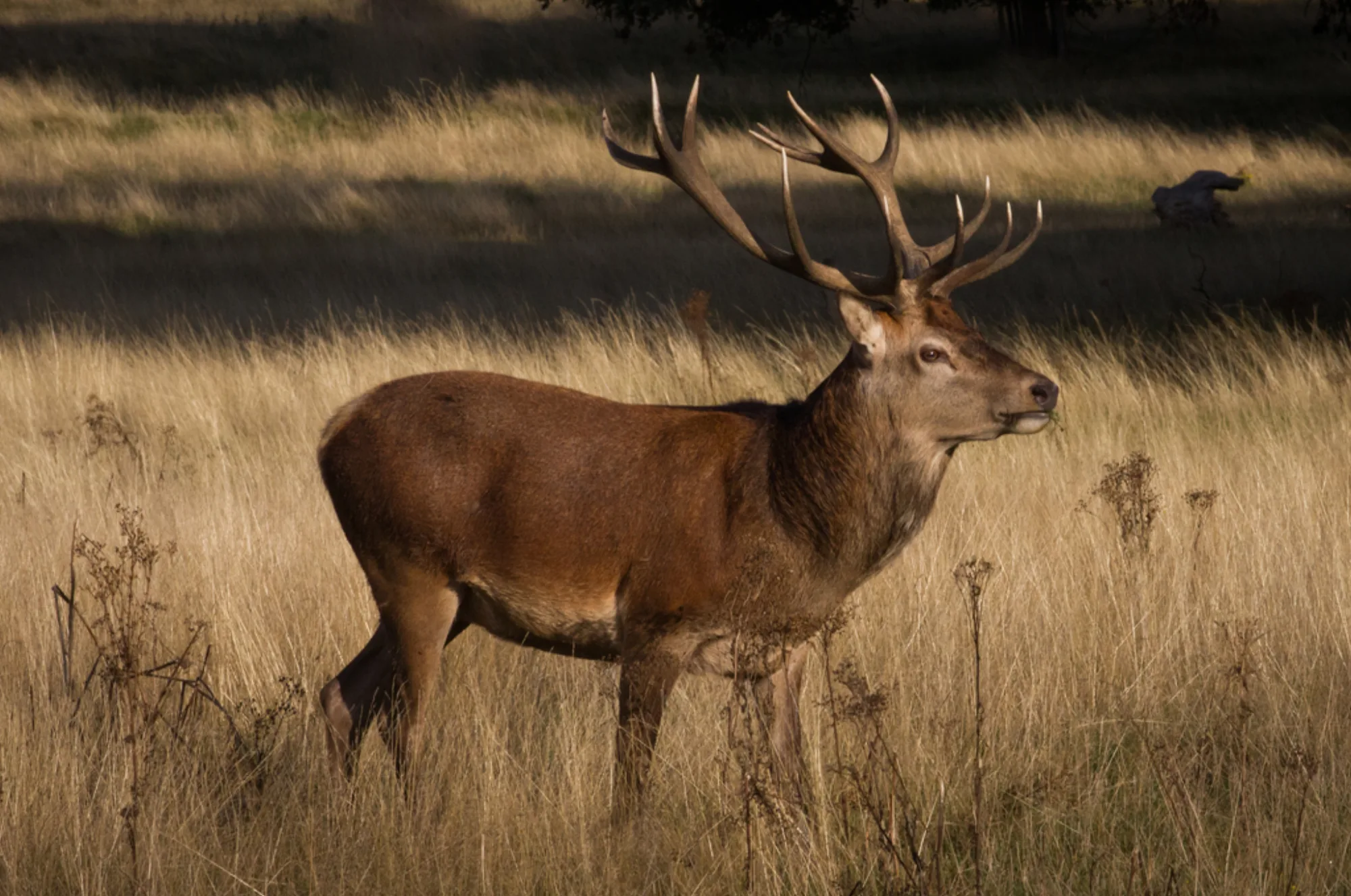
Among the largest deer species, the Red Deer has a coat that changes with the seasons. European animals tend to be reddish-brown in summer, while winter coats are generally greyer or lighter. Males, known as stags, are much larger than females, or hinds. Only stags grow antlers, which begin to develop in spring and are usually shed at the end of winter. In many subspecies, males also grow a short neck mane in autumn.
Red Deer live across most of Europe, the Caucasus Mountains, Anatolia, Iran and parts of Western Asia, as well as in North Africa's Atlas Mountains. They have also been introduced to places including New Zealand, Australia and Argentina. In Europe, they generally spend winter at lower elevations in wooded country, moving higher in summer where food is more plentiful and conditions are better for calving. The species also occurs in Iran's Hyrcanian Forest.
For most of the year, mature deer usually gather in groups of the same sex. During the rut, stags compete for hinds, challenging rivals with calls and parallel walks, sometimes followed by clashes of antlers. Roaring is most common at early dawn and late evening, when the deer are also generally most active. Females usually produce one calf a year, and the spotted young stay with their mothers for almost a year. Herds often have deer on watch while others feed and rest. In Europe, predators include grey wolves, humans and domestic dogs, while brown bears occasionally prey on them. Red Deer are widely hunted in New Zealand, where they are also heavily culled. Populations have declined in North Africa, although reintroduction and conservation efforts have increased numbers in places including the United Kingdom and Portugal.
Written from the English Wikipedia article Red deer (CC BY-SA 4.0).
- Records
- 211,015
- Countries
- 37
- Atlas places
- 5
These are open occurrence records, so they show where people looked for and recorded the Red Deer as much as where it lives. Cells are up to 25 km across, and every location is generalised to its cell.
Generalised encounter areas, not exact locations. Each shape is a grid cell coloured by how likely the species is there.
- Very likelySwitzerland25 km zone · high confidence · 121562 records · updated 86 days ago
- Very likelyFrance25 km zone · high confidence · 50056 records · updated 86 days ago
- Very likelySpain25 km zone · high confidence · 11567 records · updated 86 days ago
- Very likelyItaly25 km zone · high confidence · 11135 records · updated 86 days ago
- Very likelyAustria25 km zone · high confidence · 4203 records · updated 86 days ago
- Very likelyEstonia25 km zone · high confidence · 3020 records · updated 86 days ago
- Very likelyUnited Kingdom25 km zone · high confidence · 2364 records · updated 86 days ago
- Very likelyDenmark25 km zone · high confidence · 2291 records · updated 86 days ago
- Very likelyNorway25 km zone · high confidence · 1915 records · updated 86 days ago
- Very likelyUkraine25 km zone · high confidence · 1084 records · updated 86 days ago
Conservation status not assessed here yet, so every location is generalised to its grid cell.