Elk
Cervus canadensis
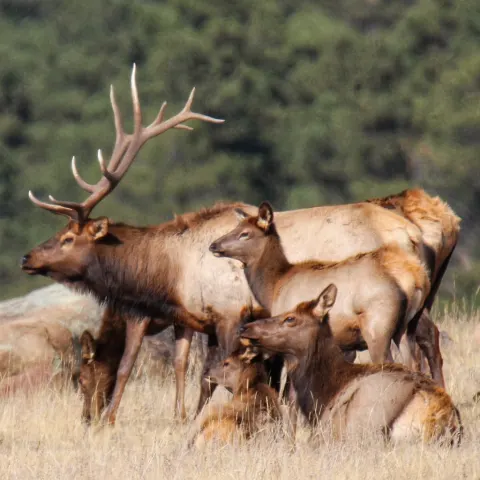
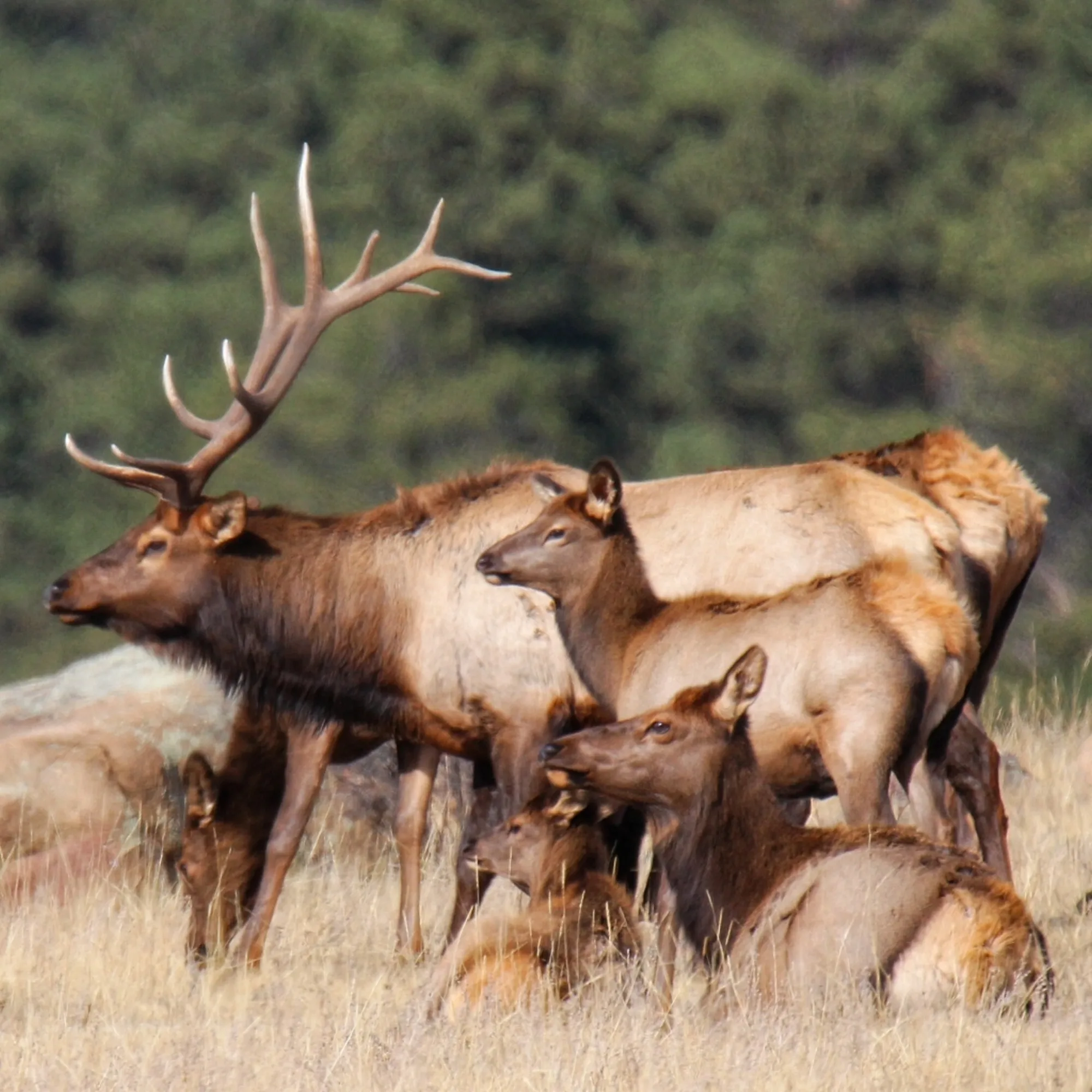
A broad rump patch and a heavy body on slender legs help identify the Elk, also known as the wapiti. One of the largest members of the deer family, it has a short tail and a coat that changes with the season. Most have a yellow-brown to orange-brown body in summer, contrasting with a dark head, neck and legs. Males carry large antlers, which they shed each year as the weather warms. Native to North America and parts of Central, East and North Asia, elk also live in Argentina and New Zealand, where they were introduced. Look for them in open woodland, forest edges, grasslands and mountainous areas.
Elk are sociable, with summer groups sometimes reaching 400 animals. Adult males and females usually live in separate herds, joining one another during the breeding season. At that time, males display their antlers, challenge rivals and give loud, whistle-like calls known as bugles. Females withdraw from the herd around the time they give birth, staying apart until their calves can escape predators. The calves are born with spots, which they lose by the end of summer. Elk feed mainly in the morning and evening, grazing on grasses and sedges as well as browsing leaves, twigs and bark. In mountainous regions, they may move to higher ground in spring as the snow retreats, then return lower in autumn. Wolves, bears and cougars prey on elk, while disease and parasites can also kill them. Elk are hunted, and hunting pressure affects their movements and migration.
Written from the English Wikipedia article Elk (CC BY-SA 4.0).
- Records
- 3,996
- Countries
- 3
- Atlas places
- 14
- Yellowstone National Park· United States
- Great Smoky Mountains National Park· United States
- Jasper National Park· Canada
- Redwood National and State Parks· United States
- Banff National Park· Canada
- Grand Teton National Park· United States
- Rocky Mountain National Park· United States
- Grand Canyon National Park· United States
- Kootenay National Park· Canada
- Glacier National Park· United States
- Olympic National Park· United States
- Pacific Rim National Park Reserve· Canada
- Waterton Lakes National Park· Canada
- Yoho National Park· Canada
These are open occurrence records, so they show where people looked for and recorded the Elk as much as where it lives. Cells are up to 25 km across, and every location is generalised to its cell.
Generalised encounter areas, not exact locations. Each shape is a grid cell coloured by how likely the species is there.
- Very likelyUnited States25 km zone · medium confidence · 3561 records · updated 80 days ago
- Very likelyCanada25 km zone · medium confidence · 430 records · updated 80 days ago
- LikelyChina25 km zone · medium confidence · 5 records · updated 80 days ago
Conservation status not assessed here yet, so every location is generalised to its grid cell.