Thorold's Deer
Cervus albirostris
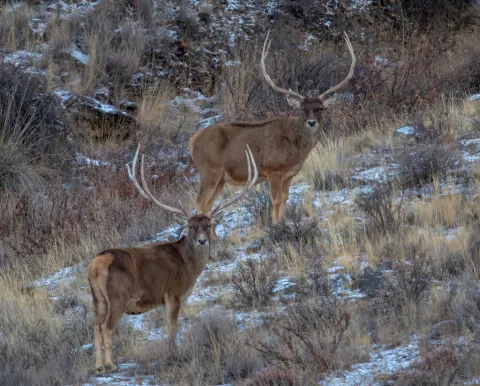
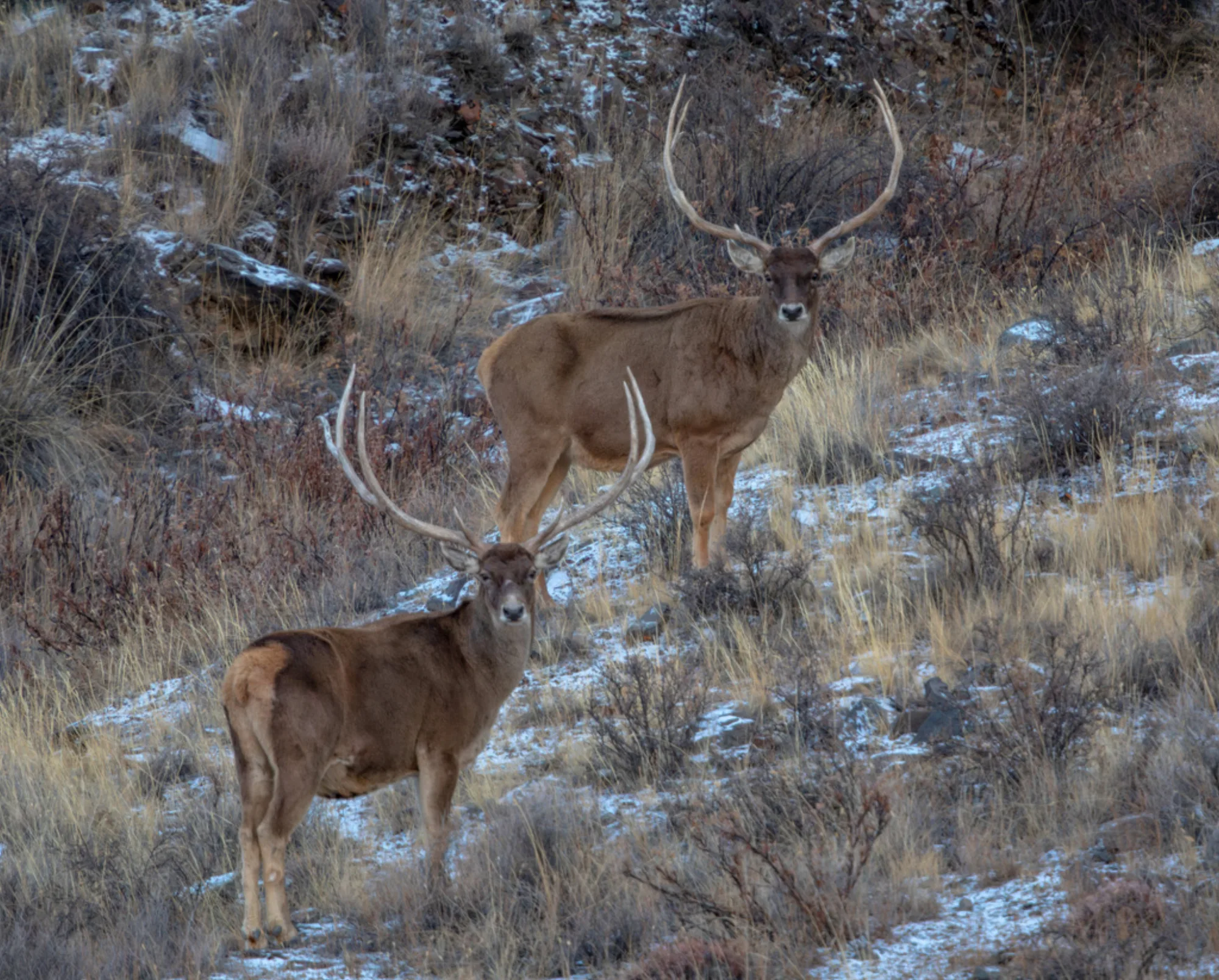
Commonly known as the white-lipped deer, this species is easily identified by the pure white markings on its snout and throat. It is one of the largest deer, standing 115 to 140 cm at the shoulder. To survive the cold, it grows a thick, grey-brown coat that is even denser than that of a moose. These agile climbers use broad hooves and large nasal cavities to navigate and breathe in the thin air of the high-altitude Tibetan Plateau. Males are notable for their heavy antlers, which can reach 110 cm in length and possess up to seven tines positioned on a single plane.
These deer favour a mix of forests, shrublands, and grasslands, typically found between 3,500 and 5,100 metres. To avoid winter weather, they migrate between elevations, descending from high summer pastures to sheltered valleys. They are most active at dawn and dusk, usually living in groups of at least 10 individuals, though males and females remain separate for much of the year. Their diet consists mainly of grasses and sedges. In the wild, they rarely live beyond 12 years, with females typically giving birth to a single spotted calf in May or June.
Once found in greater numbers, Thorold's Deer now exists in scattered populations. They face competition for resources from domestic livestock like goats, yaks, and sheep as human agriculture advances. Additionally, people hunt them for their meat and body parts, such as velvet and antlers, which are used in traditional medicine.
Written from the English Wikipedia article Thorold's deer (CC BY-SA 4.0).
- Records
- 2
- Countries
- 1
- Atlas places
- 0
These are open occurrence records, so they show where people looked for and recorded the Thorold's Deer as much as where it lives. Cells are up to 25 km across, and every location is generalised to its cell.
Generalised encounter areas, not exact locations. Each shape is a grid cell coloured by how likely the species is there.
- Very likelyChina25 km zone · medium confidence · 2 records · updated 4 days ago
Conservation status not assessed here yet, so every location is generalised to its grid cell.