Cape Barren Goose
Cereopsis novaehollandiae
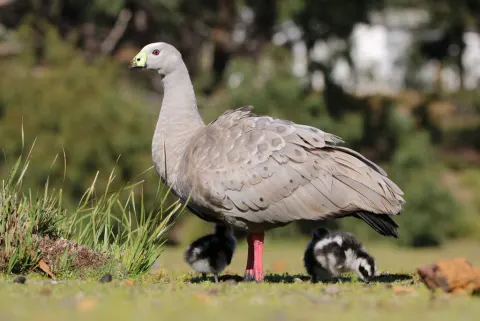
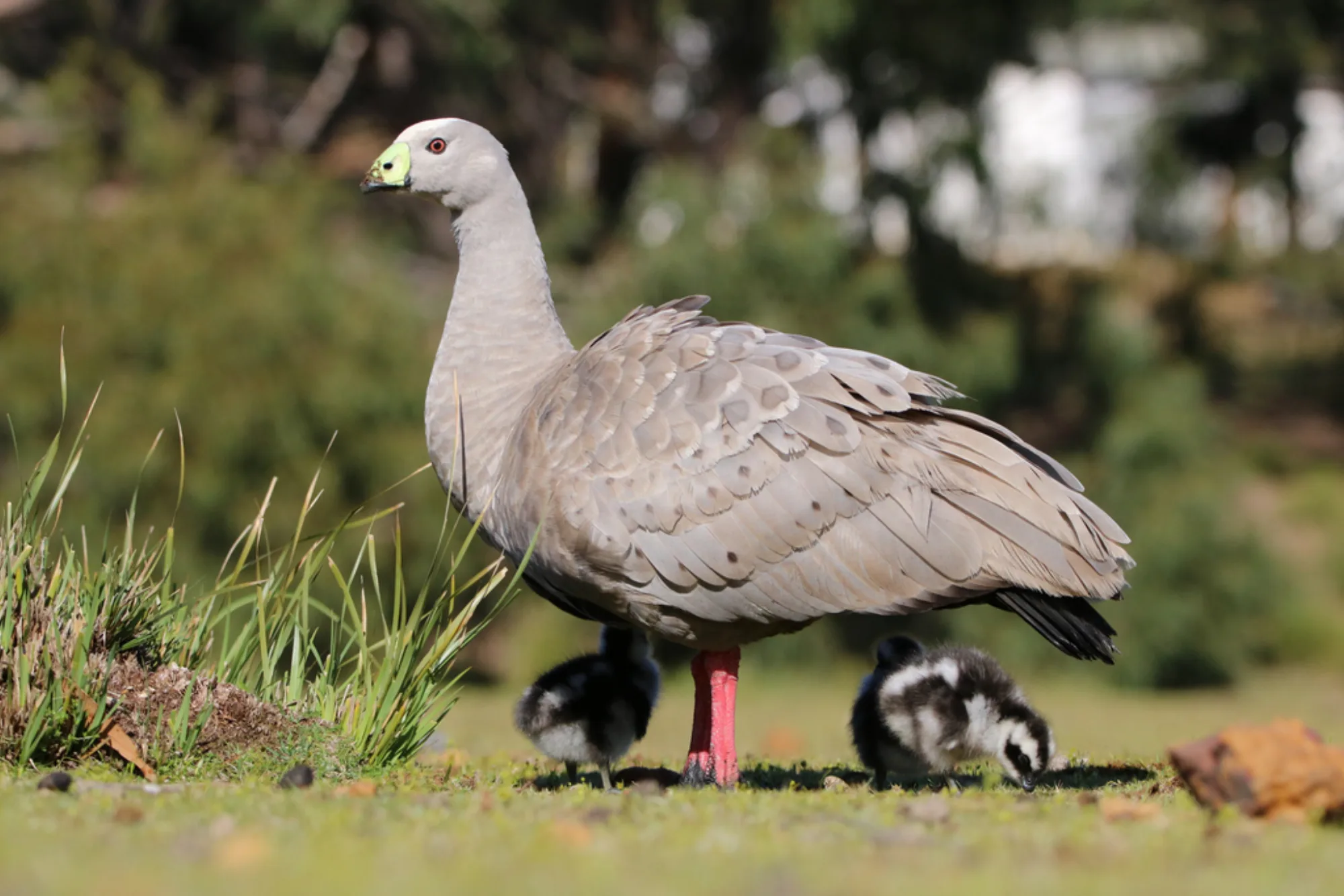
Across southern Australia, the Cape Barren Goose stands out as a large, pale grey bird that spends much of its time on land. Adults measure 75 to 100 cm long and weigh 3.7 to 5.2 kg, with males generally larger than females. Look for a whitish patch on the forehead and crown, a short black bill covered more than halfway by pale yellow-green, and pink legs with black feet. In flight, the wings show a dark trailing edge, while the tail is black.
The species lives in south-eastern Australia, including Tasmania and the Bass Strait islands, and in the south-west around the Recherche Archipelago and adjacent mainland coast. Grassy offshore islands are its breeding grounds, and its ability to drink salt and brackish water lets it stay on islands throughout the year. It mostly grazes on grasses, sedges, legumes, herbs and succulents, and only occasionally swims. Listen for the male's rapid, high-pitched honking during takeoff or flight, or the low grunts and hisses made by both sexes when alarmed.
Pairs usually remain together for life, establish territories in autumn and breed in winter. They may nest alone or in loose colonies, making a shallow, lined hollow among tussock grass, rocks or bushes. The usual clutch contains four to five eggs, creamy white in colour; the female incubates them for 34 to 37 days, and both parents care for the goslings after they hatch. Numbers declined in the past, although that decline appears to have been reversed, with birds in the east adapting to feed on agricultural land.
Written from the English Wikipedia article Cape Barren goose (CC BY-SA 4.0).
- Records
- 32,110
- Countries
- 6
- Atlas places
- 6
These are open occurrence records, so they show where people looked for and recorded the Cape Barren Goose as much as where it lives. Cells are up to 25 km across, and every location is generalised to its cell.
Generalised encounter areas, not exact locations. Each shape is a grid cell coloured by how likely the species is there.
- Very likelyAustralia25 km zone · high confidence · 31079 records · updated 80 days ago
- Very likelyNew Zealand25 km zone · high confidence · 991 records · updated 80 days ago
- PossibleUnited Arab Emirates25 km zone · medium confidence · 17 records · updated 80 days ago
- PossibleGermany25 km zone · medium confidence · 11 records · updated 80 days ago
- PossibleSpain25 km zone · medium confidence · 9 records · updated 80 days ago
- UncommonFrance25 km zone · medium confidence · 3 records · updated 80 days ago
Conservation status not assessed here yet, so every location is generalised to its grid cell.