Crab-eating Fox
Cerdocyon thous
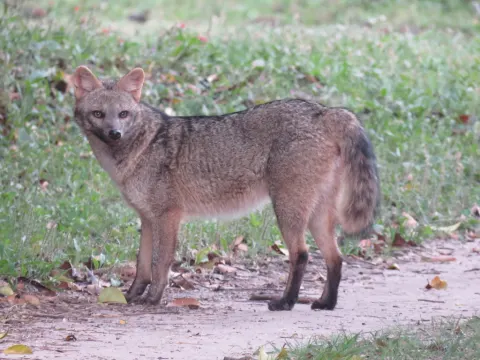
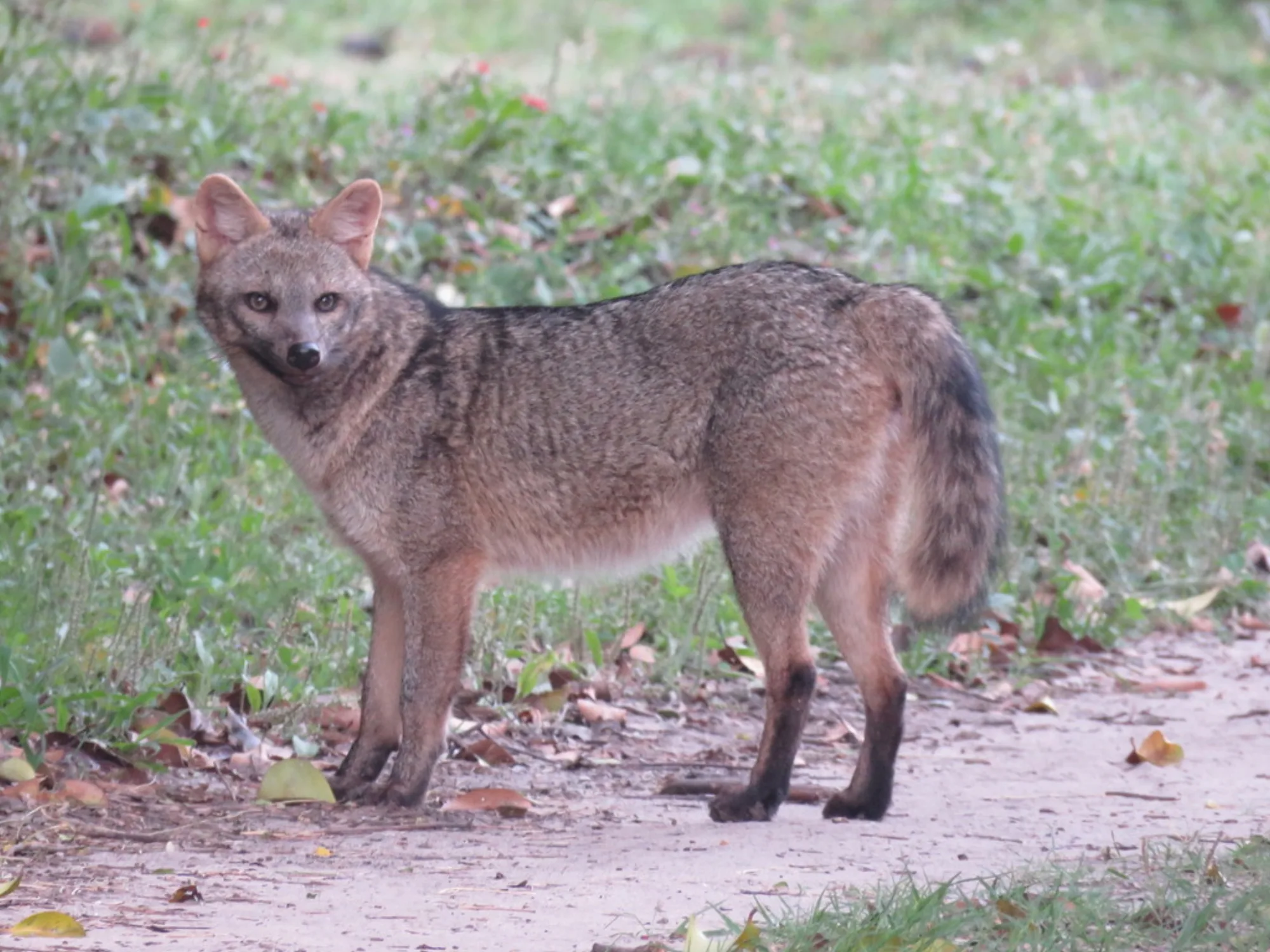
With its bushy tail and short, sturdy legs, the Crab-eating Fox has both dog-like and fox-like features. This medium-sized South American canid is usually greyish-brown, with reddish areas on its face and legs and black tips to its ears and tail. Its short, thick coat varies in colour between populations, from very dark to light grey-yellow. A black stripe runs along its spine, and its wide ears are rounded.
Its range stretches from Colombia and southern Venezuela to Paraguay, Uruguay and northern Argentina, and it has also been sighted in Panama. It lives in savannas, woodlands, subtropical forests and shrubby thickets, as well as wooded riverbanks. During the rainy season it moves uphill, returning to lower ground in drier times. Mostly nocturnal, it is most active around midnight and in the early morning. Pairs hunt together and may bark, whirr or howl when they lose contact. Their dens are often hidden in bushes or thick grass, and they prefer to take over burrows made by other animals.
On muddy floodplains in the wet season, the fox searches for the crabs that give it its name. Its varied diet includes insects, rodents and birds, which it favours when available, as well as fruit, eggs, lizards and carrion. Breeding pairs raise their pups together, and females have one or two litters a year depending on climate and food. The main threat is disease passed on by unvaccinated dogs. Some farmers consider the fox a danger to livestock, leading to illegal hunting in certain countries.
Written from the English Wikipedia article Crab-eating fox (CC BY-SA 4.0).
- Records
- 1,484
- Countries
- 8
- Atlas places
- 7
These are open occurrence records, so they show where people looked for and recorded the Crab-eating Fox as much as where it lives. Cells are up to 25 km across, and every location is generalised to its cell.
Generalised encounter areas, not exact locations. Each shape is a grid cell coloured by how likely the species is there.
- Very likelyColombia25 km zone · medium confidence · 753 records · updated 80 days ago
- Very likelyBrazil25 km zone · medium confidence · 530 records · updated 80 days ago
- Very likelyArgentina25 km zone · medium confidence · 186 records · updated 80 days ago
- LikelyUruguay25 km zone · medium confidence · 6 records · updated 80 days ago
- LikelyBolivia25 km zone · medium confidence · 4 records · updated 80 days ago
- LikelyPanama25 km zone · medium confidence · 2 records · updated 80 days ago
- LikelyParaguay25 km zone · medium confidence · 2 records · updated 80 days ago
- PossibleGuyana25 km zone · medium confidence · 1 record · updated 80 days ago
Conservation status not assessed here yet, so every location is generalised to its grid cell.