Roloway Monkey
Cercopithecus roloway
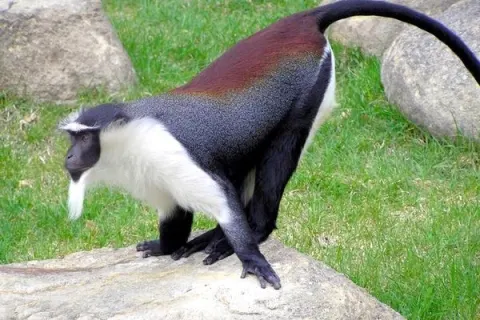
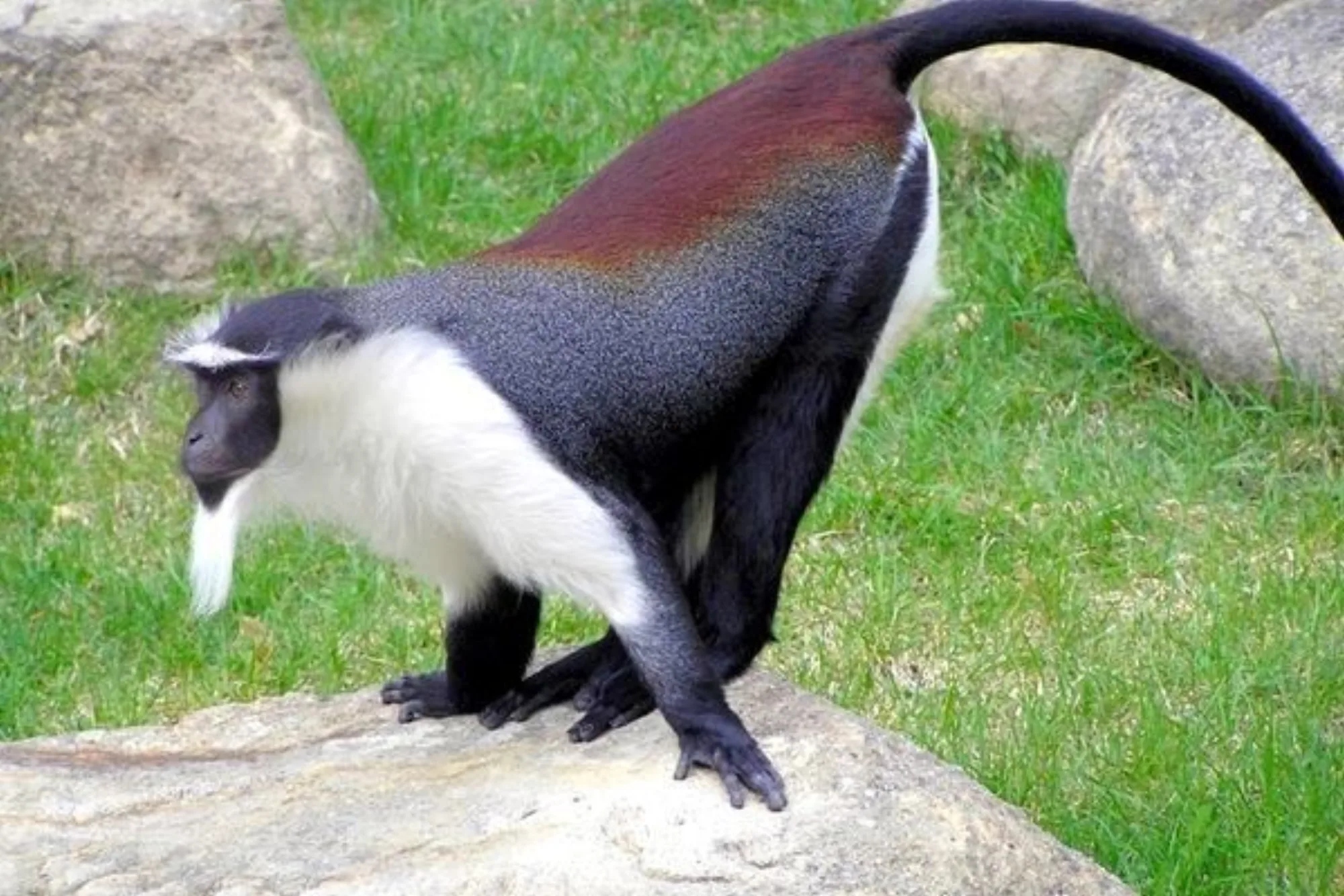
This West African guenon is distinguished by its dark face and a prominent white beard growing beneath a black chin. A horizontal white line marks the brow, while bright white fur covers the chest and shoulders. These monkeys reach a body length of 40 to 55 cm, supported by a tail that can extend up to 75 cm. Males are significantly larger than their female counterparts, weighing approximately 5.0 kg compared to 2.5 kg.
The Roloway Monkey lives primarily in the canopy of old-growth, moist forests in Ghana and south-eastern Côte-D'Ivoire. These complex habitats provide thick vegetation for hiding. Within these secluded forests, the monkeys form social groups of six to 30 individuals, usually consisting of a single male and several females with their offspring. They are diurnally active, spending their days searching for food and their nights sleeping high in the trees.
As omnivores, they consume various fruits, flowers, and leaves, but also hunt for insects, larvae, and eggs. They possess cheek pouches to store nuts and seeds. During the wet season, they focus more on insects, whereas the dry season sees them eating more fruit pulp. The species communicates through a range of vocalizations, including croaks and shrieks, and uses facial expressions like raised eyebrows to signal threats.
Survival is currently threatened by the bushmeat trade and the ongoing loss of their forest habitat. Because they cannot inhabit areas with a large human impact, they are now primarily concentrated in the Tanoé Forest. Although they can live up to 30 years, their populations are vanishing, and laws against poaching are rarely enforced effectively.
Written from the English Wikipedia article Roloway monkey (CC BY-SA 4.0).
- Atlas places
- 0
These are open occurrence records, so they show where people looked for and recorded the Roloway Monkey as much as where it lives. Cells are up to 25 km across, and every location is generalised to its cell.
No encounter zones yet
Where and when you can expect to see Roloway Monkey is calculated from observation density. No zones have been computed for this species yet.